strength or not

windwalker099107

Master of Arts
Last login streak
138 day(s)
Max login streak
138 day(s)

An interesting video that helps to explain why high-level Taiji exponents do not use strength in pushing hands.
 
If you don't use your strength, you will lose it,

Today, in my 4 miles beach walking, I held my 5 lb dumbbell and threw exactly 2,000 punches. I didn't have to use my strength. I just wanted to.

If you

- don't have strength, you may try to achieve something without using strength.
- have strength, why do you try not to use it?

If you are as

- rich as Bill Gates, do you still worry about spending money?
- strong as Mike Tyson, do you still worry about using strength?

Money is for spending. Strength is for using.
 
Last edited:
I was taught, and still believe, that taijiquan is not about using "no strength" - it's about using the minimal amount of strength necessary to achieve the goal. This comes about through developing Ting Jin to feel and understand the opponent, softening the core to reduce excess tension held in the body, and application of the 13 methods to apply the right force, at the right time, from the right direction.
 
Yes ... that’s pretty much it. 听劲 (tīng jìn) is the base.


The video title used for this thread — 推手高手為什麼不跟你比力氣?
“Why do Tai Chi pushing hands experts refuse to match strength with you?” |汪脈太極推手感知入門 — is pointing to the same thing ... not matching brute strength (力氣 lìqi), but using perception (感知) so you don’t meet force as a counter ... the response is already there if you don’t interfere with it.
 
I would say that title is slightly misleading, as "masters" or skilled practitioners in general ARE using force.
They're just using it intelligently and economically.

It's such language as "no force" that promotes the mystical nonsense that hangs around taijiquan, and the wider internal arts in general.
 
Depends on the “masters” one has actually met…

Of those I’ve met, I wouldn’t describe it as “using force” in any direct sense. You don’t feel force being applied to you - your own reactions are brought out through what you experience in the contact.

For example, if you suddenly feel like you’re falling into a hole, the natural reaction is to jump out. That reaction isn’t applied to you - it comes from you.

Same idea here.

From the outside, some might describe it as “using force intelligently”… but from the inside it doesn’t feel like force at all. Whether someone chooses to still call that “force” becomes more a matter of definition.

“No force” isn’t mystical - it’s simply not meeting force as a counter (不顶 bù dǐng), and not adding your own on top of it.

What is felt as force is generated by the other person’s own reaction, not something being applied to them.

I’d prefer to keep the discussion on the video - whether one agrees with its basic premise or not. We can share our own experiences, understanding they may be very different… but still valid.
 
The premise of the video is "why masters dont use force in push hands"
I disagree, because they do use force. They might not be using excessive, obvious, or even much force, but they ARE using force. Saying they use "no force" is just plain misleading.

As for the content of the video, the demo-partner over acting and staggering backwards is sad to see.
 
From the Utube Channel its quite interesting:

"Strongmen tried. MMA fighters tried. They all lost."It's fake! It only works because the students cooperate!"Every time Master Zhu Chunxuan's video appears, this comment shows up.I understand.

I used to say the same thing.

So I flew to Beijing to find out for myself.---Western skeptics did the same.They brought in MMA fighters. They brought in world-record strongmen.The most scientific test they could design.The video is called: Power of Chi.The result?The world's strongest man could not put force into the master's body.Not because the master moved away.

Not because of cooperation.The force simply couldn't enter.---The day I arrived in Beijing, the master touched me with two fingers — and I flew.I had trained competitive push-hands for four years.

I know what force feels like.I had never felt anything like it.Not because I was his student. Because his body structure made it physically impossible for force to enter.---This is the physics of chi.Not mysticism. Not performance.

A relaxed body receives force like a spring — and in a fraction of a second, returns it.This art is called Wang-lineage Yang-style Tai Chi. Passed down for 100 years.Many people practice Tai Chi. Just like many people make Peking Duck.But some of them have never tasted the real thing.---Watch Power of Chi here:👉 https://youtu.be/Y8Zs__qJVwc?si=szqik..."
 
Last edited:
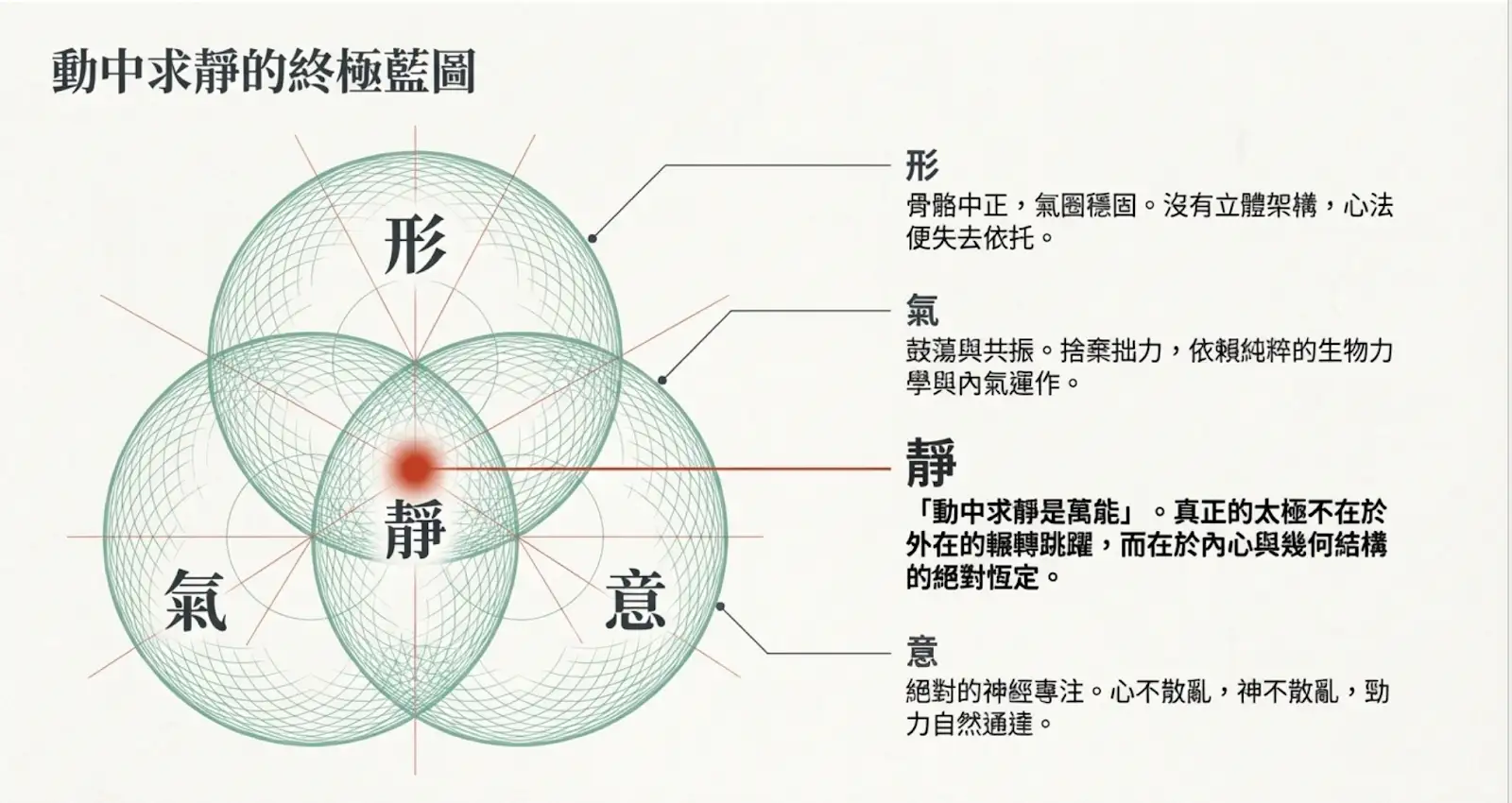
E5MkTA-QbAdhDa_Zg11fiur0KNDbjsePL3ffgZgte-5bbn9StV0mQe4yXiOXaqqe7fEOQdry6fpWuQ=s1600-rw-nd-v1


This diagram from the same YouTube channel is titled:


動中求靜的終極藍圖
“The ultimate blueprint of seeking stillness within movement”


It lays things out in four parts:


形 (Xíng) — Structure / Form
The skeleton is aligned and centered, the “qi field” is stable.
Without a proper three-dimensional structure, the mind has nothing to rely on.


氣 (Qì) — Breath / Internal Energy
Encouraging vibration and resonance.
Letting go of clumsy exertion, relying instead on natural body mechanics and internal movement.


意 (Yì) — Intent
Complete mental focus.
The mind is not scattered, the spirit is not scattered ... when that’s the case, movement connects and passes through naturally.


靜 (Jìng) — Stillness (center)
“Seeking stillness within movement is the skill.”


True Taiji is not found in external turning or visible motion,
but in the internal stability of the mind and underlying structure.


What’s interesting here is that everything points back to 靜 (stillness) as the center.


Not stillness as in “not moving” ...
but something that remains unchanged within movement.

This ties directly into what we were discussing —
it’s not about matching force or using strength (力氣 lìqi),

but maintaining that internal stillness so you don’t meet force as a counter ...
whatever happens comes out of that.
 
My way of describing this is bottom moves the top, inside moves the outside, back moves the front. Initially, words don’t describe these concepts very well and people get hung up on definitions and descriptions. My teachers would not discuss it until you had experienced it. One can only experience it through competent teachers. We just had to do what they said over and over and over again with no explanations. Eventually, the light turns on and when it does they were right there to lead. Often the explanation was just, “now what did that feel like”. One can know a thing without being able to adequately describe it to the satisfaction of others.
 
This video shows how to control someone using the point of contact. It does not require strength, but it does require a root, a structure, and the use of intention or chi to apply directional manipulation.
 
I just don't understand the logic here. You lift weight to build muscle. But in application, you try not to use your strength. Why?

If you have the strength to punch a hole through the wall, that's a good thing.

punch_through_wall.webp
 
I just don't understand the logic here. You lift weight to build muscle. But in application, you try not to use your strength. Why?

If you have the strength to punch a hole through the wall, that's a good thing.

View attachment 34089
In my experience if you "try" to use your strength, you sacrifice technique speed and form. This actually can take away from power. Being able to punch thru a brick wall is nice but is a lot more power than needed for self-defense. Rather than using energy to produce excess strength, it's better to devote that energy in keeping sound biomechanics and structure. This should provide sufficient strength, along with a bit of muscle fitness, to handle most self-defense situations. IMO some weight training is good but no need to take away from MA training time. I will note that in heavy grappling more brute strength is needed than when primarily striking.
 
I just don't understand the logic here. You lift weight to build muscle. But in application, you try not to use your strength. Why?

Because it’s not about strength.

If there’s nothing to apply strength against, then strength isn’t the issue.

Someone who can punch through a brick wall can’t make a hole in a hanging sheet.
Different methods develop and use strength in different ways.
 
I just don't understand the logic here. You lift weight to build muscle. But in application, you try not to use your strength. Why?

If you have the strength to punch a hole through the wall, that's a good thing.

View attachment 34089
Do you jab at 100% strength? No you don’t, and you know this, and you know why. Just stop with the dead horse already.
 
In my experience if you "try" to use your strength, you sacrifice technique speed and form.
Can you hurt your enemy without using strength? I still remember an old Judo movie that the Judo master stood beside a river. His opponent attacked him, he dodged. his opponent all fell into river.

You can use a punch (use force) to end a fight. You can't use a push (don't use force) to end a fight. Your goal is to end a fight ASAP. Your goal is not fooling around with your opponent that you push your opponent away, he comes back, you push him away again, he comes back again, ...

Soon or later, you have to use your force to end the fight. So why don't you just use your force on your 1st punch?
 
Last edited:
Because it’s not about strength.

If there’s nothing to apply strength against, then strength isn’t the issue.

Someone who can punch through a brick wall can’t make a hole in a hanging sheet.
Different methods develop and use strength in different ways.
You are wasting your time because this is nothing more than pedancy.
 
Do you jab at 100% strength? No you don’t, and you know this, and you know why. Just stop with the dead horse already.
I don't throw 100% strength with my jab. But I may throw 100% strength at my cross (or hook). Try to "be smart to use strength" is different from "never use strength".

The OP's video says, "Why didn't a PH expert use strength?" The answer is simple. In that video, the PH expert has no intention to finish a fight.
 
Last edited:
You are wasting your time because this is nothing more than pedancy.
"Pendency" care to expound on this

The OP's video says, "Why didn't a PH expert use strength?"
The answer is simple. In that video, the PH expert has no intention to finish a fight.

The video is addressing the method of practice within this line:

Wang Yongquan → Zhu Huaiyuan → Zhu Chunxuan → Li Youcheng

0:00 為什麼用力推手是錯的?
— “Why is pushing hard in push hands wrong?”

The explanation isn’t about intention or choosing not to finish.

It’s pointing to: how contact (點) point is established
and how the break (斷) already exists within that contact

The video is showing the errors in push hands based on that method.
How many people posting here can actually do what’s shown in the video?
 
Back
Top