Collision or impulse

We are not talking about different techniques. We are talking about "maximum power generation" here.
Then we talked past each other. I totally agree that adding body movement behind an attack, add more power if the context is "deliver a maximum power strike without constraints".
"Why did he punch without moving his feet?" I didn't have my answer because I didn't know why?
I was elaborating finding a rational explanation to this question.

What was Your answer to this question you raised?

I like to think different MA philosophies or related techniques, has a native context where the are the natural choice, because if some master somewhere at some point came up with this, I presume there is some clear logic to it, even if we do not see it from our current perspective.
 
Whole lot of telegraphing going on there. So if you can only hit hard with whole body momentum, then all I have to do is cut your momentum short, or stop it. Or with that much telegraphing, just get out of the way and counter
The "telegraphing" part is to open your opponent's guard (or block/deflect a punch) before you enter. When you use downward parry to open your opponent's guard, your opponent may not know a punch is coming.
 
What was Your answer to this question you raised?
You can't just stand still, punch, and expect your punch can land on your opponent's body. You have to move in, open your opponent's guard, and then generate your maximum power.

In this video, you deal with your opponent's leading arm first. You then deal with his back arm before you throw your punch. In order to do that, you have to move in with your footwork. So, the footwork "front foot step in 1/2 step followed by back foot move in full step" is used a lot in the "power generation with open guard".

 
The "telegraphing" part is to open your opponent's guard (or block/deflect a punch) before you enter. When you use downward parry to open your opponent's guard, your opponent may not know a punch is coming.
Unless your opponent stops your momentum, backs up. To me it is way to much telegraphing and purely hypothetical
 
Charge punch isn’t done from a distance, to bridge the gap. It is done when you are close, where you can land that punch. The charge should take you through the enemy, you run right over the top of him. The movement should be quick and sudden and powerful, no time for telegraphing.
 
Charge punch isn’t done from a distance, to bridge the gap. It is done when you are close, where you can land that punch. The charge should take you through the enemy, you run right over the top of him. The movement should be quick and sudden and powerful, no time for telegraphing.
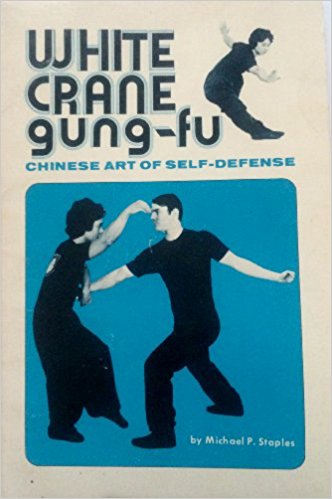
2116d-ef66c-51ymaudvzil-_sx330_bo1204203200_.jpg

Interesting perspective — maybe I’m reading it differently.

Met your teacher Quentin Fong years ago at his martial arts store if memory serves me I think it was on California Street in the 70s.

At the time, was training under Mike Staples (student of George Long), the emphasis was the same: use range and and foot work,,, so the opponent can’t charge in to begin with.

"Mike Staples

But it seemed to me that most non long-arm styles had a kind of dead spot between those two ranges that the long-arm filled. So White Crane had three different ranges -- One for kicks, one for long-arm, one for short hand. If someone was at the longest range... then kick him. If they were at a closer range, then hit him with the long-arm, and if he was close by, use the short-hand.

And of course the footwork (always the footwork) helped to make adjustments in those ranges by not only opening up unique angles, but placing the opponent into the best range. White Crane, as I saw it, was 3 dimensional on many levels, intricate and thought provoking. Like Mr. Long use to say... "Pretty sophisticate."
 
Last edited:
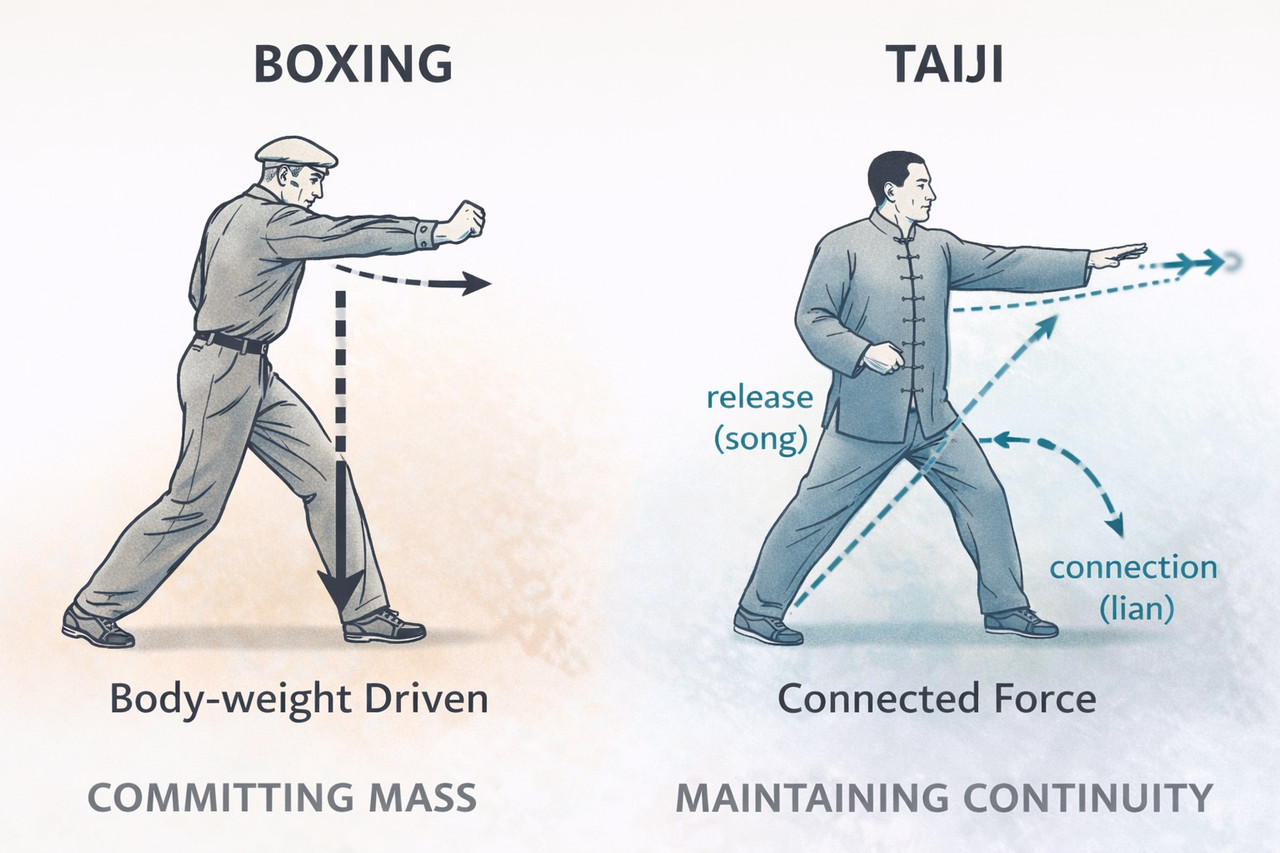
In arts like boxing, power generation is described explicitly in terms of impulse and collision, created by setting body-weight in motion (falling, surging, driving, etc.). In Taiji, explanations more often emphasize connection, release (松 song), continuity (通 tong), and borrowing force, which seems to point to a different organizing principle.

When Taiji practitioners talk about “whole-body power,” are they referring to the same impulse-and-collision model described by Dempsey, or to something mechanically different?
If different, how would you describe that difference in practical terms?


Interesting discussions.

For those who have actually trained Taiji, or interacted directly with someone who has:

Was there anything you found to be genuinely unique to it—
in method, feeling, or the way force was used?
 
Last edited:
Interesting discussions.

For those who have actually trained Taiji, or interacted directly with someone who has:

Was there anything you found to be genuinely unique to it—
in method, feeling, or the way force was used?
Why don't you want to talk about the Taiji striking skill?


Taiji has almost all the punching tools (except overhand).

- "Vital punch" is jab.
- "Fair lady work on shuttle" is cross.
- "Left/right striking tiger" is hook.
- "Snake extend tone" is uppercut.
- "Turn around hammer" is back fist.
- "Fetching arm" is hammer fist.
 
Last edited:
You have to move in, open your opponent's guard
I disagree. This is only one possibility.

The other possibility is to let opponent do this for you. Ie let your opponent do acceleration. Speaking about maximum power generation, nothing says your body must generate all power. If your opponent generates incoming momentum, and you "stop him" with a rooted punch, that can easily generate as much impulse into your opponent body as your example.
 
I have seem CXW's Fajin video for a long time. Until several weeks ago someone mentioned about "not moving feet", I didn't notice that before.
it’s the very basics for focus on waist method, at advanced levels footwork naturally adds and comes at work. As seen in Yang Taiji and it’s offsprings
 
Why don't you want to talk about the Taiji striking skill?

The thread isn’t about Taiji striking specifically.
The question was about “whole-body power” — how it’s expressed, how it’s generated, and whether the term means the same thing across different arts.

Some people brought up long-arm methods, which I’m familiar with and trained extensively in my younger years. They’re useful as a contrast because long-arm expresses force through a very different strategy and shape.

It’s not something I can use anymore — my current practice changed the internal organization to the point where those old mechanics no longer function naturally.


In this context:
I don’t view Taiji as being defined by striking, kicking, or grappling.


Its defining characteristic is a specific type of force that comes from a different way of organizing the body — that internal organization determines the shapes, tactics, and strategies available.

This is why, across different styles and lineages, the demos, movements, and applications tend to look and feel similar when someone is using the same internal method. The outward forms may differ, but the underlying engine — the way force is produced, organized, and managed — ends up expressing itself in a recognizable way.

taiji method expressed by a noted teacher

 
Last edited:
Some people brought up long-arm methods, which I’m familiar with ... I don’t view Taiji as being defined by striking, kicking, or grappling.


What can be the difference if a Taiji guy does the long-arm method (as shown in your video)? If a Taiji guy does do the long-arm method, how can you compare the difference?

If a Taiji guy doesn't do kick/punch/throw, how can you compare the difference?

IMO, you have to do it in order to see the difference.
 
Last edited:
IMO, you have to do it in order to see the difference.

IME, having practiced both, the two methods are opposite in how they organize force and intention.
If someone says they practice Taiji but feels there is no difference, it usually points to one of two possibilities:
  1. They’re not actually practicing Taiji’s internal method — only the external choreography.
  2. They haven’t reached a level where the internal distinctions become noticeable or meaningful.

@Kung Fu Wang

You still haven’t answered the question:
Are the demos really showing two different things —
or are they expressing the same method in different ways?
 
2116d-ef66c-51ymaudvzil-_sx330_bo1204203200_.jpg

Interesting perspective — maybe I’m reading it differently.

Met your teacher Quentin Fong years ago at his martial arts store if memory serves me I think it was on California Street in the 70s.

At the time, was training under Mike Staples (student of George Long), the emphasis was the same: use range and and foot work,,, so the opponent can’t charge in to begin with.

"Mike Staples

But it seemed to me that most non long-arm styles had a kind of dead spot between those two ranges that the long-arm filled. So White Crane had three different ranges -- One for kicks, one for long-arm, one for short hand. If someone was at the longest range... then kick him. If they were at a closer range, then hit him with the long-arm, and if he was close by, use the short-hand.

And of course the footwork (always the footwork) helped to make adjustments in those ranges by not only opening up unique angles, but placing the opponent into the best range. White Crane, as I saw it, was 3 dimensional on many levels, intricate and thought provoking. Like Mr. Long use to say... "Pretty sophisticate."
If it was at the White Crane Supply store, that was Sifu William Siu. Sifu Siu was the owner of that shop. He was a close friend of Sifu Fong, and passed away recently. His son contacted me and passed along some of his father’s belongings, including some writings he was working on. His son is not connected to martial arts, and recognized that I and those to whom I am connected, would get more value from them than he would. It was a fortunate meeting and I am grateful to his son for reaching out to me.

I only ever met Sifu Siu once, also at the store, before I was a crane practitioner, I was training capoeira in San Francisco at the time. Probably about 1996 or so.
 
In Jack Dempsey's book Championship Fighting
he talks about “whole-body power”.


In discussions of Taiji application, terms like whole-body power, issuing, and jin are also used frequently,
it’s not always clear whether people are referring to the same mechanics.

In arts like boxing, power generation is described explicitly in terms of impulse and collision, created by setting body-weight in motion (falling, surging, driving, etc.). In Taiji, explanations more often emphasize connection, release (松 song), continuity (通 tong), and borrowing force, which seems to point to a different organizing principle.
Your post is convoluted. Boxing power generation is described in various ways depending on the type of strike (e.g., lead or rear hand), distance, set up, etc.

When Taiji practitioners talk about “whole-body power,” are they referring to the same impulse-and-collision model described by Dempsey, or to something mechanically different?
If different, how would you describe that difference in practical terms?

boxing-taiji.jpg

ChatGPT-generated image for discussion purposes.
In the Tai Chi vs Muay Thai fight, Wang Yan (tai chi) strikes (lead and rear hand), kicks and throws. Can you timestamp and describe the “mechanical” differences in “whole body power” in practical terms?


How about in Adam Mizner’s sparring video?

 
@marvin8


I understand your questions, here’s the difficulty:


You’re approaching the discussion strictly from analysis of videos and external appearance. That’s fine as commentary, the topic of the thread is about the internal method behind the movement — something that can’t be confirmed from watching other people. The distinctions I’m asking about only become clear through hands-on practice and direct experience. If someone hasn’t felt or trained those differences, then naturally everything will look the same, because from the outside the shapes overlap.

Before we can meaningfully compare, I have to ask a simple, non-confrontational question:

Do you personally train Taiji’s internal method, and if so, what are you actually feeling when you generate force?
Do you feel it is the same as the other methods you train, or not?

Without that clarity, it’s difficult to connect your commentary to the mechanics being discussed.
 
Last edited:
You still haven’t answered the question:

This Taiji guy (in the video) should demonstrate his punch on his opponent. If his Taiji punch can knock down his opponent, that's a good Taiji punch, if not, that's just a "push" by my definition.

A good punch should have the effect as showing in this picture.

Chang_punch.gif
 
Last edited:
@marvin8


I understand your questions, here’s the difficulty:


You’re approaching the discussion strictly from analysis of videos and external appearance. That’s fine as commentary, the topic of the thread is about the internal method behind the movement — something that can’t be confirmed from watching other people. The distinctions I’m asking about only become clear through hands-on practice and direct experience. If someone hasn’t felt or trained those differences, then naturally everything will look the same, because from the outside the shapes overlap.

Before we can meaningfully compare, I have to ask a simple, non-confrontational question:

Do you personally train Taiji’s internal method, and if so, what are you actually feeling when you generate force?
Do you feel it is the same as the other methods you train, or not?

Without that clarity, it’s difficult to connect your commentary to the mechanics being discussed.
I did not give an opinion. I asked for your commentary on your OP question on "whole body power mechanical" (physical) differences…

When Taiji practitioners talk about “whole-body power, are they referring to the same impulse-and-collision model described by Dempsey, or to something mechanically different?
If different, how would you describe that difference in practical terms?
 
Back
Top