Open and Close (开合): A Single Term, Two Different Methods

windwalker099102

Master of Arts
Last login streak
133 day(s)
Max login streak
133 day(s)
Many arts talk about “open and close” (开合 kāi–hé).
On the surface the words sound the same, the methods behind them can be very different.

Externally, open–close refers to visible mechanics — expanding, contracting, loading, unloading.
Internally, open–close describes something else entirely: intent, pressure changes, whole-body elasticity, and internal reorganization.

Same words… different methods that only look similar on the outside?
 
I just (1 minute ago) had an epiphany that open and close are illusory and that there is only peng. Then I come on here and see this question! It is fate. Peng is illusory; not just peng and lu, but in the sense that there are two pengs (one, an expansive energy) and two the peng-lu dichotomy -- that even before the expansive peng there is a kind of growing force, which arises out of sinking force. The closest analogy I can come to is ground reaction force but I do not think that it is a ground reaction force because growing force operates in stillness. There must be total stillness and a total absence of the desire to affect outcome (yi). As my sifu would say, the secret key to unlock the heart. I mentioned this to you before.

I don't think anyone knows what I am talking about since I am coining the term growing force. I think it's distinct from peng; one of the underlying primordial forces. What am I talking about? It's simple; remember when you were a child, and you were growing? That. We must return to the source; to become like a child.

I'm writing a book about it called "opening the iron gate." Might be done, someday.

My question then would be, if open and close are worth studying (meaning, if one must pass through open and close) or if one can push forward directly into the great void and then beyond it into growing force? Theoretically there would be such power behind this that one could be thrown with a thought.

What do you think? Is it possible to get that close?
 
From my Japanese reading/understanding ‘kaigō means meeting/assembly/gathering. So could it imply an assembly of the inner and outer characteristics into one, inseparable entity that is the art?
 
From my Japanese reading/understanding ‘kaigō means meeting/assembly/gathering. So could it imply an assembly of the inner and outer characteristics into one, inseparable entity that is the art?

You mention meeting / assembly / gathering — interesting 🤔

Is kaigō something you actually use in your own practice?
In your reading, does the term go any deeper than the literal kanji translation?

Does it describe a method, a feeling, or a specific way the body organizes?
 
What do you think?

Open and close are worth studying.
They’re not optional — they are the path. Everything else grows out of them.
Experiences vary, but the underlying method stays consistent.

Traditionally, until someone reaches a certain stage, true open and true close aren’t available yet.
Their “closing” won’t really close, and their “opening” won’t really open.
 
You mention meeting / assembly / gathering — interesting 🤔

Is kaigō something you actually use in your own practice?
I’ve never explicitly heard the term/idea specifically. Despite all the spiritual/Budo stuff written about arts I’ve practised, nobody’s ever mentioned those ideas concentrating, instead upon the technical side of things. That’s always disappointed me 🤷🏾
In your reading, does the term go any deeper than the literal kanji translation?
I’m afraid I’ve never come across the term, but I don’t see why it can’t be interpreted in that way. I’ll hazard an unverifiable conjecture; the TMA are an assembly of technical (physical) movements and internal (psychological/spiritual) techniques to perform and apply them with maximum efficacy, so why not use that term? It seems reasonable, don’t you think?
Does it describe a method, a feeling, or a specific way the body organizes?
I think that would probably depend upon the art you practise. From the traditional conjuring of ‘juju’ in psychoactive drug-fuelled martial ceremonies to austere Zen-infused practise, they are all different pathways to the same thing; the ability to kick and enemy’s gluteals! 😉
 
I've never explicitly heard the term/idea specifically. Despite all the spiritual/Budo stuff written about arts I’ve practised, nobody’s ever mentioned those ideas concentrating, instead upon the technical side of things. That’s always disappointed me 🤷🏾
👍

I think in most traditional Asian teaching methods, ideas like this may be mentioned, but they’re almost never explained explicitly. Historically, the expectation was that the student would arrive at the meaning through practice, not through verbal instruction. The teacher demonstrates, names it, and leaves the student to discover the depth.

This reflects how my own teacher taught. He didn’t lecture; he showed the quality, gave it a name, and expected us to work until we could reproduce it. Some of the local students felt that without verbal explanation they weren’t being taught anything, they left — perhaps not understanding the method, perhaps not ready for it. Hard to say.

One side-effect of this approach is that someone can eventually do what others only theorize about, yet still struggle to talk about it. Clear explanation only becomes possible when both people share the same experiential foundation.

It’s often said: “Those who talk do not know, those who know do not talk.”
In reality, it may simply be that those who know cannot talk about it with people who haven’t experienced it. Once someone has the experience, the conversation changes — there’s no impulse to validate or prove anything. The discussion becomes mutual recognition rather than argument.
 
Last edited:
👍

I think in most traditional Asian teaching methods, ideas like this may be mentioned, but they’re almost never explained explicitly. Historically, the expectation was that the student would arrive at the meaning through practice, not through verbal instruction. The teacher demonstrates, names it, and leaves the student to discover the depth.
I think you’re right, but I often wonder if the teachers ‘really know’. There are so any martial artists who know nothing of the internal aspects of their art because of this lack of explicit steering not least because it’s the physical aspects that really interest them. Fair enough, but I fear they’re missing out on something that really cultivates their spirit/mind/heart and, perhaps indirectly, informs their physical skills. At the very least it makes them interesting, well-rounded teachers and people.
This reflects how my own teacher taught. He didn’t lecture; he showed the quality, gave it a name, and expected us to work until we could reproduce it.
I think we’re very lucky to have resources at our fingertips which allows us to find out the internal easily. In my Karate days there were books for those who were interested but at a considerable financial cost. I just liked knowing the terminology and concepts so lapped it all up; I still do!
Some of the local students felt that without verbal explanation they weren’t being taught anything, they left — perhaps not understanding the method, perhaps not ready for it. Hard to say.
Perhaps that was a strategy on the teacher’s part to separate the wheat from the chaff. Only the tenacious will endure…
One side-effect of this approach is that someone can eventually do what others only theorize about, yet still struggle to talk about it. Clear explanation only becomes possible when both people share the same experiential foundation.
Yes, absolutely; a very good point! When I was teaching an anatomy class, I used to explain tothe students various bits of terminology; lateral, medial, rostral, chordal and then insist they used these terms all the time in pubs, parties etc…” you have something on you face….no, no…on the medial aspect of your right eye”! I told them that using the vernacular was part of the apprenticeship and a sign of accomplishment. I think it’s the same in the TMA.
It’s often said: “Those who talk do not know, those who know do not talk.”
In reality, it may simply be that those who know cannot talk about it with people who haven’t experienced it.
😄👍🏽
Once someone has the experience, the conversation changes — there’s no impulse to validate or prove anything. The discussion becomes mutual recognition rather than argument.
Oh…nicely expressed! 🤗
 
I think you’re right, but I often wonder if the teachers ‘really know’. There are so any martial artists who know nothing of the internal aspects of their art because of this lack of explicit steering not least because it’s the physical aspects that really interest them. Fair enough, but I fear they’re missing out on something that really cultivates their spirit/mind/heart and, perhaps indirectly, informs their physical skills. At the very least it makes them interesting, well-rounded teachers and people.

In the internal arts it’s not indirect at all — it directly informs physical skill.
One could even say the internal component is what makes the skills function in the way they’re known for.

From an internal lens, you can sometimes see traces of these qualities in other arts as well. Some practitioners express elements of internal coordination without formally training it — they’ve arrived there through long experience, body awareness, or simply good instruction. But they may not recognize it as “internal,” something they don’t cultivate it deliberately.

On the other side, practitioners of externally based methods may feel they are working on the same things. That’s actually one of the points of this thread — the same words can be used, the method and outcome diverge depending on the engine behind the training.
 
From an internal lens, you can sometimes see traces of these qualities in other arts as well. Some practitioners express elements of internal coordination without formally training it —
Can you explain what is meant by ‘internal coordination’?
 
There is the civil way and the martial way. Internal, and external. Both teach the same art.

If you teach via the martial, it does not matter if you know or teach the internal, so long as you pass down the civil with wu de; for if you say "this is it, I never learned any internal secrets" you will destroy a generation, but if you tell your students to be thankful to the ancient masters, one day one of them may discover great success. I think that's what you mean by saying some schools begin to develop things that are sort-of internal but that they don't view them as "internal" because they came from an older "technology" of martial arts.
 
Last edited:
Can you explain what is meant by ‘internal coordination’?
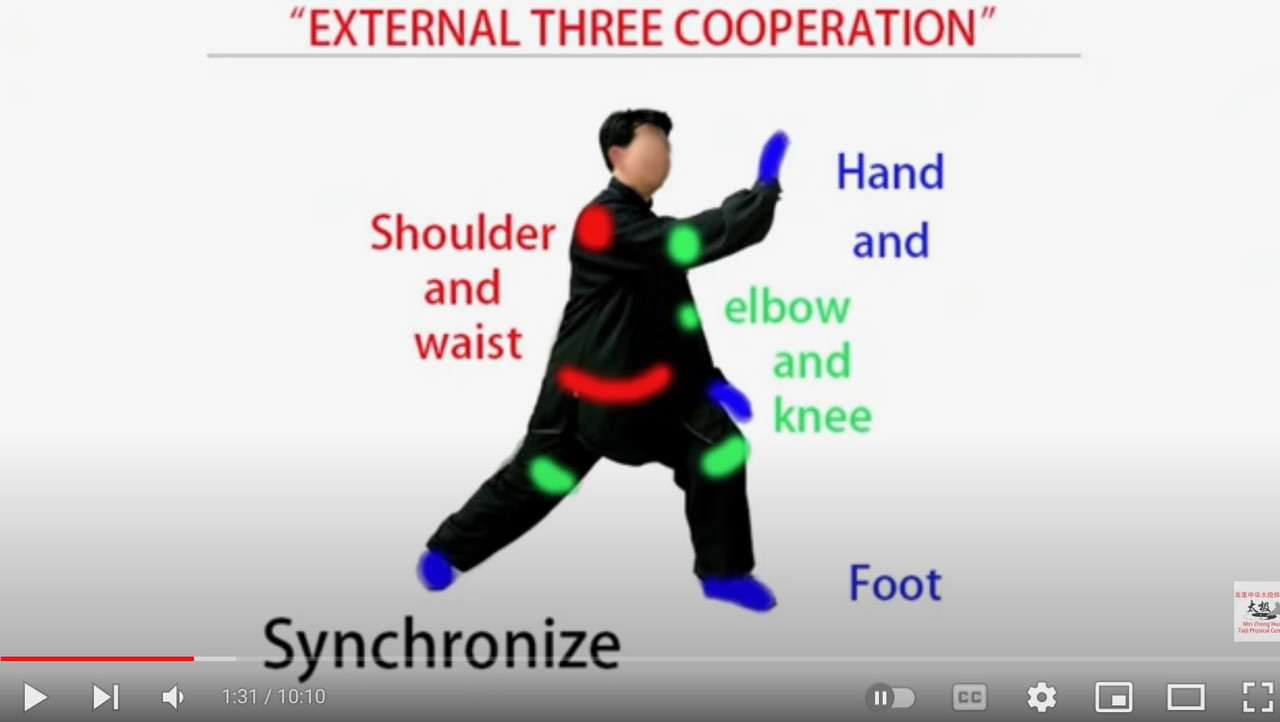
The Six Harmonies (六合) have long been referenced in both martial and Daoist traditions as a framework for unifying external structure with internal awareness — a way to move from external coordination into true internal integration.


Screenshot_2024-10-15_at_6.46.28_AM.jpg
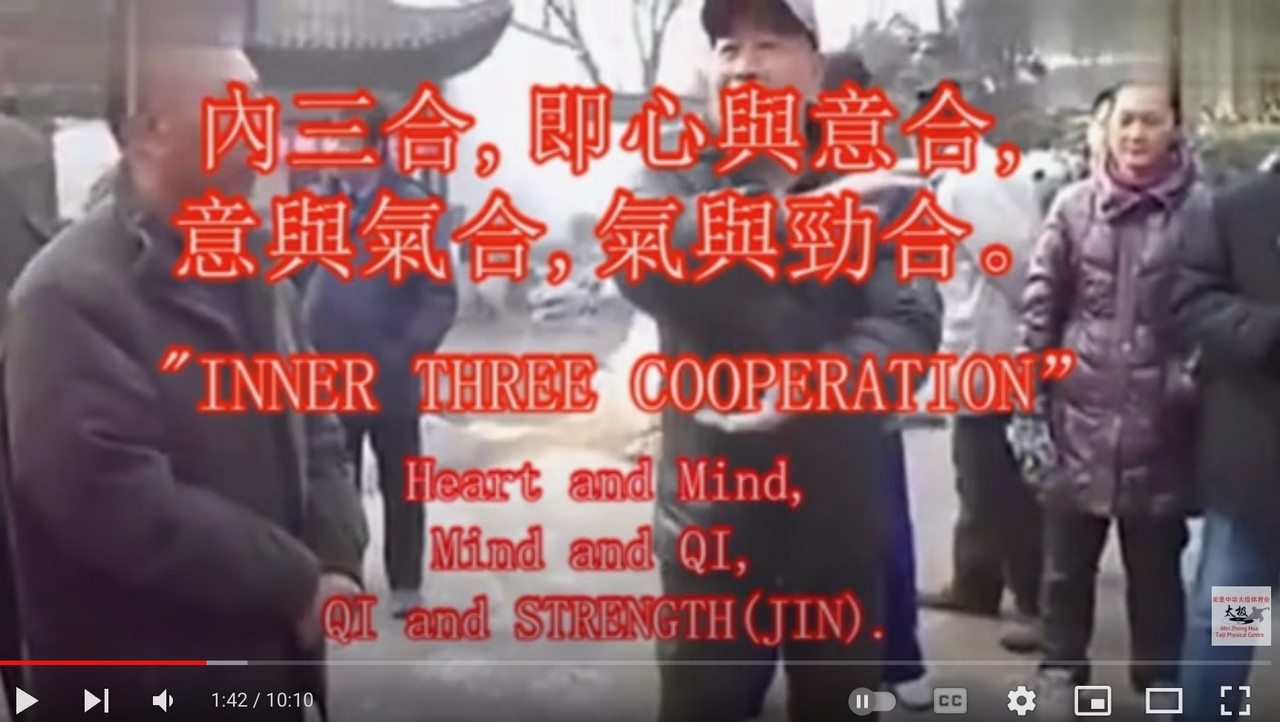
Screenshot_2024-10-15_at_6.47.48_AM.jpg

Screenshots from the video below illustrate this clearly:


The Six Harmonies are what make that kind of work possible.

It’s very common for people to train the external harmonies without ever developing the internal, and it’s also common for people to work on Yi, Qi, and Shen without being able to use any of it.
It all depends on what someone is training and for what purpose.

In the internal arts, open–close (开合) isn’t just “expand / contract.”
It’s the whole body acting as one unit through the Six Harmonies.

The internal method allows something external mechanics usually don’t:

unity can be separated when needed.
You can open inside a close, and close inside an open — those changes affect the other person directly.

As the video shows, the other person isn’t reacting to visible movement.
They’re reacting to the internal change they’re joined to.
 
So it is a biomechanical phenomenon? That’s not what I expected 😄
 
I’ve Not read through the comments.
Anyways

The 合 is same as the “Ai” in Aikido - to join(harmoniously).
The 开 can be as - start/begin/make happen.
So it goes deeper than just simple - to open and then close.
 
So it is a biomechanical phenomenon? That’s not what I expected 😄
🙂

You asked what was meant by “internal coordination.”
The video shows : how the internal aspects are organized with the external ones, and how the two work together in real time.

Open and close (开合 kāi–hé) is part of this process — it’s the bridge that lets internal organization express through external movement in a functional way. The body still moves biomechanically, but the coordination behind it isn’t only biomechanical. That’s what the video helps illustrate.

Externally, open–close can look like simple expansion, contraction, loading, unloading. Some people stop there and see it as purely mechanical.

Teacher Guo Shilei (郭石磊) demonstrating "loading shifts"
When he talks about “loading shifts,” he’s showing internal open–close — the internal reorganization of fullness/emptiness, pressure, and intent that causes structural change before visible movement.

 
Wow, he really launches his opponent into the air, seemingly defying physics! I sort of get it but it’s so different to, say, Karate, where you’re just trying to hit as hard as you possibly can using KE = ½mv² !
 
Wow, he really launches his opponent into the air, seemingly defying physics!

👍

Thanks for the well-reasoned reply. Most people question these kinds of demonstrations simply because they don’t match their own experience — which is understandable — but it’s very different for those who can do this or have felt it directly.

I sort of get it but it’s so different to, say, Karate, where you’re just trying to hit as hard as you possibly can using KE = ½mv² !

People question these reactions because they don’t match the mechanical model they’re using.
They come from real, familiar principles applied in an unfamiliar way.

Internal method uses timing, pressure changes, joining, emptying and filling (开合), and instantaneous loading shifts.
When you combine these with someone who is already connected to you, their body reacts automatically as it tries to stabilize.

In physics terms, you can think of it as impulse timing plus sudden vector reversal — small internal changes producing large external reactions.

a different organization of force


AN INTERVIEW WITH GUO SHILEI

For many people, the kind of gongfu that can throw people 3 or 4 metres away sounds like the stuff of wuxia novels. But our reporter witnessed such gongfu with his own eyes yesterday in People’s Park in Dongguan, in Guangdong province, in the form of Guo Shilei, a young master of Yang style taiji and Ma style bagua.

An Unassuming Exterior Hides Extraordinary Skills

Yesterday at around 9am our reporter managed to find Mr Guo in People’s Park. On first impressions, one would never guess that Guo is in fact an accomplished martial arts adept: apart from his short beard and keen gaze, there is nothing to distinguish him from any other thin, short young man.

In order to get a glimpse of Guo’s skills, our reporter asked his disciples to attack him, only to see them repelled backwards more than 3 meters by a simple twist and shove from a motionless Guo Shilei.

Seeing that our reporter was astonished by this display, Guo had our reporter experience his nei li (internal power) for himself. He told our reporter that he would only use a tenth of his full strength, and that this could not do any lasting damage. Even though our reporter took up a ready stance, a light pat on the shoulder from Guo was enough to shake his entire body, it took him several mintutes to recover.

In order to test Guo’s gongfu, our reporter asked a well-built onlooker to punch Guo in the stomach. The onlooker rushed up to Guo from a distance of 3 metres and punched Guo in the belly, only to be knocked down to the floor, complaining that his fist hurt; only after 10 more tries (with exactly the same results) did the onlooker give up.

Shaolin Iron Arm to Neijia
 
continued ☝️

“My family is from Pingding Shan in Henan province, but later moved to Zhengzhou (the provincial capital). I was really weak when I was little, so I started to learn external martial arts like Shaolin boxing. When I was around 10 or so, I used to love practicing iron arm, I would knock my arms against trees whenever I could. ” Upon inspection by our reporter, Guo’s forearm was indeed extremely hard.

” When I was 15 I met my teacher Shi Chongying and, thinking that my iron arm was already pretty awesome,

I asked him to hit my arm. To my surprise, a light touch from him was enough to numb my arm for an entire afternoon.

After that experience, I was determined to study neijiaquan (meaning xingyi, bagua and taiji) with Shi.

Guo Shilei’s idol, his teacher Shi Chongying
 
I don't know that I can separate the "external" and "internal" things (at this stage of learning). For example if we do a form move of "peng" and arms sort of visibly move up and out, on the "inside" we may feel some kind of "energy expansion". If we do a form move of push down, pull down, roll back, with some visible movement on the outside, on the inside, we may feel some kind of "energy going down or back". So for me to activate whatever is happening on the inside, it's nice to have the cue of some kind of external thing, or at the very least, some intent for that movement. Then, it doesn't really matter too much what are the physics - fascia, energy - everything is ultimately energy if we follow physics far enough down the rabbit hole - these are too hard to understand and "science" doesn't look at this much. Maybe later the external and internal seem more distinct and windwalker's questions at the top will make more sense
 
Back
Top