Collision or impulse

But with poor cardio, this really drains you.
This strategy work well in challenge fight. When your opponent finds out that he can't block all your punches, the challenge fight can stop there. Being able to scare your opponent (without hurting him) can be a good way to stop a fight.
 
Last edited:
If you compare these 3 videos, you may ask, "Why this Taiji guy doesn't move his feet when he punch?"

If you don't move your foot when you punch, how can you coordinate your hand with your foot? Does the term "dynamic punch" exist in the Taiji world?

Taiji power generation:


Baji power generation:


You have Yang-TJQ in your curriculum, in authentic Yang-TJQ form you have :


  • Step forward parry punch (appears several times in the form)


  • Step forward punch to groin


  • Step forward punch ā€œdownā€(ā€œstrike to liverā€)


  • Fists strike to ears/(temples) comes with a forward momentum( landing the foot on ground)
 
You have Yang-TJQ in your curriculum, in authentic Yang-TJQ form you have :
  • Step forward parry punch (appears several times in the form)
  • Step forward punch to groin
  • Step forward punch ā€œdownā€(ā€œstrike to liverā€)
  • Fists strike to ears/(temples) comes with a forward momentum( landing the foot on ground)
I'm not talking about Yang Taiji form. I'm talking about that Chen Taiji power generation video. One day someone asked me, "Why did he punch without moving his feet?" I didn't have my answer because I didn't know why?
 
If you compare these 3 videos, you may ask, "Why this Taiji guy doesn't move his feet when he punch?"

If you don't move your foot when you punch, how can you coordinate your hand with your foot? Does the term "dynamic punch" exist in the Taiji world?
Makes good sense to me. He uses angular momentum instead of linear momentum (rotation insted of step), power is generated by using hips and torso, without changing his center of mass. So he generates power while maintaining a rooted stable stance.

One might call this a dynamic punch as well, except it's rotational dynamics, not linear dynamics. After all, his upper body is very dynamic.
 
Varying attacks by spatial 3-D (angles of attack) is good. You can also attack on a single spatial dimension but vary the 4th dimension of timing. Or combine the two. Unpredictability in any form is good
Pulling off a sequence fast, requires training the actual combo on the bag. So that it is like "one reflexive sequence" rather than 4 punches in a row. But to make it fast it's hard to maintain guared, so during the machine gun execution, your other hand is loading before the other hand lands, so no guard. At least how I do it on the bag. To take the state via intermediate guared makes it too slow for me.
 
But pulling off a sequence fast, requires training the actual combo on the bad. So that it is like "one reflexive sequence" rather than 4 punches in a row.
Yeah. Think of a combo as a single move. As Ed Parker would put it, "Not C-A-T, but CAT." Not three letters, just one word.
But to make it fast it's hard to maintain guared, so during the machine gun execution, your other hand is loading before the other hand lands, so no guard.
One hand guards (or checks, grabs or immobilizes), the other attacks, then the attacking hand becomes guard as the guard hand becomes the attacking hand. In Okinawan, this is called findi. Don't reload/rechamber but launch the next attack from the guard position. This way you are pretty close to always being guarded. Moving your body offline, or the opponent's body offline during the attack will also help keep him from countering.
 
Makes good sense to me. He uses angular momentum instead of linear momentum (rotation insted of step), power is generated by using hips and torso, without changing his center of mass. So he generates power while maintaining a rooted stable stance.

One might call this a dynamic punch as well, except it's rotational dynamics, not linear dynamics. After all, his upper body is very dynamic.
If you only use hip and torso, you can generate power but not maximum power. You don't use full body momentum at all. Since your opponent is a moving object, without moving your feet, your mobility is another concern.
 
Last edited:
I'm not talking about Yang Taiji form. I'm talking about that Chen Taiji power generation video. One day someone asked me, "Why did he punch without moving his feet?" I didn't have my answer because I didn't know why?
I misunderstood your question that included - ā€œpunch" exist in the Taiji world?ā€ - as TJQ in general
 
If you only use hip and torso, you can generate power but not maximum power. You don't use full body momentum at all. Since your opponent is a moving object, without moving your feet, your mobility is another concern.

šŸ¤”

He is using his feet and the ground path — the force is rising and spiraling through the whole body. In Taiji this is described as winding silk (ē¼ äø / chĆ”n sÄ«) or pulling silk (ęŠ½äø / chōu sÄ«). The internal torque builds without needing visible external wind-up or large movements.

The sharp release in solo practice a visible training expression; not what application looks like under real contact.

Taiji approaches power through four ideas:

  • Attach (粘)
  • Join (čæž)
  • Follow (随)
  • Release (放 / 发)
Why push-hands is central: it trains how force is managed through contact, not produced in isolation.

Taiji organizes around managing force through contact;
striking arts organize around creating force into the opponent.
 
If you only use hip and torso, you can generate power but not maximum power. You don't use full body momentum at all. Since your opponent is a moving object, without moving your feet, your mobility is another concern.
Just because you don't constantly jump around during actual punching, doesnt mean you are glued to the floor during the whole fight. I see occasions when power generation that way can be useful. For example if you are attacked/pushed and want to strike. Backing while striking is probaly not good, and falling forward when you get pushed is hard. Then such a strike might have alot of power, especially if your opponent runs into you - sort of adding that extra impulse ("borrowed energy" what they sometimes call it) that you didnt get from falling forwards?

But maybe I missed your point.
 
Just because you don't constantly jump around during actual punching, doesnt mean you are glued to the floor during the whole fight. I see occasions when power generation that way can be useful. For example if you are attacked/pushed and want to strike. Backing while striking is probaly not good, and falling forward when you get pushed is hard. Then such a strike might have alot of power, especially if your opponent runs into you - sort of adding that extra impulse ("borrowed energy" what they sometimes call it) that you didnt get from falling forwards?

But maybe I missed your point.
You don't need to jump around. But you do need to spring forward. Here are 2 examples. Both punches use forward foot work and full body momentum.

Power come from compress -> release.

- bottom and up.
- back and forward.

back foot (up) -> back knee (up) -> hip (up) -> spine (up) -> shoulder (forward) -> elbow (forward) -> hand (forward)

IMO, in order to generate "maximum power", this process is required.

1. Some MA systems believe if you train long enough, you will understand power generation.
2. Some MA systems believe if you train certain drills (as showing in videos), you will understand power generation.

I prefer 2 over 1.

adam-jab.gif


Adam_cross.gif
 
Last edited:
I'm not talking about Yang Taiji form. I'm talking about that Chen Taiji power generation video. One day someone asked me, "Why did he punch without moving his feet?" I didn't have my answer because I didn't know why?
My teachers teach that you should never move your feet when you kick or punch. However, in the beginner training we do a move where you step and punch and your whole leg moves. I asked my sifu and he said it's because that is a different method of power generation. He didn't explain, which means that was supposed to be enough to warn me not to use that method of power generation everywhere. This is how they taught. Later on when I asked for confirmation of an idea he would tell me it was correct or incorrect.

Frankly I cannot believe you that you do not understand why you don't move your foot when you kick or punch, because I think you have great combat ability, but it may be that your ability is so great that for you it does not matter. Me, I am a theorist, I have been in plenty of fights before, from a self-defense perspective. But not in the ring, not officially anyways. Anyways, I told this story because 'my teachers told me,' and you might find that interesting based on that we learned similar things.

Do you really not know or are you just trolling these guys? Does this mean I finally have some leverage over you? :) Ok, tell you what. Tell me the whole poem and I will tell you why you don't move your foot when you punch! Although you may be surprised to know there are a lot of Chen style people, especially in Taiwan, that move their foot in various ways when they punch. And, they do it on purpose.
 
in Taiwan, that move their foot in various ways when they punch. And, they do it on purpose.
I have seem CXW's Fajin video for a long time. Until several weeks ago someone mentioned about "not moving feet", I didn't notice that before.

Your opponent is outside of your kicking range. You have to enter the kicking range, and then enter the punching range before your fist can land on your opponent. In order to cover that distance, footwork must be included in the power generation.

Here are videos that footwork is added into the power generation.


Last edited:
ā€œpunch" exist in the Taiji world?ā€ - as TJQ in general
Taiji has almost all the punching tools (except overhand).

- "Vital punch" is jab.
- "Fair lady work on shuttle" is cross.
- "Left/right striking tiger" is hook.
- "Snake extend tone" is uppercut.
- "Turn around hammer" is back fist.
- "Fetching arm" is hammer fist.
 
Taiji has almost all the punching tools (except overhand).

- "Vital punch" is jab.
- "Fair lady work on shuttle" is cross.
- "Left/right striking tiger" is hook.
- "Snake extend tone" is uppercut.
- "Turn around hammer" is back fist.
- "Fetching arm" is hammer fist.

If we treat the shapes as containers, they may look similar to punches from other arts, but how they’re used in Taiji isn’t based on the same method of power generation.

 
If we treat the shapes as containers, they may look similar to punches from other arts, but how they’re used in Taiji isn’t based on the same method of power generation.

Push is not punch.
 
Last edited:
You don't need to jump around. But you do need to spring forward. Here are 2 examples. Both punches use forward foot work and full body momentum.
Your context presumes you start disengaged. Ie your target is 2m in front of you.

You can't spring forward in a close range context. Then what do you do? Back down, to create space? You wont get 2m space if something is pushing you.

I get your point, but my point was that each context may prefer different techniques.
 
I get your point, but my point was that each context may prefer different techniques.
We are not talking about different techniques. We are talking about "maximum power generation" here.

If we compare 2 different punches:

1. Static punch (without footwork) may generate 80% power.
2. Dynamic punch (with footwork) may generate 100% power.

I walk 4 miles on the beach everyday. When I walk, I do my 1200 "dynamic punches (with foot work)". I can tell big difference when I punch while my feet are moving (with full body momentum) vs. when I punch while my feet are not moving (without full body momentum).
 
Last edited:
Push is not punch.
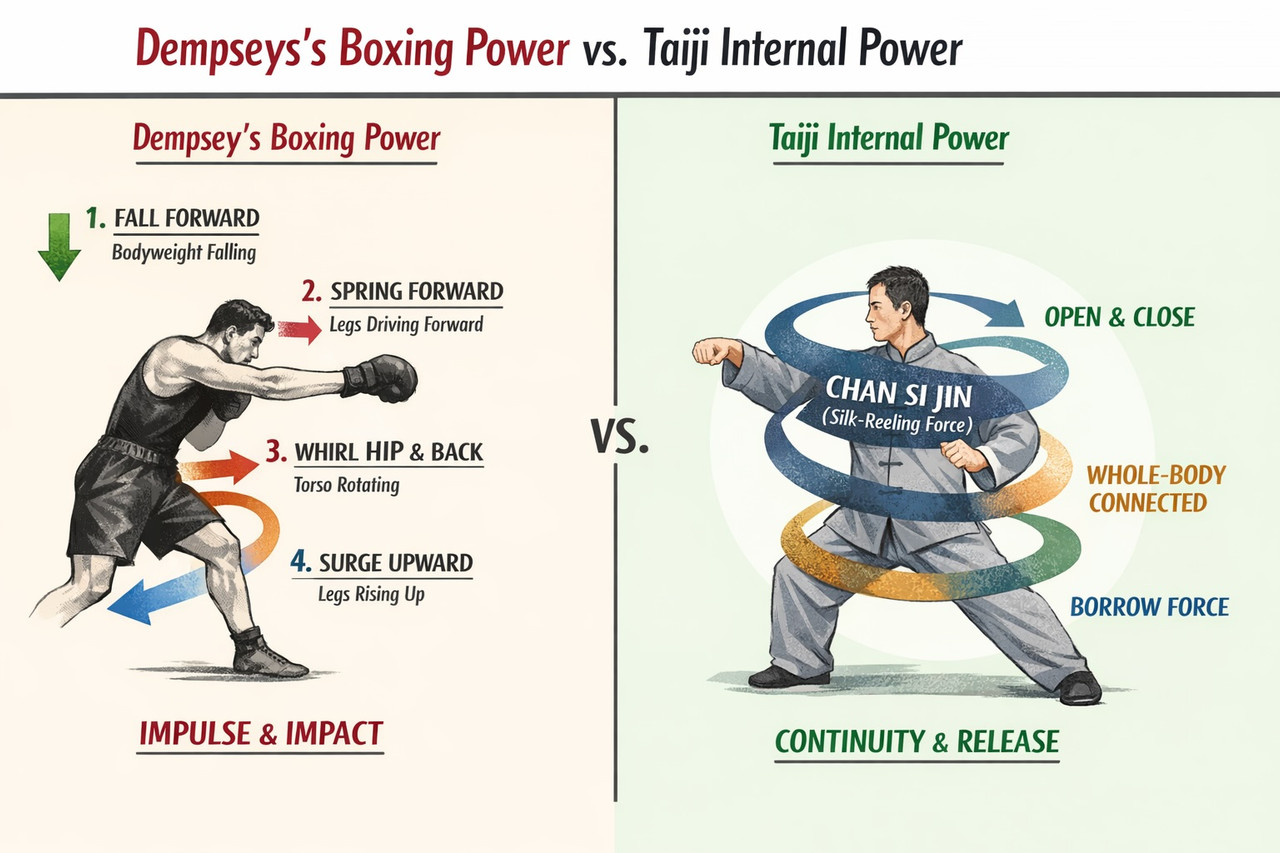
In Dempsey’s mechanics, a punch is essentially a push delivered with bodyweight in motion — short contact, high acceleration, and an impulse designed to shock the target. Mechanically they use the same chain (ground → legs → torso → arm), just arranged for a different timing and intention.


compare.jpg


Taiji organizes force differently.
Once contact is made, Taiji doesn’t rely on launching mass or creating impulse. It uses attaching (粘), joining (čæž), following (随), and releasing (放/发) to manage the interaction. Force is channeled through continuous structure rather than through collision.

What looks like a push in Taiji is usually long power (é•æåŠ²), used so the other person can feel the direction and adjust safely.


What looks like a push In Taiji its often referred to as "long" power...used in demos and training to allow the other to feel it, with out being damaged.

Using "short power " 冰劲 (cold power), is different. It releases so quickly and cleanly that the opponent has no time to react or brace — the effect is sudden and internal.

The outward appearance can seem similar — just as a push and a punch can share basic mechanics — the timing, intent, and internal organization behind long power and cold/short power are not the same.


Regarding the video:

It’s a demonstration meant to show that force can travel through the body and into another person with very little visible external movement. The changes come from internal adjustments that create pressure or torque which are released only when the connection point is established.

If you slow the video down, you can see that the partner is reacting to changes already happening inside his own structure — not from external striking or pushing. The effect is triggered from the inside, not imposed from the outside.
 
You don't need to jump around. But you do need to spring forward. Here are 2 examples. Both punches use forward foot work and full body momentum.

Power come from compress -> release.

- bottom and up.
- back and forward.

back foot (up) -> back knee (up) -> hip (up) -> spine (up) -> shoulder (forward) -> elbow (forward) -> hand (forward)

IMO, in order to generate "maximum power", this process is required.

1. Some MA systems believe if you train long enough, you will understand power generation.
2. Some MA systems believe if you train certain drills (as showing in videos), you will understand power generation.

I prefer 2 over 1.

View attachment 33697

View attachment 33698
Whole lot of telegraphing going on there. So if you can only hit hard with whole body momentum, then all I have to do is cut your momentum short, or stop it. Or with that much telegraphing, just get out of the way and counter
 
Back
Top