Collision or impulse

windwalker099102

Master of Arts
Last login streak
133 day(s)
Max login streak
133 day(s)
In Jack Dempsey's book Championship Fighting
he talks about “whole-body power”.


In discussions of Taiji application, terms like whole-body power, issuing, and jin are also used frequently,
it’s not always clear whether people are referring to the same mechanics.

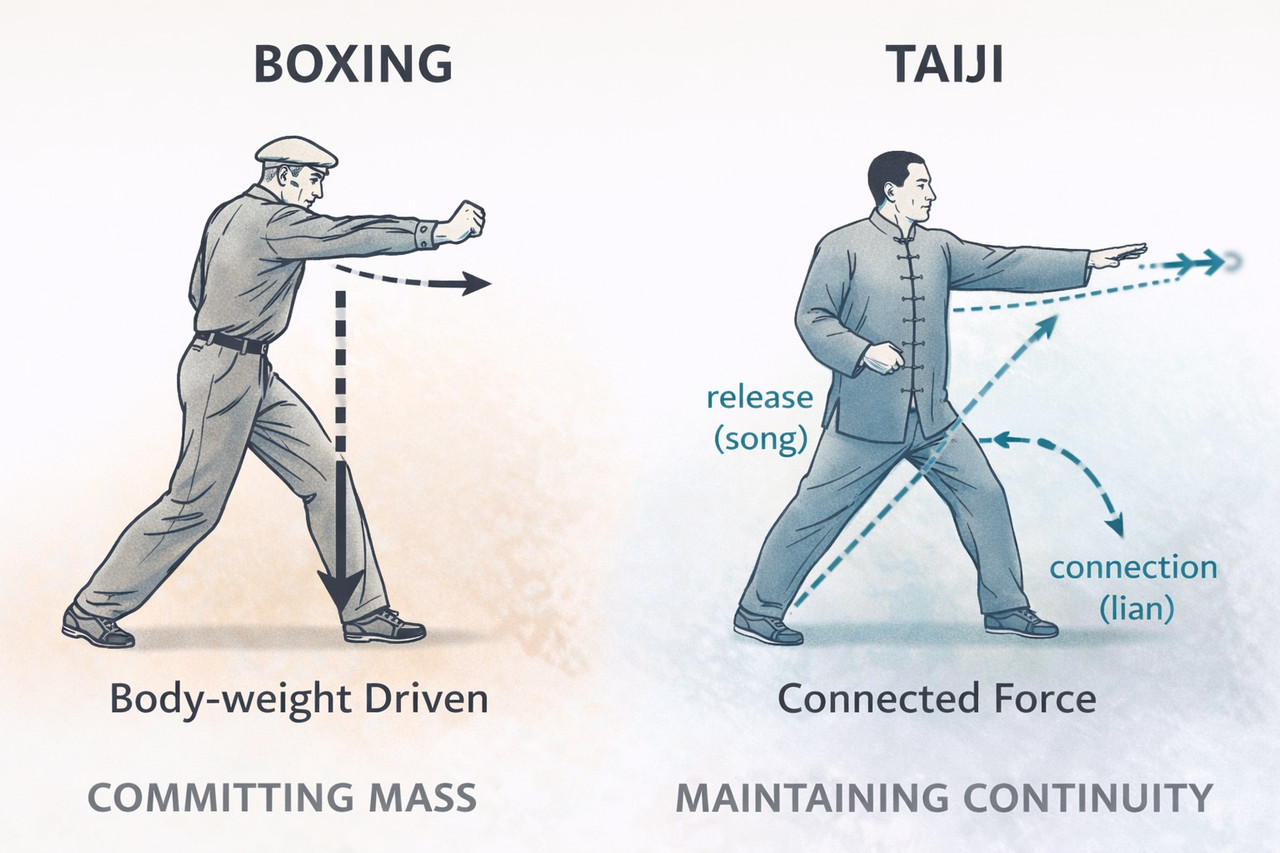
In arts like boxing, power generation is described explicitly in terms of impulse and collision, created by setting body-weight in motion (falling, surging, driving, etc.). In Taiji, explanations more often emphasize connection, release (束 song), continuity (通 tong), and borrowing force, which seems to point to a different organizing principle.

When Taiji practitioners talk about “whole-body power,” are they referring to the same impulse-and-collision model described by Dempsey, or to something mechanically different?
If different, how would you describe that difference in practical terms?

boxing-taiji.jpg

ChatGPT-generated image for discussion purposes.
 
Last edited:
With tiaiji, as the very name implies it isn’t about collision.
Some(and also me) has said the Dempsy’s text describes Xingyiquan at work, on a level yes, but on another level no, XYQ share higher levels with TJQ, well probably boxing do too but more on an talent level - Ali’s “phantom” punch, maybe comes close
 
We need a proper physicist to explain what’s really going on @Fungus 😉

As an improper physicist, I’d say it’s exactly the same thing. You’re aim is to give a projectile (fist) as much kinetic energy (1/2 it’s mass multiplied by the square of it’s velocity) as possible so on impact it transfers that energy into the target causing maximal tissue damage. Whatever method you employ is your/your art’s choice.

I’d rather be on the receiving end of a Taiji punch than a boxer’s.
 
Chapter 9 looks right up my street! 😉
 
With tiaiji, as the very name implies it isn’t about collision.
Some(and also me) has said the Dempsy’s text describes Xingyiquan at work, on a level yes, but on another level no, XYQ share higher levels with TJQ, well probably boxing do too but more on an talent level - Ali’s “phantom” punch, maybe comes close
This is a matter of perception and style (lineage). The notion that everything is about increasing the force of a strike comes from certain kinds of kungfu, but not all. The name Taiji -- does not at all imply anything about collision or not.

Commonly people will say the movements and principles of the martial art embody the philosophy of the taiji tu, adding "softness overcoming hardness", "stillness in motion, motion in stillness" and the continuous flow. This actually has nothing to do with the taiji tu and is a mischaracterization of daoism applied to the buddhist and Confucian art of "taijiquan". The Taiji tu is a confucian symbol that appears nowhere in the dao de jing or the chuang tzu. In the best case here, Lao Tzu was a Confucian scholar in the sense that he was roughly a contemporary of Confucius in the same general school of thought as Confucius and Mencius. Actually, signs point to him having lived after Confucius. It was Confucius who first said "道䞀仄èČ«äč‹"; the Dao is one principle. The structure of the Dao De Jing is primarily to advise and comment on the character of the sage -- just as the gentleman (sage) in Confucianism. This is something most practitioners simply never hear; they are too focused on the martial and not enough on the civil.
 
We need a proper physicist to explain what’s really going on @Fungus 😉

As an improper physicist, I’d say it’s exactly the same thing. You’re aim is to give a projectile (fist) as much kinetic energy (1/2 it’s mass multiplied by the square of it’s velocity) as possible so on impact it transfers that energy into the target causing maximal tissue damage. Whatever method you employ is your/your art’s choice.

I’d rather be on the receiving end of a Taiji punch than a boxer’s.
Yes so many, even Taiji folks chases power generation as in - land fist on opponent.
opponent land on fist, is a different way
 
I haven't read dempseys book and don't know alot about taji, but a comment from physics perspetive and my limited MA experience. I dont have near as much experience as most others here.

But surel a given force, or a given energy or impulse transer into any target is the same regardless of how it's generated.

But looking at the discussion and the picture, I see this difference:

In discussions of Taiji application, terms like whole-body power, issuing, and jin are also used frequently,
it’s not always clear whether people are referring to the same mechanics.

In arts like boxing, power generation is described explicitly in terms of impulse and collision, created by setting body-weight in motion (falling, surging, driving, etc.).

In Taiji, explanations more often emphasize connection, release (束 song), continuity (通 tong), and borrowing force, which seems to point to a different organizing principle.

When Taiji practitioners talk about “whole-body power,” are they referring to the same impulse-and-collision model described by Dempsey, or to something mechanically different?
I think the term means something slightly different. It seems Dempsey favours propelling as much body mass as possible BEHIND the punch, this is accomplished not only by accelerating your limb, but also your whole body - ie you fall into the attack, and kinetic linkage happens dynamically at impact, perhaps at the expensive of transiently loosing some rooting during power generation but recovers it at impact, when foot is down - which IMO means it is more aggresive, has the potential to generate more power, BUT also makes you vulnerable to a pushing opponent in close range. by push here i dont mean litteral hand pushing, it can also mean something punching you hard and fast - effectively forcing you back.

In the Taiji picture, I think the philosophy is to give priority to stability and structure. Ie. you can shift your body (center of mass) during strike, but not so much that you compromise (fall into) the target. This IMO would be better aginst a pushing opponent, and allows for strongly continously rooted punches. IMO - probably perfect for a stop punch to a charging oppponent! Because the challenge is not only to strike the opponent, but also to makes sure your own balance is not compromised. Which easily happens when a charging opponent comes to you if you are in the middle of initiating a "dempsey charge"?

so from the perspective of a dynamical fight, I magine that if you are hunting andp pushing your opponent, and he is backing down as you interact, dempseys aggresive method will work better. But if you are struggling with an opponet that is pushing you, and you are force to attack and defend at same time, then you must give higher priority to structure.

So I would say dempsey give priority of power generatation in an aggresive way, taiji priorities power generation is a more robust rooted defensive way.

When thinking about this, I realize that BOTH philsophies are requires, for different moves nad differnt opponents.

Due to may own limitations, I do not like dancing too much, I prefer to avoid unnecessary movements, and opt for strong rooting. In kyokushing we often do close range exnchanges, and if your opponent is big, that simply pushes you out of balance. So jumping too much is risky. It works if the opponent backs down, then the need for my own solid rotting is less important.

So dempsey style has more "effective mass", as in a decent fraction of hte body mass, in addition to the arm behind.

But if meeting resistance or beeing pushed, taiji gives priority to rooting to ground.
If different, how would you describe that difference in practical terms?

boxing-taiji.jpg
I thought about this when I traing on the heavybag, and I find a clear paterny. If I strike at head level, or downward strikes, the ground rooting serves less of a purpose as the counterforce is NOT downwards, it's sideways or even a bit up. Here falling into the attackes gives you more power.

but a midl/lowrib strike you often have a downwars counterforce, especially if y ou lower your body weight before firing, here ground rooting is critical. So the dempsey style would not be useful - my personal analysis.

Indeed boxing focous alot of head shots, so this is not unexpected.
 
When Taiji practitioners talk about “whole-body power,” are they referring to the same impulse-and-collision model described by Dempsey, or to something mechanically different?
One briefer way to comment: Based on my possibly misunderstanding on taiji :rolleyes: but still - I suspect it's not the same - I think taiji "whole-body power" does not refer to "throw your whole body-mess behind the punch" but more "synchronize your whole body behind the punch".. it structure and linkage instead of only focusing on raw power only. Obvoulsy you still need to generate power in taiji punch, but it less comes from accelerating your body mass.

It also seems that the taiji method also may be more energy saving than boxing version?

When you are tired in a fight, baiting your opponet to charge into your stop punches while you rest is nice.
 
I haven't read dempseys book and don't know alot about taji, but a comment from physics perspetive and my limited MA experience. I dont have near as much experience as most others here.

But surel a given force, or a given energy or impulse transer into any target is the same regardless of how it's generated.

But looking at the discussion and the picture, I see this difference:


I think the term means something slightly different. It seems Dempsey favours propelling as much body mass as possible BEHIND the punch, this is accomplished not only by accelerating your limb, but also your whole body - ie you fall into the attack, and kinetic linkage happens dynamically at impact, perhaps at the expensive of transiently loosing some rooting during power generation but recovers it at impact, when foot is down - which IMO means it is more aggresive, has the potential to generate more power, BUT also makes you vulnerable to a pushing opponent in close range. by push here i dont mean litteral hand pushing, it can also mean something punching you hard and fast - effectively forcing you back.

In the Taiji picture, I think the philosophy is to give priority to stability and structure. Ie. you can shift your body (center of mass) during strike, but not so much that you compromise (fall into) the target. This IMO would be better aginst a pushing opponent, and allows for strongly continously rooted punches. IMO - probably perfect for a stop punch to a charging oppponent! Because the challenge is not only to strike the opponent, but also to makes sure your own balance is not compromised. Which easily happens when a charging opponent comes to you if you are in the middle of initiating a "dempsey charge"?

so from the perspective of a dynamical fight, I magine that if you are hunting andp pushing your opponent, and he is backing down as you interact, dempseys aggresive method will work better. But if you are struggling with an opponet that is pushing you, and you are force to attack and defend at same time, then you must give higher priority to structure.

So I would say dempsey give priority of power generatation in an aggresive way, taiji priorities power generation is a more robust rooted defensive way.

When thinking about this, I realize that BOTH philsophies are requires, for different moves nad differnt opponents.

Due to may own limitations, I do not like dancing too much, I prefer to avoid unnecessary movements, and opt for strong rooting. In kyokushing we often do close range exnchanges, and if your opponent is big, that simply pushes you out of balance. So jumping too much is risky. It works if the opponent backs down, then the need for my own solid rotting is less important.

So dempsey style has more "effective mass", as in a decent fraction of hte body mass, in addition to the arm behind.

But if meeting resistance or beeing pushed, taiji gives priority to rooting to ground.

I thought about this when I traing on the heavybag, and I find a clear paterny. If I strike at head level, or downward strikes, the ground rooting serves less of a purpose as the counterforce is NOT downwards, it's sideways or even a bit up. Here falling into the attackes gives you more power.

but a midl/lowrib strike you often have a downwars counterforce, especially if y ou lower your body weight before firing, here ground rooting is critical. So the dempsey style would not be useful - my personal analysis.

Indeed boxing focous alot of head shots, so this is not unexpected.
A very lucid explanation! Thanks @Fungus!

I remember Mike Tyson saying that his coach, Cus D'Amato, told him to land his punches all at the same time to produce devastating impact damage. Of course, he wasn’t suggesting that he lands both fists at once, but with very little time between punches; like machine gun fire. I think Tyson hit ‘pretty hard’, didn’t he?
 
@Fungus 👍 and others thank you,
good reading.

The point of starting this thread wasn’t to argue that Taiji lacks whole-body power, but to question how that term is often being used.

Many practices labeled as Taiji demonstrate what they call “whole-body power” in ways that are mechanically not very different from other arts that don’t make that claim. In particular, the commonly shown "fa-jin demonstrations" are often presented as evidence of something unique, yet when looked at closely, they don’t differ much from how other martial artists express coordinated body movement.

Some of these demonstrations are less convincing than something as a boxer shadowboxing, where whole-body coordination, balance, timing, and force expression are clearly visible—even without impact.

So the issue isn’t whether Taiji can involve whole-body power, but whether the examples most often used to illustrate it actually demonstrate anything distinct, or whether they simply reflect a familiar method of force expression under a different label.
 
Of course, he wasn’t suggesting that he lands both fists at once, but with very little time between punches; like machine gun fire. I think Tyson hit ‘pretty hard’, didn’t he?
Yes, he seems to have punched very hard.

The rapid left-right torso and hip transitions requires also lots of muscle and cardio to be fast. I love to train 4 puches in succession on the heavy bag. But I find it's extremely exhausting. After a 4 sequence L-R-L-R at full power i need a micro rest.

When I meet others in sparring that are much better than me, the only thing that works well is step in to break their distance and throw one of these 4 puch combo. There is no way they can block 4 spots at once, so guarateed hit. And this effectively push even a heavy opponent, the reaction is usually that they desperately try to cover kidnes liver the whole chest with only two arms. But I rarely do this in sparring, as it feels like "not so elegant". But when someone better than me gets my, this is the trick i have, and with some aggressive attitudue its the most successful one. Especially as I know that noone with elbow my face with doing the punching.

But with poor cardio, this really drains you. I'm sure mike tysons had stellar cardio fitness as well, not just muscles!
 
The point of starting this thread wasn’t to argue that Taiji lacks whole-body power,
If you compare these 3 videos, you may ask, "Why this Taiji guy doesn't move his feet when he punch?"

If you don't move your foot when you punch, how can you coordinate your hand with your foot? Does the term "dynamic punch" exist in the Taiji world?

Taiji power generation:


Baji power generation:


Last edited:
Yes, he seems to have punched very hard.

The rapid left-right torso and hip transitions requires also lots of muscle and cardio to be fast. I love to train 4 puches in succession on the heavy bag. But I find it's extremely exhausting. After a 4 sequence L-R-L-R at full power i need a micro rest.
You need to do a bit of running, Fungus 😉
When I meet others in sparring that are much better than me, the only thing that works well is step in to break their distance and throw one of these 4 puch combo. There is no way they can block 4 spots at once, so guarateed hit. And this effectively push even a heavy opponent, the reaction is usually that they desperately try to cover kidnes liver the whole chest with only two arms.
😆
But I rarely do this in sparring, as it feels like "not so elegant". But when someone better than me gets my, this is the trick i have, and with some aggressive attitudue its the most successful one. Especially as I know that noone with elbow my face with doing the punching.
đŸ™đŸœ
But with poor cardio, this really drains you. I'm sure mike tysons had stellar cardio fitness as well, not just muscles!
Have you tried interval training for cardio?
 
When I meet others in sparring that are much better than me, the only thing that works well is step in to break their distance and throw one of these 4 puch combo.
This is a good strategy I've used. Move in swiftly to stuff/nullify a superior opponent's technique and fire away, putting him on the defensive.
 
I love to train 4 puches in succession on the heavy bag. But I find it's extremely exhausting. After a 4 sequence L-R-L-R at full power i need a micro rest.
I love the following combos:

- 3 punches combo - Right jab, right hook, left uppercut.
- 4 punches combo - Right jab, left cross, right hook, left uppercut.
- 5 punches combo - Right hook, left uppercut, right jab, left hook, right uppercut.
- 6 punches combo - Right jab, left cross, right hook, left hook, right uppercut, left uppercut.

This is called "machine gun" strategy. When you attack your opponent in 3 dimension (not just linear), it's difficult for your opponent to block/dodge all your punches.
 
When you attack your opponent in 3 dimension (not just linear), it's difficult for your opponent to block/dodge all your punches.
Varying attacks by spatial 3-D (angles of attack) is good. You can also attack on a single spatial dimension but vary the 4th dimension of timing. Or combine the two. Unpredictability in any form is good
 
Back
Top