

Same Trick93 44
Master of Arts
The pic were guys pushing agains ZMQ’s arm one clearly see how all of them together kind of form a pyramidal shape, it might be for the purpose of describing importance of structure but also underneath telling the importance of letting go of physical structure, I mean the guys pushing with all their might and if ZMQ would let go of himself structuring back at them and side step the guys would fall into void[and perhaps to the ground], with proper TJQ practice that idea might manifest in a much more refined way.Yes it is interesting.
People using different models to explain what they do, then trying to map those models onto what others are doing as if they’re the same thing. I tend to look at outcomes. That’s why I often ask: can the people debating this actually produce the same results with their method? If they can’t, or won’t show their work, arguing terminology or models doesn’t get us very far. It just becomes theory layered over different experiences.
View attachment 33775
Pushing: Front Leg and Back Leg
by Mike Sigman
Sigman’s “ground path” is not sequential.
In his model, the ground path is a continuous, unified structural connection rather than a series of linked actions. Force is not passed step-by-step through joints in a linear kinetic chain; it emerges from an integrated whole-body structure that is already connected to the ground.
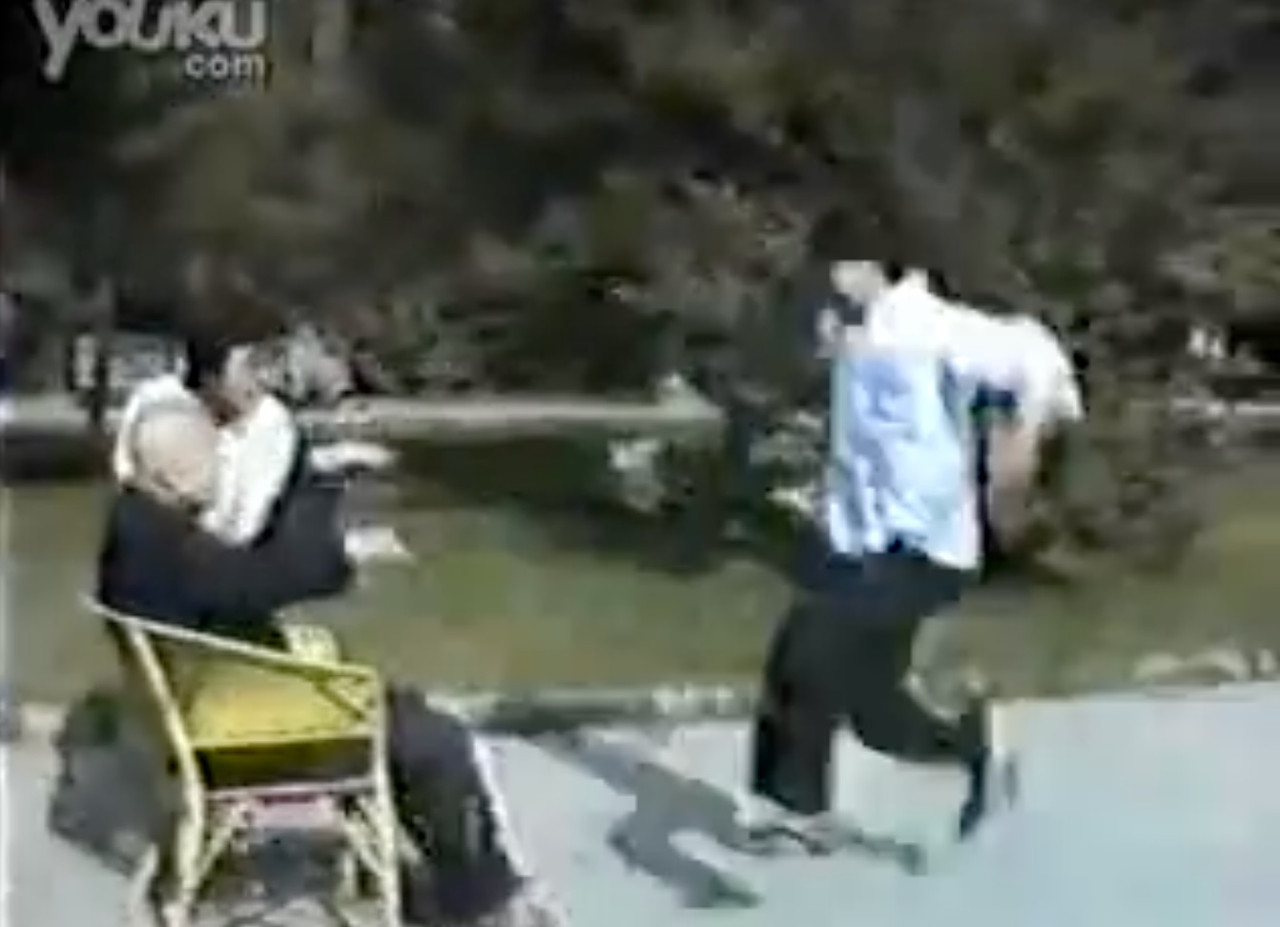
Wang Yongquan , the other is reacting to what he feels.
Wang Yongquan’s approach appears to operate on a different level.
Whether sitting or standing, the outcome would be fundamentally the same. Standing does not increase the effect, just as sitting does not reduce it. This suggests that the mechanism is not driven by external kinetic chains or posture-dependent force, but by internal structural reorganization and center-based interaction.
The resulting effect does not necessarily depend on a visible or fully developed kinetic chain.
In that sense, “wave mechanics” may be a more accurate way to describe what is happening.
In my own practice, what I experience aligns more closely with that second view. Instead of feeling like power is being sent through a chain, it feels like the opponent’s center and balance are being shifted so that their own structure generates the movement. When we say “power must go up before it goes forward,” that’s true within a kinetic model, it may not be able to describe how Taiji operates in all cases.
Last edited:


