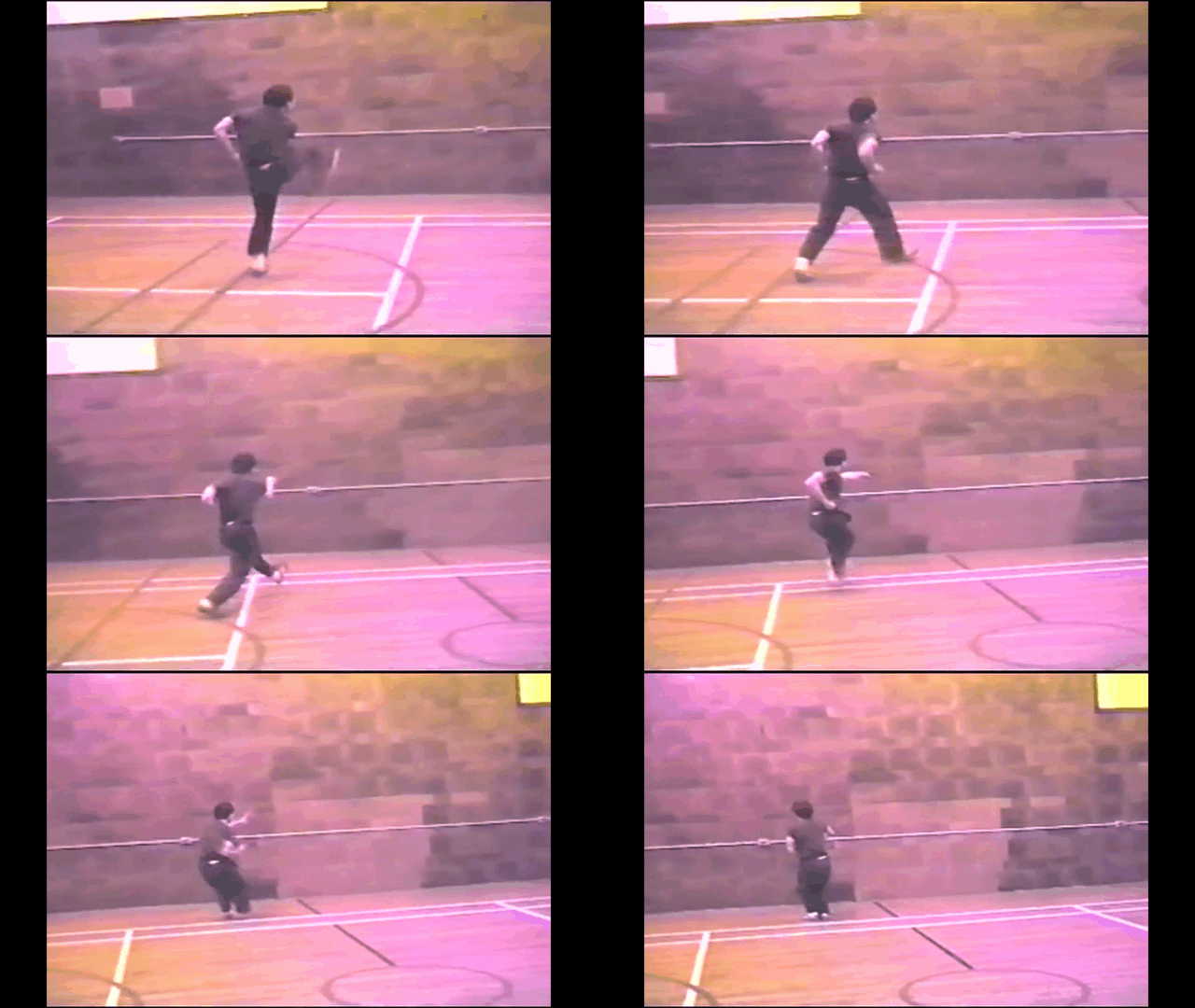
What I see when I do my forms.

If you train this way, you can only feel that power come from your hip and then reach to your fist. You won't feel that power come from your foot and then reach to your fist.

In other words, your legs are not part of the power generation process. If power come from bottom -> up, your bottom should be your foot and should not be your hip.

This may make the beginner's training a bit easier. But the beginners won't get the full power generation picture.
Joe Schilling, a MMAist, performs similar to repulse monkey while using rear hand for power. Joe’s movement…
  1. coordinates elbow and knee and hand and foot.
  2. uses economy of movement.
  3. creates space by stepping back into bow stance.
  4. uses rear hand power.
 
Power generation using small movement.
I think this is one of the things that differentiate styles. It's related to that style's doctrine of fighting range and main method of power generation. Traditional Okinawan karate is close range. The puzzle is how to get power without a big step or long extension of the attacking arm/leg to build momentum. In my style it's by chinkuchi in which hips play a role. There are a couple of other elements in close range power generation involved but they are hard to describe.
 
I think this is one of the things that differentiate styles. It's related to that style's doctrine of fighting range and main method of power generation. Traditional Okinawan karate is close range. The puzzle is how to get power without a big step or long extension of the attacking arm/leg to build momentum. In my style it's by chinkuchi in which hips play a role. There are a couple of other elements in close range power generation involved but they are hard to describe.
Static punch and running punch are different. If you look at this video, between his 1st right punch and his 2nd right punch, there are footwork involved. This is what I call "3 steps 1 punch".

 
Do you agree that punching power should include "leg spring - bend knee -> straight knee"?

One method is external, the other internal ..Different theories.
I can do, did do, what you have done
Can you say the same ?

You've made a point of saying there is no distinction...
Not an issue, thats your experience

Mine and others are different


I think this is one of the things that differentiate styles
A little more then that...
as mentioned not really the topic of this thread...

640-1.jpeg


The moment sum of the moment at a certain point is zero, that is,
the principal moment of the force system to a certain point is zero.
 
Off topic

a question answered.


does "internal" power generation theory require "knee bend -> knee straight"? If the answer is no, why?


no

Knee straight or bent has nothing to do with
the type of power that taiji develops


ę±Ŗę°øę³‰ęŽˆę„Šå¼å¤Ŗę„µę‹³čŖžéŒ„åŠę‹³ē…§
Wang Yongquan Writings on Yang Style Tai Chi Chuan


č¦å…Øčŗ«ē„”äø€č™•åƒµę»Æļ¼Œē„”äø€č™•åˆ„ę‰ę‰­ć€äøå¾—å‹ć€‚
ē·“ę‹³č¦å…Øčŗ«ę”¾é¬†ć€ē„žčˆ’ļ¼Œåæƒęƒ…ę”¾é¬†ļ¼Œę‚ ē„¶č‡Ŗå¾—ļ¼Œč‡Ŗęˆ‘ę¬£
č³žļ¼Œč‡Ŗå¾—å…¶ęØ‚ļ¼Œå®‰é€øć€å¾—ę„ć€åæƒé‡Œē¾Žę»‹ę»‹ēš„ļ¼Œé¢åø¶ē¬‘å®¹ć€‚
ē·“ę‹³č¦č‡Ŗå·±ę„Ÿåˆ°åæƒé‡Œē¾Žļ¼Œåˆ„äŗŗēœ‹č‘—ä¹Ÿē¾Žć€‚

The body must not be stiff, nor twisted, nor rigid.
Your entire body must be 鬆 (Soong / ā€˜relaxed’), your ē„ž (Shen / spirit) restful, your mind is
tranquil and relaxed. Leisurely and unhurried.
Enjoy the moment, feel confident, bring out your smile.
If you feel graceful and beauty within, other people will also see the gracefulness


The theory


äø€čˆ¬ē†č§£ļ¼Œę‰€č¬‚å‹å…’ļ¼Œę˜ÆęŠŠęœ¬čŗ«ēš„ē„žć€ę„ć€ę°£é›†äø­åˆ°äø€é»žäøŠļ¼Œå†ęŠŠé€™å€‹é»žé‹ē”Øåˆ°ęŸå€‹å§æå‹¢äøŠ
åŽ»ć€‚ē¶“éŽé•·ęœŸēš„é›ē…‰ä»„å¾Œļ¼Œå°±ęœƒé€ę¼øę““å¤§å¢žé•·čµ·ä¾†ļ¼Œč®Šęˆäø€ēØ®åŠ›ć€‚é€™ēØ®åŠ›ę˜Æē¶“éŽé›ē…‰å–å¾—ēš„ļ¼Œ
ę˜Æå¾Œå¤©ä¹‹ę‹™åŠ›ć€‚é€™ēØ®åŠ›å½¢å¼å¤§ć€å‹•é‡ę»Æć€č®Šę›é²ć€å‹•ēš„åŽ»č·Æē›“ļ¼ŒåœØęŠ€ę“Šę–¹é¢ē”Øčµ·ä¾†ļ¼Œå› čŗ«å½¢å‹•
ä½œå¤§ļ¼Œé‹å‹•é‡č¼ƒå¼·ļ¼Œå› ę­¤å½±éŸæå…§ę°£ēš„ę³¢å‹•ļ¼Œę˜“ę–¼ęµ®čŗć€‚é€™čæ‘ę–¼é•·ę‹³ēš„ē·“ę³•å’Œč¦ę±‚ć€‚


Generally understood, the so-called jin (劲) is the concentration of one's spirit, intent, and qi (energy) into a single point, which is then applied to a specific posture. After long-term training, this jin gradually expands and grows, becoming a form of force. This force is acquired through training and is considered an acquired or developed strength. This form of strength is characterized by its large form, slow momentum, delayed changes, and straight trajectory. In the context of martial arts, using this strength involves large body movements and strong exertion, which can affect the fluctuation of internal qi, making one prone to restlessness. This approach is similar to the training methods and requirements of long fist (长拳).

this method describes what is shown in the video....
The mind can not go beyond the bricks being held in the hands.
What is developed is different

"wrong" or "right"
depends on theory followed


åˆē·“å¤Ŗę„µę‹³ēš„äŗŗč¦ŗå¾—å¤Ŗę„µę‹³ēš„ē·“ę³•čˆ‡äøŠé¢ēš„ē·“ę³•ē›øä¼¼ļ¼Œå…¶åÆ¦äøē„¶ć€‚å¦‚ęžœęŒ‰ē…§å¤Ŗę„µę‹³ēš„ē†č«–č¦ę±‚
ļ¼Œē¶“éŽäø€ę®µę™‚é–“ēš„é›ē…‰ļ¼Œé€ę¼øęŠŠē†č«–čˆ‡å§æå‹¢ēµåˆčµ·ä¾†ļ¼Œå°±ęœƒå¾ˆę˜Žé”Æåœ°ę„Ÿč¦ŗå‡ŗä¾†ļ¼ŒäøŠé¢ēš„ē·“ę³•å’Œ
č¦ę±‚ę˜Æčˆ‡å¤Ŗę„µę‹³äøåŒēš„ć€‚ē·“ēæ’å¤Ŗę„µę‹³ēš„č¦ę±‚ļ¼Œę˜ÆęŠŠęœ¬čŗ«ēš„ē„žć€ę„ć€ę°£åŒ–åˆę­øäø€
ļ¼ŒčžåˆåœØäø€čµ·ļ¼Œ
å½¢ęˆäø€ēØ®č¼•éˆåœ“ę“»ä¹‹å‹å…’ć€‚é€™ēØ®å‹å…’ę˜Æä»„ę°£ć€ę„ę··ä¹‹ē‚ŗäø»ć€‚å®ƒēš„ęœ¬č³Ŗę˜Æę°£ļ¼Œå°å®ƒēš„č¦ę±‚ę˜Æē©ŗć€
č™›ć€ę•£ļ¼Œč€Œäøę˜Æé›†čšēš„ć€‚é€™å°±ę˜Æå¤Ŗę„µå‹å…’ļ¼Œåˆå«åšå…ˆå¤©å‹å…’ć€‚

When beginners practice Taiji, they may feel that the training method of Taiji is similar to the previously mentioned methods. However, this is not the case. According to the theoretical requirements of Taiji, after a period of training, gradually combining theory with posture, it becomes very apparent that the previous training methods and requirements are different from those of Taiji. The requirements for practicing Taiji involve the unification of one's spirit, intent, and qi, merging together to form a kind of light, agile, and circular force (jin). This force is primarily based on the blending of qi and intent. Its essence is qi, and the requirements for it are to be empty, void, and dispersed, rather than concentrated. This is known as Taiji jin, also called innate jin.

Takes a lot of time, with those that have reached the skill sets to clearly show what is different.

note:

Questions along this line will not be responded to
by me. in this thread.

Feel it's off topic...a disservice to the OP
 
Last edited:
The puzzle is how to get power without a big step or long extension of the attacking arm/leg to build momentum.
I think every system has this puzzle. I'm sure they had large crowds back where fights broke out in restaurants or shops on a crowded street where there was limited space, or at a sporting event. If my punches are only strong if I take a step forward then I'm at a disadvantage when there is not enough space to take that step forward.
 
If my punches are only strong if I take a step forward then I'm at a disadvantage when there is not enough space to take that step forward.
You can always punch when you

- step back,


- or just sink your body back without moving your feet.

 
What's your opinion about "stay in horse stance and doing multiple punches without moving the legs"? The reason I ask is because there is "elbow and knee coordination" issue. If my elbow is moving but my knee is not moving, I can't feel the energy that transfer from my heel all the way up to my fist.

In Gong Li Quan at 0.01 - 0.10, there is punch from horse stance. But it's just 1 punch and then switch into bow-arrow stance. You can see the elbow and knee coordination there - Elbow and knee start to move at the same time. Elbow and knee stop at the same time.

The way I see it, at least when we do this in karate, it's there to practise the hand motion of the punch in isolation and it's also useful for conditioning. Doing 300 triple punches in horse stance will get you winded and strengthen your legs as a side effect, but when you then add the waist and leg motion in later exercises, you have a functional punch. That's almost all it's there to do.
 
Also, to be absolutely fair, there are better ways of doing this. When I was doing MMA, I was taught a simple set of exercises that starts with simply rotating your waist keeping your arms out of the picture, then slowly adding all the other integral parts to the punch. I learned faster and the resulting punches were stronger. There's a reason why we call it throwing a punch- it's a rotational motion with the arms as simply the means to transmit the power.
 
Mind you, what I didn't get across is that it's an explosive rotational motion, so those big obliques you built doing Russian twists or my relatively puny ones I build doing Turkish getups will only be of any use to you if you also actually use them to hit things.
 
The elbow and knee coordination are one of my favor subjects. So far, I have not heard many different opinions yet.

It's clear to see that this training can make a beginner to feel that power come from his foot and all the way up to his fist.

- Elbow bend and knee bend.
- Elbow straight and knee straight.

Is that the same as "don't care"?

Do you agree that punching power should include "leg spring - bend knee -> straight knee"?
You can always punch when you

- step back,

In your video, 6 Harmony Praying Mantis does not use "leg spring - bend knee -> straight knee.ā€ Do you agree that they should follow your 6H interpretation and straighten knee?
 
When you have different way, you still need to have a reason why. As long as your reason is logic, people can agree with your difference.

There are only 3 options here.

1. Elbow and knee coordinate is needed. My reason has been given.
2. Elbow and knee coordinate is not needed. What's your reason?
3. You don't care one way or another. What's your reason?

Is there a 4th option besides

1. truth,
2. false,
3. don't care?
Things don’t need to move in the same range in order to be coordinated, they only need to be activated. Exaggerating the concept into an overtly visible motion does not lend any validity to the concept itself. The airplane wing doesn’t need to flap like a bird to create lift, it just needs to be connected to the rest of the plane as it moves. I don’t need to visibly round my back to create Peng. I can still activate the ankle to feel root and force generation while in a deep Ma Bu. I can still coordinate my knee with my elbow while one is bent and other is straight. Where you show them straighten the knee and ā€œpushā€ against the ground to punch, I will have them bend the knee and ā€œpullā€ against the ground to punch. That is still coordinating, just not the way you do it. Since I’m already down and pulling, you may not see much motion in the leg when I’m down and pulling with the leg to punch. Since this is my practice, I can move from the position and stay down. Will you need to stand straight up in order to straighten your knee for a punch to full extension? We have discussed this before.
 
Also, to be absolutely fair, there are better ways of doing this. When I was doing MMA, I was taught a simple set of exercises that starts with simply rotating your waist keeping your arms out of the picture, then slowly adding all the other integral parts to the punch. I learned faster and the resulting punches were stronger. There's a reason why we call it throwing a punch- it's a rotational motion with the arms as simply the means to transmit the power.
I don’t like the word ā€œthrowingā€ the punch, I use ā€œshootā€ the punch for this exact reason you describe.
 
In your video, 6 Harmony Praying Mantis does not use "leg spring - bend knee -> straight knee.ā€ Do you agree that they should follow your 6H interpretation and straighten knee?
To be fair, I don’t agree with that interpretation of 6h.
 
In your video, 6 Harmony Praying Mantis does not use "leg spring - bend knee -> straight knee.ā€ Do you agree that they should follow your 6H interpretation and straighten knee?
I'm talking about "freeze the legs and throw multiple punches" that elbow and knee have no coordination.

If you only throw 1 punch at any stance, when you throw next punch, you have to change stances. You may not bend knee -> straight knee, but your knees have to coordinate with your elbow.

 
motion of the punch in isolation and it's also useful for conditioning. Doing 300 triple punches in horse stance will get you winded and strengthen your legs as a side effect, but when you then add the waist and leg motion in later exercises, you have a functional punch. That's almost all it's there to do.
IMO, body coordination training should start on day one. Any further delay may cause more problem in the future.
 
Back
Top