

Branko Knezevic28 9
Yellow Belt
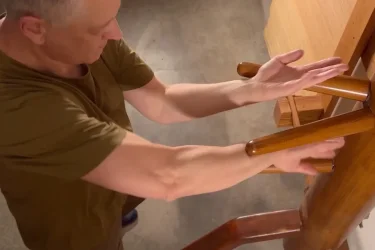
Martial arts have traditionally passed from teacher to student through observation, imitation, correction, repetition, and physical contact. A student does more than memorize movements. Through practice, the student gradually develops coordination and perception that words alone cannot convey.
Video offers a way to preserve and share wooden dummy training, but recording a movement does not necessarily transmit the knowledge within it. We can see where an arm ends up while missing what happened at the point of contact, how force changed direction, or how the body supported the transition.
Movements such as Tan, Bong, Fok, and Man give us a vocabulary. To understand them, we must also study how one movement becomes another while contact continues. Those relationships form a kind of movement grammar.
Movements provide the vocabulary.
Transitions provide the grammar.
Continuous practice develops fluency.
The wooden dummy is a reference tool for developing this fluency. It gives the student a consistent structure through which to explore contact, angles, force, and coordination. It is not a substitute for a training partner, and its arms do not dictate a fixed response to an opponent.
Structured video instruction can show the sequence and draw attention to details that are easy to miss. Beginning with one arm, then working with two arms, and eventually practicing the complete form gives the student a path for developing these relationships. But the student must still practice and feel what changes through contact. That is where visible instruction begins to become personal knowledge.
To transmit wooden dummy training through video, we must do more than preserve the appearance of techniques:
Preserve the movement.
Explain the relationship.
Develop the perception.
Transmit the principle.
What deserves to be passed on is the knowledge contained within the movement.


