Instead of learning technique from form/Kata, why don't you create it by common sense?

Kung Fu Wang115 145

Sr. Grandmaster
MT Mentor
You can learn a technique from a form/Kata. You can also create a technique from your common sense. Which way is better?

For example, a jab-jab-cross (or jab-jab-hook, jab-jab-uppercut, jab-jab-overhand, ...) can be a technique that you can create from your common sense. Those punching combos may not exist in your MA system. But you know it works very well in fighting.

Do you really need a teacher to teach you jab-jab-cross (or jab-jab-hook, jab-jab-uppercut, jab-jab-overhand, ...)?

If you ask your MA teacher, "Why jab-jab-cross combo doesn't exist in our MA system"? What do you think his answer will be?
 
Last edited:
I think there's a difference between "technique", "combination", and "concept". I think it's difficult for most people to create a technique from common sense, but easy to create a combination, especially given the concept of how to build combinations.

I think martial arts is best when you start off by learning foundations, such as different techniques in striking or different positions in grappling, and slowly move towards a more conceptual understanding.

For example:
  • You may learn combination of jab-cross, jab-uppercut, jab-overhand. Then you learn the concept of using the jab to bait their guard, and then preparing to attack the holes in that guard next time you jab.
  • You may learn a technique in BJJ such as a flower sweep. You find yourself in a different position but with similar grips and leverage, so you apply the concepts of the flower sweep even though it's not specifically the technique you were taught.
 
you learn the concept of using the jab to bait their guard, and then preparing to attack the holes in that guard next time you jab.
The moment that you understand how to use "jab to bait their guard", the moment that you can be your own teacher after that day.

IMO, MA is a research task and not just a learning process from a teacher. A teacher may help you to start your lifelong MA path. You have to finish it all by yourself.
 
Last edited:
If you ask your MA teacher, "Why jab-jab-cross combo doesn't exist in our MA system"? What do you think his answer will be?
I have a question for my English teacher from high school. We went through the entire English Grammar book... I looked for these words: Martial Arts, Karate, Kung Fu, Judo, Jujitsu... but those words were not in the grammar book at all. Therefore, those words must not be words in the English language. So, how is it possible that we can communicate in English about these words, when these words were never included in an English Grammar book? After all, if a word is not included in the English Grammar book, it is not an English word and cannot be used when one is speaking English.
 
I have a question for my English teacher from high school. We went through the entire English Grammar book... I looked for these words: Martial Arts, Karate, Kung Fu, Judo, Jujitsu... but those words were not in the grammar book at all. Therefore, those words must not be words in the English language. So, how is it possible that we can communicate in English about these words, when these words were never included in an English Grammar book? After all, if a word is not included in the English Grammar book, it is not an English word and cannot be used when one is speaking English.
At this point, I think a lot of these words are in the English language. For example, a while ago I looked at several dictionaries for the words "gi" and "dojo", and more often than not it was included in an English dictionary.

In the same way that many other English words came from German, Spanish, French, etc., I think at this point some very common martial arts words are effectively English words.

Some people in Taekwondo get very offended and think you're a fraud if you use the Japanese terms (i.e. Gi instead of Dobok, Dojo instead of Dojang). But I think that's just using the local term. Ask 99% of Americans what a dojang is and most of them won't have a clue. Ask them what a dojo is, and they'll know it's a place to train martial arts.
 
At this point, I think a lot of these words are in the English language. For example, a while ago I looked at several dictionaries for the words "gi" and "dojo", and more often than not it was included in an English dictionary.

In the same way that many other English words came from German, Spanish, French, etc., I think at this point some very common martial arts words are effectively English words.

Some people in Taekwondo get very offended and think you're a fraud if you use the Japanese terms (i.e. Gi instead of Dobok, Dojo instead of Dojang). But I think that's just using the local term. Ask 99% of Americans what a dojang is and most of them won't have a clue. Ask them what a dojo is, and they'll know it's a place to train martial arts.
But, you are talking about a dictionary, not a grammar book. That is my point, kata / forms are not a dictionary of all the techniques that comprise an art. Kata / forms are a grammar book that describe rules, the principles, the ideas that define the art. When you understand the rules, the principles, the ideas... you can use any technique at all, and the idea is to increase your vocabulary, not restrict it to only the words found in the grammar book.

Example: your art does not have to have a kata or form containing: jab-jab-cross in order for someone to use that combination as part of that art.
 
But, you are talking about a dictionary, not a grammar book. That is my point, kata / forms are not a dictionary of all the techniques that comprise an art. Kata / forms are a grammar book that describe rules, the principles, the ideas that define the art. When you understand the rules, the principles, the ideas... you can use any technique at all, and the idea is to increase your vocabulary, not restrict it to only the words found in the grammar book.
Yes, too a large extent, TMA forms transmit principles and ideas that define the art. While they do contain a wide variety of techniques that can be used singly or in combinations as needed, the main thing they transmit is how to use them situationally, against specific attacks, quite often against an arm grab, choke, or similar type of attack and sometimes against a kick or punch.

I know no kata that has a 3-punch combination, and one would be hard-pressed to find one in any traditional form, especially Okinawan. This doesn't mean they shouldn't be used in fighting - one should certainly drill them. I think this is a given by experienced practitioners. They are much used in competition and slugging it out in the street. But kata has the purposes as described above: Principles and set responses (which can be modified to fit exact circumstances) to specific attacks.

In traditional karate, these responses include grabs, breaks, vital point attacks and low kicks, so three punches in a row are not often seen. Karate (as portrayed in kata) instead favors these other responses to be used whenever and as soon as possible.

Rather than kata containing a series of individual notes, they contain a series of chords.
 
I know no kata that has a 3-punch combination, and one would be hard-pressed to find one in any traditional form, especially Okinawan.
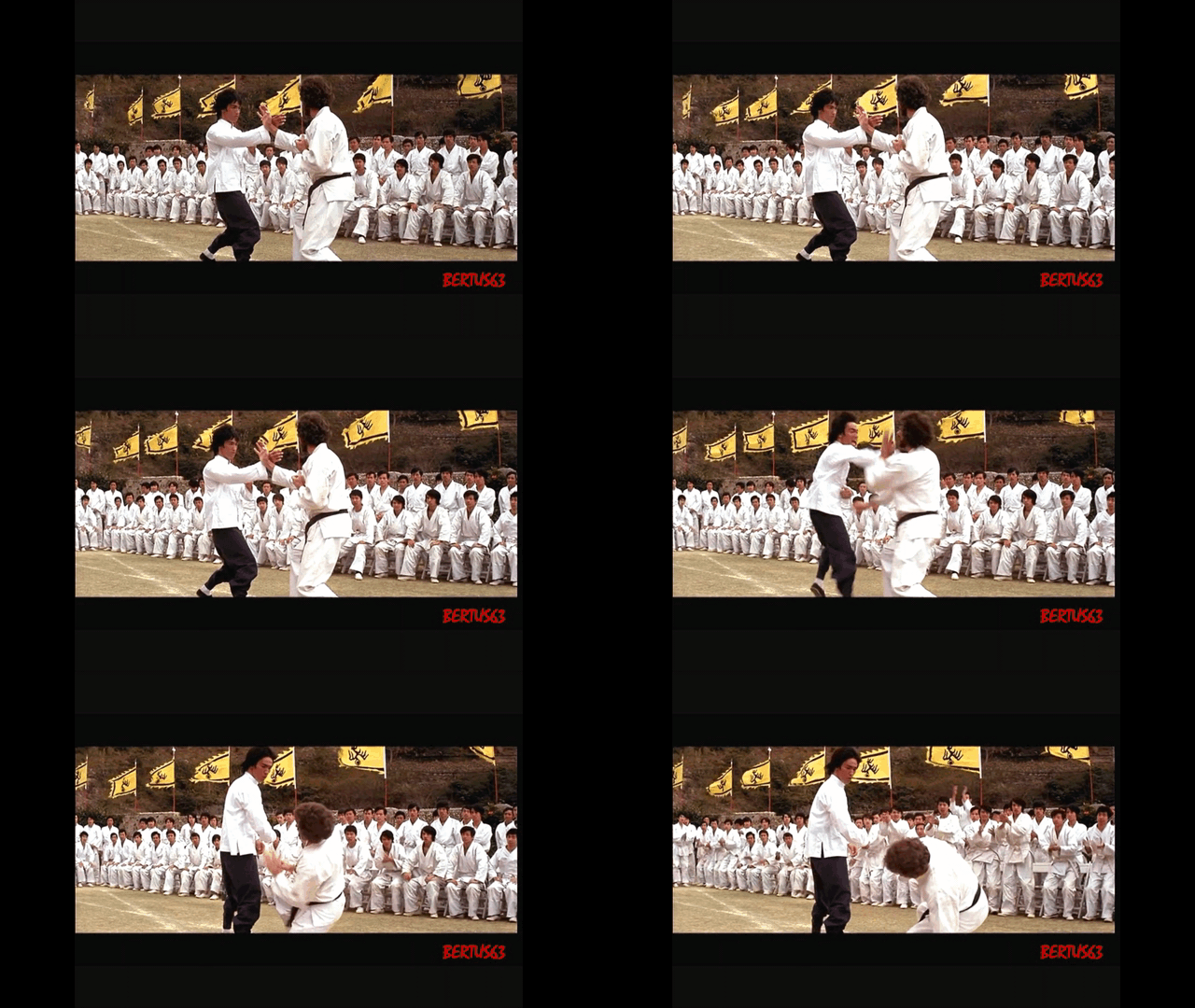
The "switch hands" concept exists in almost all CMA systems.

- You throw a right punch (1st punch), your opponent blocks it.
- You use left hand to remove your opponent's blocking arm (2nd block).
- Your free right punching arm can strike again (3rd punch).

Since you are pretty sure that your opponent will block your 1st punch, you won't commit 100% on it. You use your 1st punch to set up your 3rd punch instead.

Of course, if your opponent blocks your 3rd punch, your 4th blocking hand will take over, and continue with your 5th striking hand again. So, a 3 moves combo can be extended into 5 moves combo, 7 moves combo, ...

I like this strategy. This is the perfect missing link between the striking art and the throwing art - punch -> grab -> pull.

This video is a perfect "switch hands" example. the 1st punch is the arms contact instead.

 
Last edited:
You can learn a technique from a form/Kata. You can also create a technique from your common sense. Which way is better?

For example, a jab-jab-cross (or jab-jab-hook, jab-jab-uppercut, jab-jab-overhand, ...) can be a technique that you can create from your common sense. Those punching combos may not exist in your MA system. But you know it works very well in fighting.

Do you really need a teacher to teach you jab-jab-cross (or jab-jab-hook, jab-jab-uppercut, jab-jab-overhand, ...)?

If you ask your MA teacher, "Why jab-jab-cross combo doesn't exist in our MA system"? What do you think his answer will be?
I feel for the the average masses, this will never work well. Most everyone needs some degree of life experience or training to learn. Yes, there will always be prodigies that can create their own thing(s), but they are definitely in the minority.
How/why would a person desire to learn if they were unaware of any reason to do so?
 
How/why would a person desire to learn if they were unaware of any reason to do so?
If you spar 15 rounds daily, after 3 years, will you be able to tell which MA techniques are useful and which MA techniques are not?
 
The first principle of kung fu should be honesty. May people do not train honesty. in bruce lee's clip, there is honesty (gong = truth).

What is honesty and how do you train it? When we cross arms to train, at that moment my opponent starts pushing, so I yield. Later, when it is time to deflect, he changes the angle of his push to match my rotation, often demanding that I turn my waist, use less force, etc. This is a kind of bullying. That is a good example of dishonesty.

In the bruce lee clip, bruce lee is honest, as is his student. The two kinds of honesty are honesty in reality (shown in the clip) and the training of honesty (in the practice of wu de).

This leads to situations like the master crying on his deathbead that he failed to teach his student properly, and now it is too late. There is honesty in reality (the student didn't abandon the master) and there is honesty in training (the master is crying because he realised the student's wu de is higher than his).
 
Yes, too a large extent, TMA forms transmit principles and ideas that define the art. While they do contain a wide variety of techniques that can be used singly or in combinations as needed, the main thing they transmit is how to use them situationally, against specific attacks, quite often against an arm grab, choke, or similar type of attack and sometimes against a kick or punch.

I know no kata that has a 3-punch combination, and one would be hard-pressed to find one in any traditional form, especially Okinawan. This doesn't mean they shouldn't be used in fighting - one should certainly drill them. I think this is a given by experienced practitioners. They are much used in competition and slugging it out in the street. But kata has the purposes as described above: Principles and set responses (which can be modified to fit exact circumstances) to specific attacks.

In traditional karate, these responses include grabs, breaks, vital point attacks and low kicks, so three punches in a row are not often seen. Karate (as portrayed in kata) instead favors these other responses to be used whenever and as soon as possible.

Rather than kata containing a series of individual notes, they contain a series of chords.
Not exactly three punch combinations as KFW seemingly mean, but there are quite some 1..2.3 rhythm combinations, already to be learned about in the Heian/Pinan katas(primary stage forms)

.
 
If you spar 15 rounds daily, after 3 years, will you be able to tell which MA techniques are useful and which MA techniques are not?
You have lost me. If a person is already able to spar, then they obviously are at least aware of at least some aspects.
 
You have lost me. If a person is already able to spar, then they obviously are at least aware of at least some aspects.
When talking about "create by common sense", we are not talking about beginners. We are talking about someone who has many years of MA training/knowledge.
 
This leads to situations like the master crying on his deathbead that he failed to teach his student properly, and now it is too late. There is honesty in reality (the student didn't abandon the master) and there is honesty in training (the master is crying because he realised the student's wu de is higher than his).
If a teacher taught his student A and B but without C, his student later on figured out C by himself. That's very normal. A teacher can only help a student to start. That student has to continue and finish his MA journey by himself.
 
If a teacher taught his student A and B but without C, his student later on figured out C by himself. That's very normal. A teacher can only help a student to start. That student has to continue and finish his MA journey by himself.
I think the issue is more that the teacher taught the student A, B and C... as 3 separate techniques to be memorized.... and never taught the student to dive deep into those techniques to see what can be learned.... never taught the student the how and why these techniques are important.... never gave the student the tools to truly study on their own.

I see way too many students memorizing a kata, thinking that memorizing is mastering, and then moving on to the next. They always need more katas to memorize, with more techniques to memorize... never stopping to dive into the things they have already memorized. I see way too many teachers being happy that they have essentially taught their student to line dance without music.... with no martial understanding of anything they are doing. The sad part is, that many of these people have no idea that they were supposed to study the thing that they merely memorized... they think that if the memorize enough things, that the magic will happen.... To this end, they are always looking for more katas and more techniques, and being dissatisfied when the new kata just contains a collection of old techniques in a new order....

The true magic happens when you realize how much is actually inside any one kata and even inside any one technique. When you get past the kata being: step into stance A while making hand go from point 1 to point 2... and see all the things taught in those motions, and realizing that once you start figuring those out, there are more just beyond... again and again... That is when the magic happens. This is when you start to understand what you have been practicing and you realize how little you actually know of those first kata that you learned. All of a sudden, you have a lot more to learn.
 
I think the issue is more that the teacher taught the student A, B and C... as 3 separate techniques to be memorized.... and never taught the student to dive deep into those techniques to see what can be learned.... never taught the student the how and why these techniques are important.... never gave the student the tools to truly study on their own.
You are absolutely right on this.

All those fancy moves in those CMA forms are all "switch hands". If a teacher can honestly tell his students that there are only 3 categories of techniques in the striking art such as:

1. Block and punch at the same time (WC system emphasize on this).
2. Dodge (without block) and punch at the same time (boxing emphasize on this).
3. Switch hands (long fist, praying mantis, Taiji, Bagua emphasize on this).

Students can understand the striking art much clearly.

This fancy Taiji moves is just another "switch hands".

- Right back fist.
- Left hand takes over opponent's block.
- Right hammer fist again.

 
The true magic happens when you realize how much is actually inside any one kata and even inside any one technique.
You are also correct on this. Some MA teachers do not explain the detail of application in MA forms. In long fist, there is a walking that may look funny. What people don't know is, when you use the long fist walking to escape, you suppose to kick the dirt back at your opponent's face. Since your footwork include dirt back kicking, it just looks funny.

Believe it or not, this move in the video is to pull out a dagger from your boots and then stab it into your opponent's chest.

 
When talking about "create by common sense", we are not talking about beginners. We are talking about someone who has many years of MA training/knowledge.
I would argue than we are not "creating by common sense".

But, as to your example. of a "jab/jab/cross". You wouldn't find that combo in a form/kata because the context is completely different than what those were created for. Forms and kata were created for civilian self-defense and not a sporting competition. A competition (even an ego fight) has a different distancing and uses different tools and strategies.

Here's an example. Let's say that new MMA rules are introduced. Roles are assigned by a flip of a coin. "Heads" and the job of the person is to keep his opponent IN the cage. The cage has an open door to it. "Tails" has to get out of the cage as quickly as possible in order to win. Both parties will switch roles for a number of equal rounds. The winner is the person who could hold the other person in the cage the longest AND escape the fastest.

In what ways would current boxing techniques and strategies change?
 
Forms and kata were created for civilian self-defense and not a sporting competition.
How do you train "civilian self-defense"? You find a training partner and spar for 10,000 rounds. When you spar, you are doing "sport competition".

After you have sparred 10,000 rounds, you will find out that your first punch will have 75% of chance to be blocked by your opponent. You then won't throw your 1st punch 100%. You start to use your 1st punch to set up your 2nd punch. You then start to train jab-jab as "common sense".
 
Back
Top