Ecological Training / Game-based Training

Alchemist

White Belt
A big trend these days in BJJ is "Ecological" training, basically using games to specifically train certain positions or techniques. It comes in multiple forms, but in general it focuses more on live work rather than drilling, the theory being that you learn better that way.
An example is if you are training Triangles, the game would be that you are only allowed to strangle with your legs. Or if you're training back takes, the game would be no submissions and taking the back means you win. That's pretty simple, but some schools have gone really far with it to the point of never drilling at all.
What are your thoughts on this game-based training? I personally enjoy it, but my school does still drill a little bit even after we started trying out the games and I think that blend is a good way to do things.
 
I think mixing both is the best way to go. The way we do it at my school is technique, then positional rolls, then live rolls.

I do wish we did a little bit more specific constraints in the constraints-based approach, but overall it seems to work pretty well.
 
I think mixing both is the best way to go. The way we do it at my school is technique, then positional rolls, then live rolls.

I do wish we did a little bit more specific constraints in the constraints-based approach, but overall it seems to work pretty well.
I find constraints really help me learn, even when I just started and we went live I would limit what I allowed myself to do so I could focus on a specific thing and it's worked so far.
My favorite game is "Snap, Grab, or Throw" where we stand and either Snap, make our partner go on all fours with a Snap Down, Grab, lock our hands around their waist or head and arm or leg, or Throw, just throw them like in Judo. I also like Stand Up, where one person starts in Turtle and the other person starts in Referees' and the goal is for Turtle to stand up and the other guy has to not let them, no submissions allowed.
I've noticed we've all gotten a lot better at standing wrestling and escaping with those games, much quicker than when we were drilling more.
However, in certain more nuanced areas drilling is still really important to understand the finer details of something.
 
Do you train hip throw, single leg, double legs, ... in BJJ? If you do, can you master those take downs without going through partner drill?
We do, we are a school with more wrestling involvement, and the way we train takedowns is we drill for a little bit so everyone gets the idea and then we go live with the games. The professors go around and give pointers as we go live so it’s not just flailing around hoping you’re doing it right.
 
We do, we are a school with more wrestling involvement, and the way we train takedowns is we drill for a little bit so everyone gets the idea and then we go live with the games. The professors go around and give pointers as we go live so it’s not just flailing around hoping you’re doing it right.
All throwing art systems train this way, partner drill + live wrestling.


For those not familiar with ecological drills, I'll give a bit more detail.

The idea is not just "live rounds". The idea is to create competitive "games" where the participants are given certain constraints and have to focus on accomplishing some specific task within those constraints, without instruction on a particular way to accomplish that task. One benefit is that you can take a complex skill like throwing an opponent or passing their guard, and break it down into a bunch of mini-games and let the students explore all the possibilities within each step of the process.

For example ...

Suppose you want your students to get better at the single leg takedown. You could have them work on a bunch of interrelated games, as follows:
  1. Hand fighting. No takedowns allowed, both partners are just looking to establish superior grips on their partners hands, wrists, neck, or body, and maintain them as long as possible.
  2. Leg tag. Both partners try to touch one of the other person's legs without having their own touched.
  3. Leg pickup. Both partners try to pick one of the other person's legs off the ground without having their own picked up. No takedowns.
  4. Finishing part one: One partner starts having already picked up the other person's leg. Partner A tries to finish a takedown. Partner B tries to get both feet down to the mat and break free.
  5. Finishing part two: Partner B allows partner A to finish a single-leg takedown. Immediately upon hitting the mat, partner B tries to either establish guard or scramble to their feet. Partner A tries to establish a pin without allowing B to get guard or stand up.
I'm a fan of ecological games. However, I'm not in agreement with the most zealous advocates who think they can completely replace instruction and drilling. I think that approach is essentially asking students to reinvent the art from scratch and is inefficient, particularly for beginners and those who are not naturally gifted.

My preferred use for the games is in polishing a subject where my students have already at least a little introduction to the techniques in question. I can break down the position into these smaller games, observe where people are having the most problems, then offer a suggestion or two to give them a direction to explore and work through their difficulties.
 
I'm a fan of ecological games. However, I'm not in agreement with the most zealous advocates who think they can completely replace instruction and drilling. I think that approach is essentially asking students to reinvent the art from scratch and is inefficient, particularly for beginners and those who are not naturally gifted.

My preferred use for the games is in polishing a subject where my students have already at least a little introduction to the techniques in question. I can break down the position into these smaller games, observe where people are having the most problems, then offer a suggestion or two to give them a direction to explore and work through their difficulties.
We used to have a coach who heavily favored eco, who would run a few classes per week. I think it was nice having drills Monday through Wednesday and Eco Thursday and Friday.
 
Can someone explain the name to me? Ecosystems are like deserts or forests or ocean waters... so wouldn't "ecological" be something to do with an ecosystem?
 
Can someone explain the name to me? Ecosystems are like deserts or forests or ocean waters... so wouldn't "ecological" be something to do with an ecosystem?
I think it's because the individual interacting with the environment, in this case the environment is the constraints games you're placed in. For example, instead of doing drills that operate like a laboratory setting (where all factors are controlled), you're operating in a more open environment.
 
to focus on accomplishing some specific task within those constraints,
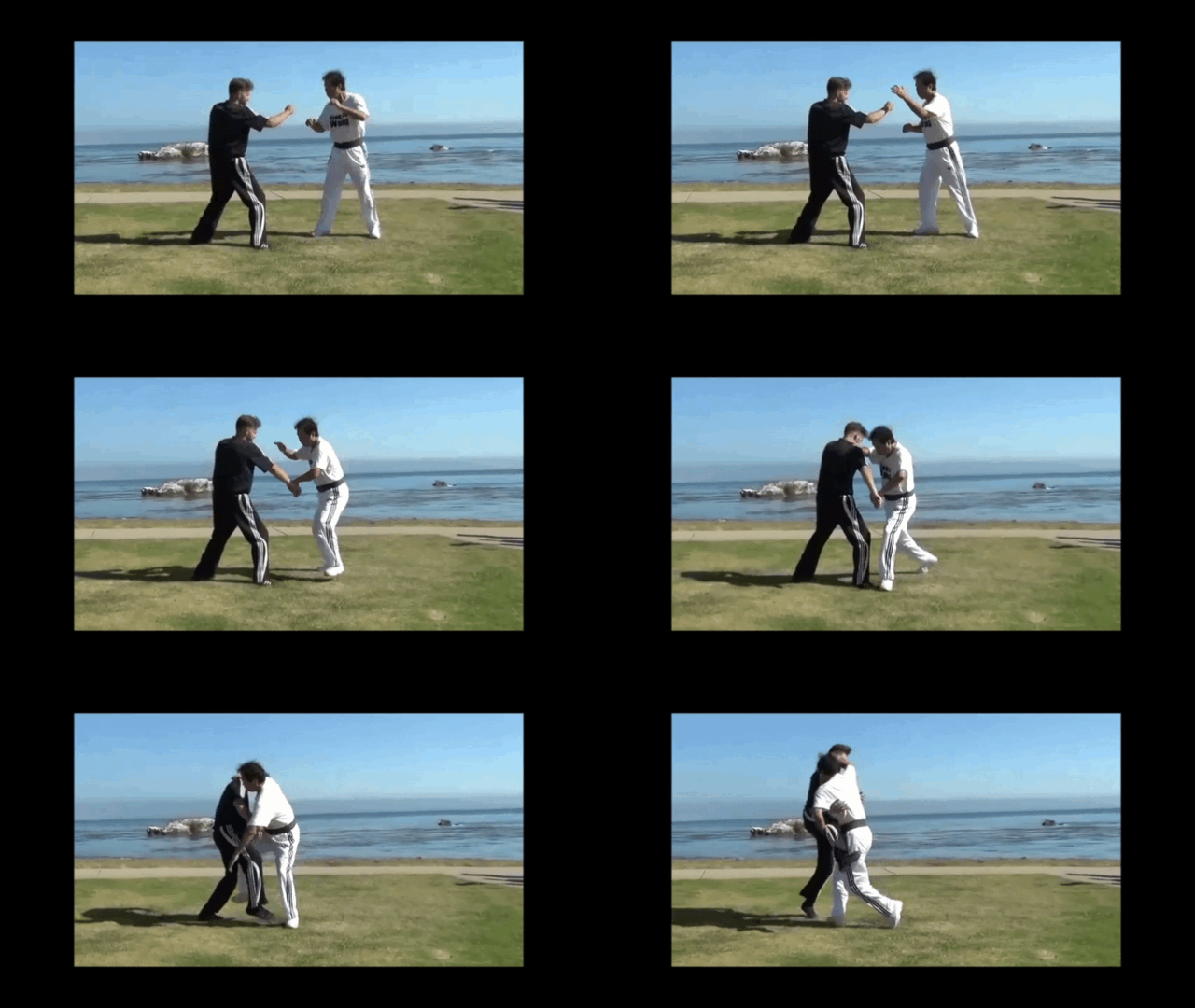
This seems to be similar to the "entering strategy" training for stand-up game. If your opponent has right side forward, or left side forward, and you don't switch sides, the set up for a "single leg" can be different. This kind of training is important. This will make your "single leg" to work on all situations.

For example, you can use "knee strike" to set up your "single leg".

 
Last edited:
A big trend these days in BJJ is "Ecological" training, basically using games to specifically train certain positions or techniques. It comes in multiple forms, but in general it focuses more on live work rather than drilling, the theory being that you learn better that way.
An example is if you are training Triangles, the game would be that you are only allowed to strangle with your legs. Or if you're training back takes, the game would be no submissions and taking the back means you win. That's pretty simple, but some schools have gone really far with it to the point of never drilling at all.
What are your thoughts on this game-based training? I personally enjoy it, but my school does still drill a little bit even after we started trying out the games and I think that blend is a good way to do things.
This might be one of the biggest stretches of word usage to create a buzzword I have ever seen.
 
Never heard that phrase. They're not unique to BJJ though. I've been doing games like that in kempo since I was a kid, and we'd regularly have challenges like that back when I was fencing in college.

It's not even unique to martial arts. We'd do similar stuff in basketball practices growing up.
 
I think the unusual aspect of the ecological approach isn't in the exercises per se. It's in the (minority) of instructors who are experimenting with using them as a full replacement for normal instruction and drilling. In other words, such an instructor wouldn't actually show you how to execute a guard pass. He'd just give you a bunch of games and exercises intended to guide you into figuring out for yourself how to pass the guard.
 
To put that into the basketball perspective, it would be something like telling kids:
  • You have to move the ball across the court without holding onto it for more than 3 steps. (Instead of teaching them dribbling or ball handling skills).
  • You have to throw the ball into the net while the other person is trying to block your shot. (Instead of teaching a fake pump or a hook shot).
 
To put that into the basketball perspective, it would be something like telling kids:
  • You have to move the ball across the court without holding onto it for more than 3 steps. (Instead of teaching them dribbling or ball handling skills).
  • You have to throw the ball into the net while the other person is trying to block your shot. (Instead of teaching a fake pump or a hook shot).
To put that into the MA perspective, it would be something like telling your students:

You have to

- pick up your opponent's leading leg,
- wrap your opponent's leading arm,
- lock your opponent's head,
- underhook/overhook your opponent's shoulder,
- bear hug your opponent's waist,
- ...

while he is trying to knock your head off.
-
 
To put that into the MA perspective, it would be something like telling your students:

You have to

- pick up your opponent's leading leg,
- wrap your opponent's leading arm,
- lock your opponent's head,
- underhook/overhook your opponent's shoulder,
- bear hug your opponent's waist,
- ...

while he is trying to knock your head off.
-
That pretty much sums it up. Easy, right? :D
 
The ecological vs "drilling" approach conversation in BJJ is incredibly frustrating. Greg Souders has decided to be a "heel" instead of passionately teaching his personal style of teaching. Many people act as if this deep and intentioned of a constraints-led approach was somehow always present in BJJ, this isn't true in any significant way. Congrats, your instructor does positional sparring and rolling in their instruction, please stop pretending like these are the same thing. With regards to it's validity as a training style, it depends on the competency of the instructor and the willingness of the students. Almost every example of evaluating the validity of training curriculum/pedagogy is anecdotal, and this is how it's going to remain unless there is some academic form of research.
Both sides of this argument aren't trying to fix the problem of grappling pedagogy, they are trying to sell their pedagogy as superior so they can get students, recognition, or instructional sales. Why do you think Souders is acting like such a pretentious dick? Likely because he believes it will give him more attention, which is what is happening.
The ecological approach appears to be based off creating creative grapplers with a more concrete understanding of the sport due to being forced to experiment and discover. The "drilling" approach attempts to build skill by increasing proficiency in a concrete movement. I think the question should be what environment coaches think their students would thrive in more, and what pedagogy they think they can teach most effectively.
I'm going all over the place in this response, but I don't have the time to refine what I'm saying. Essentially, I think the clash of ideals is likely marketing, and that the reality of coaching is far more grey and subjective than competition results and sports science. As well, I think the focus should be on how to most effectively use both of these systems of training, or perhaps how to combine the two.
Progress, not division.
 
The ecological vs "drilling" approach conversation in BJJ is incredibly frustrating. Greg Souders has decided to be a "heel" instead of passionately teaching his personal style of teaching.
The Ecological Approach is a pedagogy that can't really be taught. In order for it to be an applied learning model, it requires a total acceptance and acknowledgement of a fundamental truth of intuitive learning. That truth echoes the Stockhausen Theory, which I've applied throughout my 30+ years of practicing, testing and sharing Taijiquan - You can't really teach anyone anything - you can only bring out what's already there

Without an unwavering adherence to that concept in every aspect of the training of oneself and others, the premise of learning to learn is at risk of being subjected to the whim(s) of the 'teacher'. There is no teacher in that learning environment. It follows a strict Socratic regimen of problem-solving and acceptance of the idea that one does not improve - they evolve.

Why do you think Souders is acting like such a pretentious dick? Likely because he believes it will give him more attention, which is what is happening.

I don't think that's the reason at all. He can't be blamed for harboring a bit of disdain for the resistance he probably got early on only to have those same people who argued down and/or dismissed his approach then appropriate and co-opt fragments of the EA without really understanding it. It requires a commitment to the idea and an immersive exposure to the process in order for it to be effectively understood.

I posted a basic outline of a training exercise here at MT that I've used to get young aggressive trainees used to the idea that they are their own teacher, and their ownership of what they learn is more important than anything I could ever teach them.
 
Back
Top