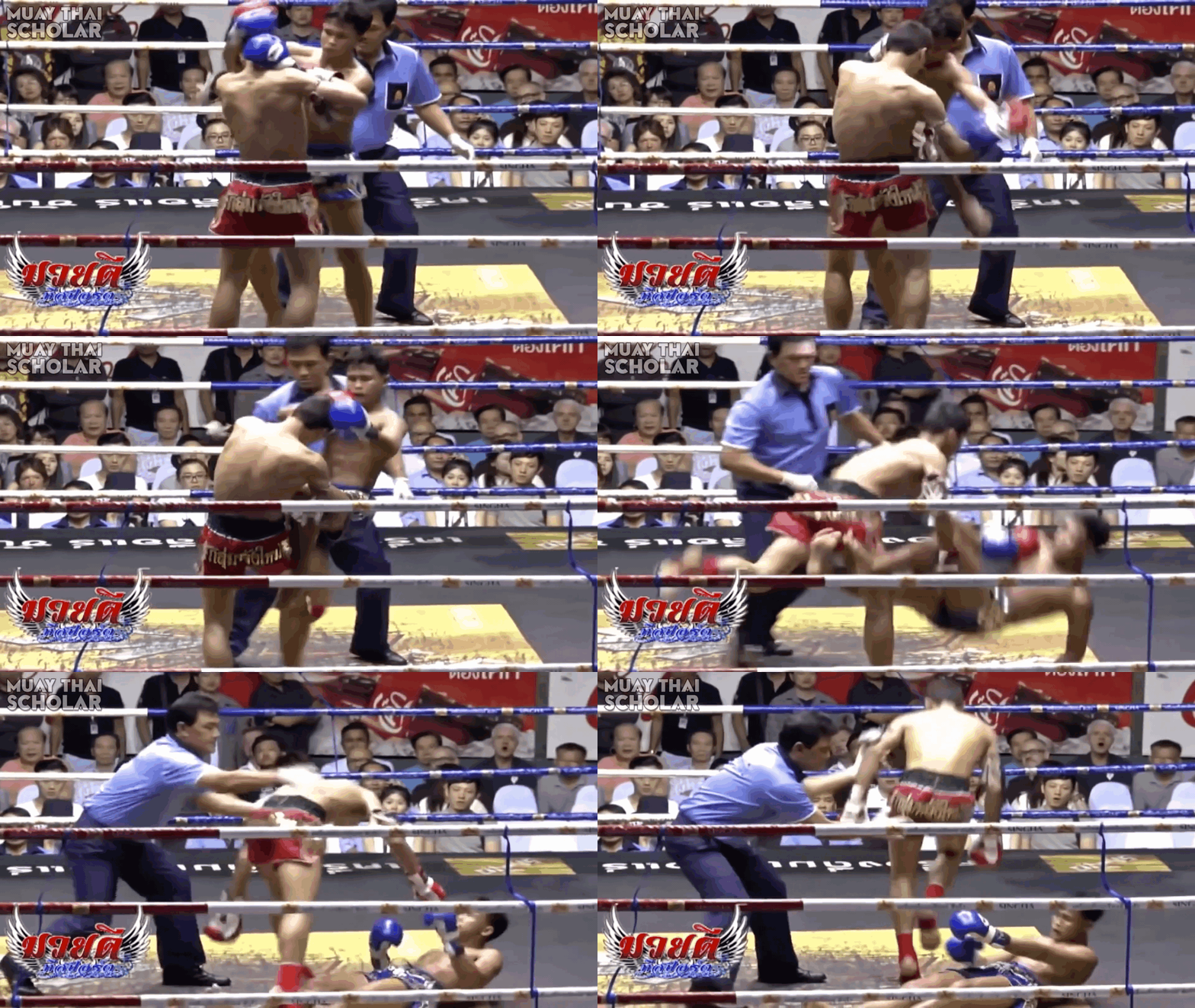
Why "clinch pull head" is a bad idea

Kung Fu Wang117 148

Sr. Grandmaster
MT Mentor
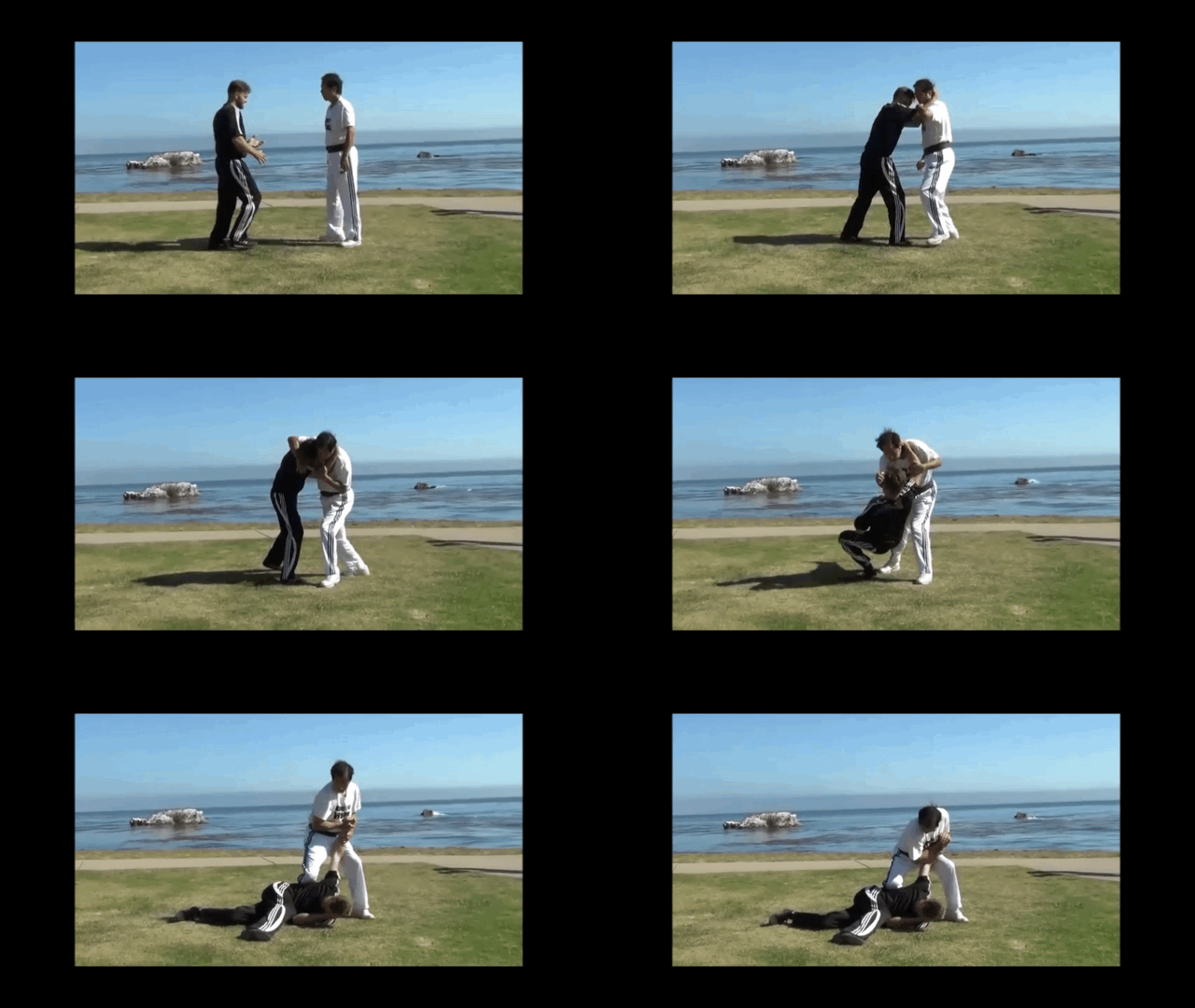
When your opponent applies "clinch pull head" on you, if you apply "head lock' on him, your "head lock" can lock his head along with both of his arms. He will have no arm to counter you. Also, his eyes will be covered by your arms and his own arms. He can not see your leg attack.

Nobody has ever addressed this issue before. It can be an interest discussion. What's your opinion on this?

 
Anyway. There is defences to a Thai clinch that kind of go around the back of the head.

But that position of elbows braced against the opponent is a very strong structure to break with just one arm.
 
It is a valuable clinch that is commonly used in MT, but it isn’t as static or loose as your video portrays it out to be. When applied our hands are grasped (not interlocked) behind the base of neck and elbows pulled together making a strong structure. Typically a downward left right jerking motion is use to facilitate kneeing, but it can be used to turn the opponent for sweeping or a throw. Anytime, you can loosen your grasp to throw elbows. This is all done in seconds and is just part of an overall strategy. Yes, there are many escapes also, including the video you provided.
 
It is a valuable clinch that is commonly used in MT,
In Chinese wrestling, you should never let your opponent to have 2 free arms during any clinching situation. If you use both arms to control your opponent's head, his both arms are free.

I have tested and put myself on the receiver side. When my opponent locks my head along with my arms, I can't see anything. It's a bad feeling to be in that situation.

If you let your opponent to control your arm like this, it will be toward your opponent's advantage.

arm_control.webp
 
Last edited:
When you put hand on your opponent's neck, you just give him a free contact point. If a take down requires 3 contact points, he only need to get the other 2 contact points afterward.

In this video, those 3 contact points are:

1. Your opponent's left hand controls your right arm (you give him for free and he doesn't need to look for).
2. His right hand control your waist.
3. His right leg control your right leg.

 
When you put hand on your opponent's neck, you just give him a free contact point. If a take down requires 3 contact points, he only need to get the other 2 contact points afterward.

In this video, those 3 contact points are:

1. Your opponent's left hand controls your right arm (you give him for free and he doesn't need to look for).
2. His right hand control your waist.
3. His right leg control your right leg.

The vid look like a demo with compliant partners. It would be more fun to watch a Chinese wrestler in the ring with a decent pro Muay Thai fighter and see these techniques in action.
 
In Chinese wrestling, you should never let your opponent to have 2 free arms during any clinching situation. If you use both arms to control your opponent's head, his both arms are free.
Until your opponent who is trying to have 2 free arms wins that battle.

The way we train BJJ at my gym, I believe my Professor's main concept of jiu-jitsu is that the pass/sweep game from guard (whether the top player passes the guard or the bottom player applies a sweep) is the biggest battle in the art. The vast majority of the techniques we drill, and the vast majority of the specific training rounds we spar with are focused on the pass/sweep game. In this situation, you can apply a similar concept:
  • The top player should never let their opponent switch positions and get on top (sweep).
  • The bottom player should never let their opponent get past their legs and control their hips and shoulders (pass).
Yet, invariably these "should" statements fail. In most cases, one player will pass every time or the other player will sweep every time. Just depends who understands the position better. Sometimes you get stalemates where both players succeed throughout the round, or where neither player does.

"Should" statements are great on paper. It's what you do when the "should" fails and you need to go to your next layer of defense that show your understanding of the sport.
 
The vid look like a demo with compliant partners. It would be more fun to watch a Chinese wrestler in the ring with a decent pro Muay Thai fighter and see these techniques in action.
Take down is used in MT all the time. If both of your opponent's hand are free, you give him a chance to do so.

 
When your opponent applies "clinch pull head" on you, if you apply "head lock' on him, your "head lock" can lock his head along with both of his arms. He will have no arm to counter you. Also, his eyes will be covered by your arms and his own arms. He can not see your leg attack.

Nobody has ever addressed this issue before. It can be an interest discussion. What's your opinion on this?


I think the effectiveness of this greatly depends on the person applying it. It's not a "just do it and it works" type of skill. I've been in a few and the clinch can be really nasty if someone who knows the finer point put you in one.


For the ones I trained on. The person will immediately see to destroy your balance. That's the first battle you have to win. In order for your technique to work in this scenario, it will be a race to see who gets unbalanced first.

If you cannot unbalance your opponent first then your technique won't work. Even though Muay Thai uses the clinch. There is a lot of "Tai Chi" attacks to the balance and a lot of "sense the balance" type approach.

I'm not saying your technique doesn't work. But I am saying that there is quite a bit that has to be dealt with before you can apply it.

For me personally, whenever I see a clinch incoming, I try to avoid, redirect, prevent. When I see that a clinch is going to be applied then I try to win the First Battle. - The Battle for Balance. Losing that balance can mean that I eat some knees and elbows while getting my neck realigned :cool:
 
"Should" statements are great on paper. It's what you do when the "should" fails and you need to go to your next layer of defense that show your understanding of the sport.
We are discussing the logic here. Let's compare the following 3 situations.

You use

1. both arms to pull down my neck - I have 2 free arms.
2. left arm to wrap my right arm while you use your right arm to lock my head - I have 1 free left arm.
3. left arm to wrap my right arm while you use your right arm to underhook my left shoulder - I have no free arm.

IMO, 1 < 2 < 3.

MT_clinch.webp


Chang_head_lock.webp


underhook.webp
 
Losing that balance can mean that I eat some knees and elbows while getting my neck realigned :cool:
The purpose of MT clinch is for MT knee strike. But it's a double edge sword. It gives your opponent a chance to seize your leg. This is why we don't see "knee strike" used very often in MMA. If you don't intend to use knee strike, you have no reason to use MT clinch.

When you take your opponent down, the striking game ends and the ground game starts.

 
Last edited:
When your opponent applies "clinch pull head" on you, if you apply "head lock' on him, your "head lock" can lock his head along with both of his arms. He will have no arm to counter you. Also, his eyes will be covered by your arms and his own arms. He can not see your leg attack.

Nobody has ever addressed this issue before. It can be an interest discussion. What's your opinion on this?


There is a huge difference in the "clinch pull head" shown in these two videos.

In the first, the pulling the head, is pulling the head, the other guy has his head pulled down to the other guys chest. This destroys his posture, look at his neck bent down 90 degrees... this effects the rest of his body. Not only is there no balance but there is no structure either... from that position, there is no way he can reach a head lock, unless you regains his posture first.

In the second video, there is no pull on the head... the other guy receiving the pull is still standing upright, on balance and with structure. In fact, the guy doing the head pull is still reaching up.... he is more accurately "gently resting both hands on the other guys head." Yes, you counter works.... after you regain your posture. There are ways to do that.... but its not as easy as the second demo shows.
 
1. both arms to pull down my neck - I have 2 free arms.
2. left arm to wrap my right arm while you use your right arm to lock my head - I have 1 free left arm.
3. left arm to wrap my right arm while you use your right arm to underhook my left shoulder - I have no free arm.
I still think it's folly to try and compare one position to another, because they are each going to have their pros and cons.

Even then, it's easier for the person to posture up the less control you have over their head. The more control you have over the head, the weaker their arms are to try and engage.

My best attacks in no-gi right now are snap-downs where I clinch both hands on the head and then push down. It's easy to set up a guillotine or front headlock, and if that fails I can usually take the back.
 
In the first, the pulling the head, is pulling the head, the other guy has his head pulled down to the other guys chest. This destroys his posture, look at his neck bent down 90 degrees... this effects the rest of his body.
- If your opponent's arms can bend your head down, your opponent is stronger than you.
- If it takes 1/2 second for your opponent to put both hands behind your neck, and you can't respond properly within that 1/2 second, your opponent is faster than you.

It's very common that your counter won't work because your opponentb is stronger and faster than you.
 
Last edited:
The more control you have over the head, the weaker their arms are to try and engage.
In ground game, if you can use your head lock to tap out your opponent fast enough, you may not have to worry about his hands.

"Head lock" in the ground game is more powerful than in the stand up game. The advantage of "side mount" position can eliminate most of your opponent's counters.

 
It's very common that your counter won't work because your opponentb is stronger and faster than you.
I did not propose a counter.... I pointed out that of course your counter worked.... because the other guy never pulled your head down, like was being shown in the original technique. But, anything counters a technique that is not actually being done. I would not take that as proof that your counter works though, until you try it on someone actually applying the technique you want to counter.
 
In ground game, if you can use your head lock to tap out your opponent fast enough, you may not have to worry about his hands.

"Head lock" in the ground game is more powerful than in the stand up game. The advantage of "side mount" position can eliminate most of your opponent's counters.

You are demonstrating "Kesa Gatame" or "scarf hold".... and there are many counters, reversals and a few submissions that can be done from the bottom.
 
In ground game, if you can use your head lock to tap out your opponent fast enough, you may not have to worry about his hands.
Again, if you control the head, it is very difficult for your opponent to use his hands. If your opponent can use his hands to stop you from getting to his head, then you must deal with the hands first. But if you can get to the head, it's a good idea to control it.

This post started with the idea that it was a bad idea to control the head, which assumes you already had it.

The big problem that I have with your post is it sounds like you're speaking theoretically about something you've never done, and trying to apply logic instead of experience. I've experienced all of these things. I've experienced various combinations of arm control and head control from standing and on the ground, both as the person doing the control and the person receiving it.

Controlling the head is absolutely a viable tactic and often the best one if available.
 
Back
Top