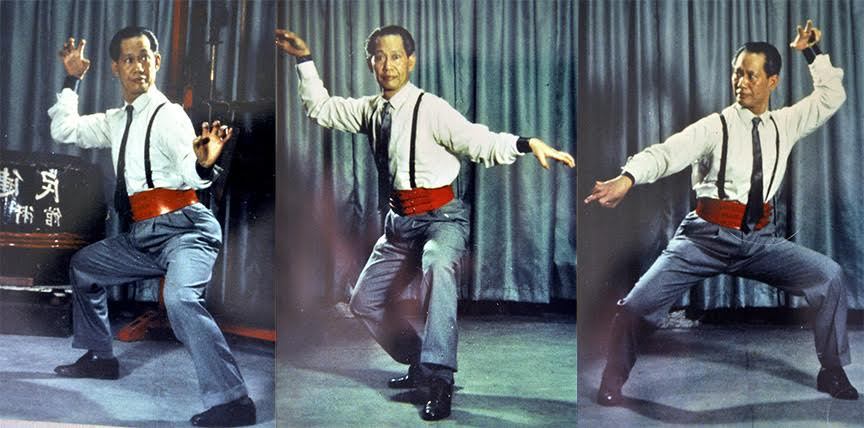
Eight Pieces of Brocade 八段錦 and Five Animal Frolics 五禽戏

Interesting

Not many IMA teachers (read; very few) have that kind of work in the foundational training. If it were otherwise, you'd see it being discussed everywhere. As it is, I've never seen it in any teacher's videos or writings. Nor have I ever seen it being discussed by regular folks posting on MA forums. Surely them with all the words would have at least mentioned it with some explicit detail to show us all up. Gee, I wonder why that is?

Anyway, in what way are the exercises similar to what you were taught? In what way is it dissimilar?
Both my Sifu Paul Gale and my Sigung James Wing Woo are interviewed in the book Nei Jia Quan by Jess O Brien. It’s not instructional, but still a good read with many very skilled IMA teachers being interviewed.
 
😂 I can relate to that

"He had me repeat only the opening movement. Each time I finished, he softly said, “Again.”"

For an hour, I repeated the same movement. I didn’t know what he was looking for, but when he finally saw it, he gave a small nod. At the time, I didn’t understand what had changed."
When my Sigung was a Hop Sing Tong member in the late 1940s and 1950s he lived with T.Y. Wong and they trained with Lau Bun. According to him the training there was quite strenuous. The slippery floor aspect came from a teacher in Canton that poured cooking oil on the floor and made the students try to jump up, their shoes sucking to the floor from the oil but the floor also being slippery to move in horse. It takes a lot of additional effort.
 
When my Sigung was a Hop Sing Tong member in the late 1940s and 1950s he lived with T.Y. Wong and they trained with Lau Bun.

Interesting a friend of mine brought me down to T Y Wong’s gym in Chinatown, his teacher.

think his son was teaching at the time.
Most traditional training is always quite strenuous, the process designed to weed out the people who couldn’t do it. A little different with public commercial gyms. during that time they had outdoor and indoor students .
 
Last edited:
My teachers never advertised or made videos. They believed that the students will come that need to be there. I began training in Wing Woo Gar Gung fu first. My Sifu encouraged us to train in both gung fu and Tai Chi. His goal was integration of Southern gung fu arms and Yang TaiChi legs but trained separately and consecutively. When training Tai Chi, the first two weeks I only stood and feel bottom of feet. Start to lift the big toe but don’t actually lift it. Same intention, no motion. Then feeling each ray of each toe. ( 4 th toe is a dead zone in most people.) eventually feeling the space between the joints. Then beginning the form he would direct us to focus on a spot on the completely white wall in front of us and focus on the intention to raise the arms but not actually raise them. Only when that intention becomes action without motion inside the bottom of the foot without tension could the arms begin to move as a result of that internal action. “The inside moves the outside, the bottom moves the top.” All this to do before ever learning the first motion. Only a tiny piece of the form itself being taught as satisfactory internal progression was observed. No mention of application until after the entire form could be completed to the Sifu’s satisfaction. Days and weeks spent trying to keep the same tone throughout countless repetitions of the form. The only encouraging words being “now do it again”. When some epiphany would come, Sifu would only say “ now what does that feel like?” Another similar exercise, our floor is polished concrete covered in slippery wax, our shoes are cotton soled slippers. The floor is a nearly frictionless surface. We had a rolling stool, we would sit on the stool and attempt to pull ourselves forward without scooting. The Sifu would sprinkle powdered dance wax mixed with ground cornmeal to reduce the friction even more. This means one must use correct posture and internal expansion and lift to maintain balance and focus. Most people cannot move the stool at all without scooting. Feeling the foot in relationship to the earth is more difficult without the full weight of the body to provide friction. Yet another exercise, a tripod with a rotating disc to stand on, a bicycle wheel and tire with a handle jutting from either side of the axle. Stand on the rotatable disc while holding the bicycle wheel horizontally in front of the body one hand on each handle jutting vertically from the axle. Now someone else gets the bicycle wheel spinning. The centrifugal force of the rotating wheel will cause the rotatable disc youare standing on to rotate in the opposite direction of the wheel in your hands. Now if you turn the bicycle wheel upside down the direction of the disc will also reverse. The exercise is to prevent the centrifugal force of the bicycle tire from rotating the disc you are standing on… This last one is a daunting proposition, one that the physics professor from HSU deemed impossible to achieve until he saw it done.
Holy cats, that's awesome

Thanks for taking the time to share your experience of having been given that foundational training.

Beginning Yang style felt like all my long bones were broken every morning for the first couple of weeks from the Horse Stance - not moving. I was very athletic with good strength and conditioning, but it didn't help, and actually hindered most everything at first. "Musclehead..."

"The inside moves the outside":cool: - heard that for weeks while getting tortured with Wu/Hao postures; "Move but don't move"..."now move"
 
You can always ask what if, but I think you've done enough tai chi to know how slowly or quickly you can breathe. 20(minutes)/100(moves)/2 (inhale/exhale) is just under 10 seconds for a breath cycle (inhale/exhale). Pretty average really.
20 x 60 / 108 = 11.11 second for a breath cycle. Since a normal person cannot breath this slow, multiple breaths must be involved within 1 move. IMO, that's not a proper training.

The time required for a normal breath cycle in an average adult is approximately 3 to 6 seconds.
 
Last edited:
Holy cats, that's awesome

Thanks for taking the time to share your experience of having been given that foundational training.

Beginning Yang style felt like all my long bones were broken every morning for the first couple of weeks from the Horse Stance - not moving. I was very athletic with good strength and conditioning, but it didn't help, and actually hindered most everything at first. "Musclehead..."

"The inside moves the outside":cool: - heard that for weeks while getting tortured with Wu/Hao postures; "Move but don't move"..."now move"
Exactly that! Over and over again. Then he would say, “they tell you can be anything in America, but that’s not true. You cannot be a bird, you cannot be a fish, but if you are lucky, and you train very hard, you might be able to be a human.” Also, “Tai chi is you in relationship to the earth, and you in relationship to you.”
 
Holy cats, that's awesome

Thanks for taking the time to share your experience of having been given that foundational training.

Beginning Yang style felt like all my long bones were broken every morning for the first couple of weeks from the Horse Stance - not moving. I was very athletic with good strength and conditioning, but it didn't help, and actually hindered most everything at first. "Musclehead..."

"The inside moves the outside":cool: - heard that for weeks while getting tortured with Wu/Hao postures; "Move but don't move"..."now move"
Sounds like we some things in common. I’m very curious who was your teacher, there aren’t very many like that.
 
Holy cats, that's awesome

Thanks for taking the time to share your experience of having been given that foundational training.

Beginning Yang style felt like all my long bones were broken every morning for the first couple of weeks from the Horse Stance - not moving. I was very athletic with good strength and conditioning, but it didn't help, and actually hindered most everything at first. "Musclehead..."

"The inside moves the outside":cool: - heard that for weeks while getting tortured with Wu/Hao postures; "Move but don't move"..."now move"
When two of my training brothers and I went to visit Sigung in our twenties, we were all muscles. He said “ all three of you puff out the same chest, I get it, no pecs, no sex.” Then, “when you do the form, feel your bunghole on top of your head” we laughed hard at that, then did the form. Sigung said “now which one of you felt your bunghole on top of your head? THATS RIGHT! NONE OF YOU!” Not much laughing then.🤣
 
That's exactly why Chang Taiji coordinate move with breath - by using the breath, one can integrate himself into the harmony of the universe.
I may talk too abstract here. But I truly cannot find any other reason why Chang Taiji emphasizes "breath guide move". In combat, "move guide breath" and that's for sure.

This has nothing to do with combat. When you concentrate on your breathing, you will feel that you are the center of the universe. The sun is moving around you. that's a good feeling.
 
I may talk too abstract here. But I truly cannot find any other reason why Chang Taiji emphasizes "breath guide move".
Maybe your teacher was trying to emphasize how to practice —
over time, you and others developed your own interpretations of that idea,
or adapted your practice to fit your own experience.

In combat, "move guide breath" and that's for sure.


My take on this — referencing my own practice:


Intent guides movement, qi follows, and the body moves.


At a certain level of practice, there’s no gap between these — they occur as one process.
Before that, there are gaps that can be exploited.


“In combat, move guides breath,”
what that means is that the body leads first — which isn’t wrong, just a different approach.


IME, the two methods don’t lead to the same result.


That’s why internal and external exist as distinctions — not just in training method,
but in how the body generates and expresses force.


External starts from the body and moves inward;
internal starts from awareness and moves outward.
 
Interesting a friend of mine brought me down to T Y Wong’s gym in Chinatown, his teacher.

think his son was teaching at the time.
Most traditional training is always quite strenuous, the process designed to weed out the people who couldn’t do it. A little different with public commercial gyms. during that time they had outdoor and indoor students .

TY Wong..

96-A67252-276-C-49-A8-A686-AC575-FAB2143-4641-0000035-DDB5-A75-FA.jpg
 
Maybe your teacher was trying to emphasize how to practice —
over time, you and others developed your own interpretations of that idea,
or adapted your practice to fit your own experience.


My take on this — referencing my own practice:


Intent guides movement, qi follows, and the body moves.


At a certain level of practice, there’s no gap between these — they occur as one process.
Before that, there are gaps that can be exploited.


“In combat, move guides breath,”
what that means is that the body leads first — which isn’t wrong, just a different approach.


IME, the two methods don’t lead to the same result.


That’s why internal and external exist as distinctions — not just in training method,
but in how the body generates and expresses force.


External starts from the body and moves inward;
internal starts from awareness and moves outward.

This is where we are again, on completely on the same page. I agree they do not lead to the same result which is what gives more value to the distinction between both methods/ideas/concepts. This type of conversation can require some level of trust amongst the participants.
 
Back
Top