What IS Hapkido?

skribs123 143

Grandmaster
A long time ago, I asked a similar thread in the TKD forum. I posited that TKD is, at its core (what you'll find in any TKD school) a combination of forms, kick-based sparring, and acrobatic kicks. There's a lot of other things that could be included, such as practical striking, self-defense, weapons, etc., but at its core TKD is about those three fundamental things.

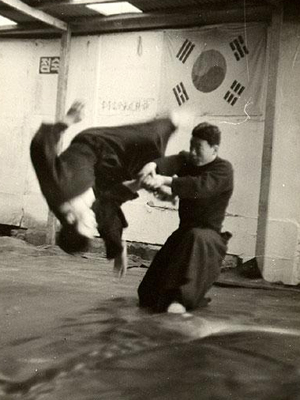
Hapkido I'm a little bit less sure what it is. I know what it was for me at my school. But I don't really know how that plays out overall. I know most literature on the art says it has a lot of strikes (many of the same strikes you find in TKD). But at my school, it was almost exclusively grappling techniques, even more specifically aikido-style joint locks.

I know there are Hapkido competitions, although they're mainly 2-person kata self-defense demonstrations. They're also not very popular.

If you were to go to a Hapkido school, what would you expect? What would you hope to learn from that class?
 
From what outside observers like to describe, it is a mix of of Aikido-like stand-up grappling and joint-locks and Taekwondo-like kicks. But the kicks actually come from Taekkyon. And Choi Yong-sool the founder of Hapkido, studied Daitō-ryū Aiki-jūjutsu which Morihei Ueshiba also studied before founding Aikido. Hope this is not confusing.
 
No idea what hapkido looks like now, but in the 70's is bore little similarity to TKD. Since I saw it in the karate competition environment, I didn't see the grappling/locking aspects. But the striking/kicking was agile, coming from various angles and had quick combinations.
 
This is a good question and it's hard to answer if you want something that's sort of universal. I haven't formally trained Hapkido in >20 years but I was super serious about it for 5-6 years in the '90s, training with a very well respected instructor from Korea. He arranged for the Korean national demonstration team to come to Seattle and put on an exhibition and set up a school trip to Korea where we got to exchange techniques with schools all over the country. I've trained a little Hapkido elsewhere and looked at a few schools that I chose not to train with. So, I've seen a lot of different Hapkido demonstrated.

It all looks different. My school was very focused on practical application, lots of punching, a paired down grappling curriculum that we practiced with a lot of resistance, and a relatively small number of kicks that we spent any time on. I've seen a number of schools that were much different, they looked just like a lot of Aikido schools I've seen - no strikes at all, just very large, flowing, circular joint locks practiced without resistance. I've seen schools that looked a like TKD, but with a few more joint locks, and one school in Korea that looked just like Tracy's Kenpo. Almost all, maybe all, of them had at least some joint locks that looked like they were related to Daito Ryu, and that seems to be about the only common denominator I could identify.
 
Beginning in 1971, the Billy Jack films helped introduce Hapkido to mainstream Western audiences through the choreography of Bong Soo Han.

 
This is a good question and it's hard to answer if you want something that's sort of universal

...

I've trained a little Hapkido elsewhere and looked at a few schools that I chose not to train with. So, I've seen a lot of different Hapkido demonstrated.

It all looks different.

...

Almost all, maybe all, of them had at least some joint locks that looked like they were related to Daito Ryu, and that seems to be about the only common denominator I could identify.
This is kind of what I was thinking. It seems as if there's very little commonality between them. My school was one that was heavily focused on the wristlocks (since we had TKD for everything else). Others have looked like TKD with leg kicks and no forms. It seems all over the place.
 
From what outside observers like to describe, it is a mix of of Aikido-like stand-up grappling and joint-locks and Taekwondo-like kicks. But the kicks actually come from Taekkyon. And Choi Yong-sool the founder of Hapkido, studied Daitō-ryū Aiki-jūjutsu which Morihei Ueshiba also studied before founding Aikido. Hope this is not confusing.
Yes, and ”hapkido” translates as ”aikido”
 
Back
Top