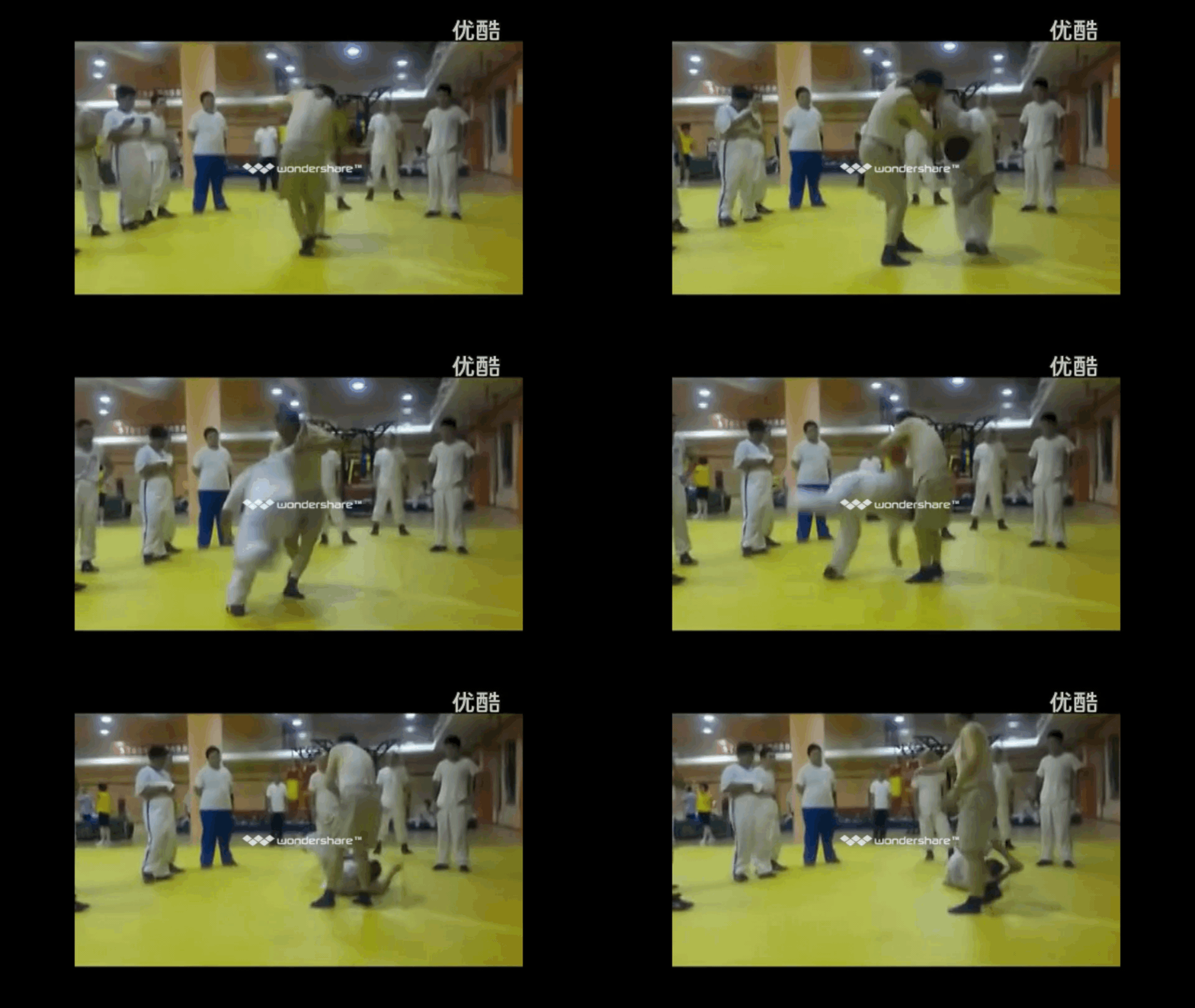
Video of aikido techniques against full resistance

ā€œLeg skillā€ is involved, you simply lack any meaningful experience with aikido to recognize it for what it is and to understand the methodology.

You understand shuai chao, which is not aikido. It’s obvious from even a cursory review of videos that are readily available in places like YouTube, that shuai chao and aikido are two different animals, with different approaches. You want to ā€œfixā€ aikido by making it more like shuai chao. Aikido does not need to be fixed, certainly not by you, and it does not need to be turned into shuai chao.

Your criticisms of aikido strike me as in the same flavor as your criticisms of Taiji. You don’t understand either of these methods so you criticize them on superficial issues and you want to turn them into shuai chao. It isn’t going to happen. Get over it.

If you had an honest interest in why things are done the way that they are in aikido, then you would find a good aikido school and you would give it at least a couple years of honest training, if not to become an accomplished aikidoka, then at least to have a legitimate understanding of the methodology. You might decide you hate it (which is ok), you might find you love it, at the least you might find your eyes opened to something you didn’t understand previously. But at least you would have a real understanding of what it is about instead of simply ā€œit isn’t shuai chao and I think it should be more like shuai chao because I can’t conceive of something working if it isn’t like shuai chaoā€.

Do some real homework, if you want to be taken seriously in this kind of discussion.
Your argument is counter intuitive. If say someone looks at Aikido and argues that they would be better if they did foot sweeps.

Doing Aikido and therefore not doing foot sweeps is not going to test that theory.

What you would do is get a foot sweep guy. Go around and knock a bunch of Aikido guys on their bums untill they start incorporating it.
 
A + B > A

twist + spring > twist
But in your case either A and/or B is an unknown variable, therefore it may or may not be greater than A.

In your opinion twist + spring is greater than twist, based on the scenario in your mind. But it is not great in every single instance. You chose random variables to suit your opinion.

Sorry your proof is simply a matter of your opinion, therefore flawed
 
Last edited:
boxing + BJJ > boxing
boxing + BJJ > BJJ
Ahh, now you changed in an effort to sound right… but even more wrong…and still only your opinion. And your are mathematically contradictory therefore incorrect since both cannot be true.

You probably missed the last part of my post, due to my editing while you were responding. So i will repeat it here

In your opinion twist + spring is greater than twist, based on the scenario in your mind. But it is not great in every single instance. You chose random variables to suit your opinion.

Sorry your proof is simply a matter of your opinion, therefore flawed

I do not doubt you know shuaijiao rather well, but as for the rest you want us to believe you are an expert at, not so much
 
Sorry your proof is simply a matter of your opinion, therefore flawed
When your opponent's legs are free, he can move around and escape your attack. When your opponent's legs are restricted, his option is reduced. To reduce your opponent's leg mobility is always to your advantage.

If you don't agree with me on this strategy, there isn't much for further discussion.
 
Last edited:
I swear, it’s like talking to a brick wall sometimes.
Again, if we don't agree on the basic strategy (add leg restriction on your opponent is to your advantage), there isn't much for further discussion.
 
Last edited:
When your opponent's legs are free, he can move around and escape your attack. When your opponent's legs are restricted, his option is reduced. To reduce your opponent's leg mobility is always to your advantage.

If you don't agree with me on this, there isn't much for further discussion.
Ahh yet another change in your approach to be right

Not disagreeing with you on that at all. But your way is not the only way, although you seem to think it is. You know shuaijiao, not aikido, and not Taijiquan…

If you don't agree with me on this, there isn't much reason for further discussion…. But you won’t stop trying to be right
 
Again, if we don't agree on the basic strategy (add leg restriction on your opponent is to your advantage), there isn't much for further discussion.
It’s much deeper (or actually much shallower) than that. You don’t understand things like aikido or taiji. But instead of trying to actually understand them, you think they need to change and be more like shuai chiao. Because that is what you know. Utter nonsense.
 
Most Aikido practitioners still wear a hakama(very wide outer pants), not really the purpose of those pants but one could theorize that they may somewhat conceal the practitioners foot positioning thus executing specific leg against leg techniques being a guestimation.
just a theory perhaps relevant in a time when those pants was a common in Japanese society .
.But in actual common Aikido sense Ueshiba(founder of Aikido) advocated wearing hakama for the simple reason they were outer pants and he regarded regular gi/dogi pants as underwear- you don’t step into a dojo in underwear, at least not in Ueshiba s dojo
 
What's the "other way"?
Different situations require different responses. If you don’t know that and only think of one way to do something you are doomed to failure.

There is more than one way to take someone down. Have you become do stagnant in your training that you cannot see that. Every person is not going to attack in the same way and allow you to do what you are proposing.

Will your way work? Yes, but only in the right situation. Will it work in all similar situations, even if they look the same? No. Opponents are different, direction of force is different, weight at roots are different, strength is different.

So just because you don’t see something working based on your training, does not mean it will not work. And trying to change it to something you understand means you don’t understand it at all. You are stuck in ā€œ if the do A i do ā€˜B’. The problem is ā€œBā€ is a you made ā€œBā€ constant, but ā€œAā€ is a variable.

And if you don’t see that then this is s pointless discussion
 
Last edited:
Chang Taiji is also called "Shuai Chiao Taiji". I fully understand Chang Taiji.
Ive not heard of Chang Taiji. How does it relate to the main lines of Chen, Yang, Sun, Wu, Hao/Wu, or Cheng Man-Ching variant of Yang? And how is it that you fully understand it?

From what I have gathered, from what you have said about your Taiji training in previous threads over the years, you learned for a very brief time when you were young (like grade school age), you were unable to use it in a fight in grade school so decided it is ineffective and have spent your life disparaging it, while also mentioning that you taught a Taiji class at the university at some point. That last part I can’t understand, for the life of me. Why would you ever teach a class in something that you have no belief in, very little training in, and criticize at every opportunity? That makes no sense.

I really don’t get you. That’s my problem, I realize. You don’t have any obligation to make sure someone like me ā€œgetsā€ you. But I’m just saying, you post some odd stuff here.
 
Ive not heard of Chang Taiji. How does it relate to the main lines of Chen, Yang, Sun, Wu, Hao/Wu, or Cheng Man-Ching variant of Yang?
I have learned Taiji from 3 different teachers.

1. A Buddhism monk when I was 11 (Yang Taiji).
2. A Taiji lady when I was in college (CMC Taiji).
3. From my SC teacher when he lived in my house (Chang Taiji).

1 and 2 were "for health only". 3 is both for health and combat.

Chang Tung Sheng (1908–1986) was a prominent Hui martial artist known for his unique style of Tai Chi, which integrated techniques from various martial arts, including Shuai Chiao and Yang-style Tai Chi.

Development of Chang Style Tai Chi​

Chang Tung Sheng's martial arts journey included significant interactions with other martial artists, notably General Li Chien, a Yang-style Tai Chi master. Their exchanges led to the development of Chang-style Tai Chi, which is characterized by its practical applications and combat effectiveness. This style incorporates elements from Shuai Chiao, Hsing Yi, and Pa Kua, making it unique among Tai Chi forms.

My old student's Chang Taiji.


1989 Chicago Chang Taiji demo.

 
Last edited:
Different situations require different responses. If you don’t know that and only think of one way to do something you are doomed to failure.
You still have not answered my question. "What's the other way?"

In this video, his opponent can step 5 steps before losing balance. In those 5 steps time, his opponent has better chance to regain balance.


In this video, his opponent doesn't have chance to use footwork to regain balance.

 
Last edited:
You still have not answered my question. "What's the other way?"

In this video, his opponent can step 5 steps before losing balance. In those 5 steps time, his opponent has better chance to regain balance.


In this video, his opponent doesn't have chance to use footwork to regain balance.

In the aikido that I train, we can run someone around, or we can drive them straight down into the ground. It is a choice we can make depending on what is appropriate. Driving someone straight down into the ground is likely to cause some serious injury. That is what you would do to an assailant. A less dramatic application is what you do to a training partner. There are safety and injury issues that are important to navigate and a certain level of cooperation is essential to do so. What you see in places like YouTube are people working with training partners and not assailants. I would not be surprised if you are unable to find video of aikido being used against actual assailants. Most things in life are not captured on video and posted on YouTube to satisfy the rubberneckers or to settle debates like this. So you probably haven’t seen that side of aikido, but you would come to understand it through training it.

I’m not going to debate further with you. I have no real interest in justifying aikido or its training methods for you. Aikido does not need me to be its champion. You can accept that aikido is something you haven’t experienced and therefore don’t understand, or not. That is your choice and I’m not going to try to fix you.
 
You still have not answered my question. "What's the other way?"

In this video, his opponent can step 5 steps before losing balance. In those 5 steps time, his opponent has better chance to regain balance.


In this video, his opponent doesn't have chance to use footwork to regain balance.

There is no one answer, don't you get that? And yet he did not lock the foot as you originally said you should do. Could you please stick to one video at a time and quit trying to change the approach to be right.

Also, you showed the result, not the attack that prompted it.... so, what is this now trying to prove?

Depending on how the aggressor approached you could have easliy and much more efficiently taken him down with diagonal flying or revers leg Hengquan.

See, there are differnt ways that work, that are not your way
 
Last edited:
Back
Top