Unlock Your Kua : Why Bone Structure Limits Your Range of Motion

If your hand can touch your foot, does it make you healthier?

Flexibility makes you feel young. Feel young makes you happy. Happiness makes you healthier.

Yes sure specific leg flexibility required for specific kicking and specific postures. When I was young I wanted do cool high kicks and cool low postures so i did tons of leg stretching, many of my friends(non martial artists) wasn’t into or cared for any stretching but still they were young as I
 
Did high kicks and leg stretching when young, lots of it. But, sadly, in my early 50s, arthritis of the hips, followed by multiple knee surgeries resulting in one getting replaced, brought that to a screeching stop. Now i find myself saying no need to kick above the waist anyway. I don’t actually believe that, but it helps accept the reality of the situation.
 
She mentions she's torn her ACL 3 times.... had surgeries done. 2 on the right one on the left...

Wonder how or what caused the injuries ?
Wushu

Opening the kua is one thing. Closing the kua from its functional limit of 'open' is the giveaway as to whether or not it's stable.

If the stance or head height changes, or the pelvis lists while the feet are brought back under the body from the 'open' postures, the kua isn't stable. The weight shouldn't have to be thrown across the centerline (vertical line dead-center between the heels) in order to move the feet back under the body. The video of å—å±±ä¼č™Ž shows all of those things happening, as well as their right feet pushing off of the toes to get the weight shifted back over the feet - not their fault.

It's better to begin developing stability by becoming acquainted with the limits of one's current range of motion.

Something you wrote in the Tension vs. Compression thread;
The form a reflection — function the substance.

When the mind chases a look, it stays on the surface.
When the mind seeks purpose and function, the body settles into what is correct on its own

Unlocking the kua is a product of its conditioning while respecting the reality of its functional range of motion. For most people, that reality is the difference of little more than an inch beyond shoulder-width at first.

Stand with the feet at shoulder-width and slightly pigeon-toed (closed kua). Turn the left foot out to 90 degrees by rolling it on the heel and then slide it one inch forward (neutral kua). Shift your weight back onto your right foot so the right knee is over the right foot (open kua), and then bring your left foot back to pigeon-toed and shoulder-width (closed kua) without bobbing the head, running out the right knee, listing the pelvis, or pushing off of the left toes. Try it from the left side. Continue sliding the feet a little further forward each time until one of those faults occurs. The distance each of the feet can slide forward while keeping the kua stable will probably be different from one side to the other.
 
Last edited:
Unlocking the kua is a product of its conditioning while respecting the reality of its functional range of motion. For most people, that reality is the difference of little more than an inch beyond shoulder-width at first.

šŸ‘

Finding that ā€œlittle differenceā€ can take time.
For most people, even an inch of real kua opening is a major change in how the body organizes itself.

Stance height isn’t what gives function.
Internal practice keeps the stance modest so the body can settle, align, and listen. A small increase in functional range matters far more than a wide or deep posture.

People sometimes mistake this for lack of effort, not realizing the training is aimed at different functions.

When the kua (胯) opens within its natural range, the body connects — foot, spine, shoulder, and hand move on one path. What the ground gives rises; what the hand receives sinks.

When the kua is closed, the body moves in pieces and softness becomes empty.

Internal skill begins the moment the kua can open, even a little. Most of what people call ā€œinternalā€ comes from that single change.
 
šŸ‘

Finding that ā€œlittle differenceā€ can take time.
For most people, even an inch of real kua opening is a major change in how the body organizes itself.

Stance height isn’t what gives function.
Internal practice keeps the stance modest so the body can settle, align, and listen. A small increase in functional range matters far more than a wide or deep posture.

People sometimes mistake this for lack of effort, not realizing the training is aimed at different functions.

When the kua (胯) opens within its natural range, the body connects — foot, spine, shoulder, and hand move on one path. What the ground gives rises; what the hand receives sinks.

When the kua is closed, the body moves in pieces and softness becomes empty.

Internal skill begins the moment the kua can open, even a little. Most of what people call ā€œinternalā€ comes from that single change.
Agree.

re: the body organizing itself is something that isn't discussed very often - if ever - in finding out what the body already knows before, as you say, "the mind chases a look".

Stability is the foundation of foundational training.
 
our hips tend to be tight from sitting all day and not going through as full a ROM and increasing it as we can. I'm still working on "full" Asian squat. have to be careful due to some cartilage damaged in my knee from middle aged futbol, but getting there. if anybody followed the World Series, a lot of material is getting discussed lately on World Series MVP and Dodgers pitcher Yamamoto's training (no weights, mainly mobility, some javelin throwing that started due to elbow injuries) and mechanics. Kind of "unlocking" all joints.
(fast forward to mobility training section)

these guys try some of his training, kind of hilarious (I'd be worse at it):
 
Last edited:
our hips tend to be tight from sitting all day and not going through as full a ROM and increasing it as we can. I'm still working on "full" Asian squat.

See it a little differently.
It’s not just about sitting too much or lacking full range of motion —


As outlined in the thread ā€œTension vs. Compression,ā€ there are many underlying factors that determine a person’s natural condition — structure, proportion, joint alignment, and even how the nervous system allows release.
Understanding these makes more difference than simply trying to ā€œopenā€ or stretch the hips.
 
Last edited:
See it a little differently.
Had to think about what you said recently. You're not going to like this.

Opening the kua isn't internal, it's external. Internal has to do with neijing, meridians, and such. It's quite a low level to have to say that people opening their kua is considered internal. In a sense I agree with you because it's actually so rare these days. But, it's not internal. Anything that has to do with physical development in that sense is external.

That isn't to say that internal doesn't depend on physicality, often and almost exclusively physicality built by external motion. This was a hard decision for me to make but it's something I can bring the receipts over. Interestingly enough (I am repeating it because it sounds amazing eve to me, now that I realize it,) isn't internal! Wow!

As for the aforementioned reorganization, well that's true, pretty much nobody knows about that, but and however, if you don't want ever to be never you will have to change the weather. A bit of a doublentendre (weather being tian qi in chinese)!
 

The first video — ā€œYoshinobu Yamamoto’s Secret Bookā€ — shows a pitcher’s approach to developing power and precision without using weights.


The second — ā€œBest Gym Exercises to Improve Baseball Performanceā€ by Coach Dane Miller of ‪@GarageStrength‬ — takes the opposite route, focusing on weighted strength training to enhance athletic output.

Both methods, interesting, they’re built around specific needs of their activity,
using different approaches.

Yamamoto’s method emphasizes coordination and timing — the integration of whole-body movement — while Miller’s method emphasizes measurable strength and torque generation.

In internal practices, when we talk about the kua (胯), the intent is different again.

Opening the kua isn’t about producing or amplifying force — a starting point that allows force to pass through without obstruction. In this sense, it’s not really about range of motion, but about opening and alignment.

The same joint, completely different relationship to effort.

In sports the kua generates;
in Taiji the kua conducts.
 
Last edited:
See it a little differently.
It’s not just about sitting too much or lacking full range of motion —


As outlined in the thread ā€œTension vs. Compression,ā€ there are many underlying factors that determine a person’s natural condition — structure, proportion, joint alignment, and even how the nervous system allows release.
Understanding these makes more difference than simply trying to ā€œopenā€ or stretch the hips.
Yep
It's about how a person ended up where they are now, and what they currently have to work with. That never changes.

I wanted to focus on the specifics of this comment in my earlier reply...:

Internal skill begins the moment the kua can open, even a little. Most of what people call ā€œinternalā€ comes from that single change

because it's a small thing, but it opens up many avenues of exploration that are exclusive to the IMA paradigm - hence the term; 'internal'. Just those features of a "person's natural condition" that you listed are enough to keep a taiji practitioner busy for a year or more before really understanding the synergy of the re-organization mentioned earlier.

Letting someone actually feel the contrasts between moving with and without an 'active' kua lights up those avenues in the understanding of even the most raw beginner. No matter where they go or who they train with after feeling it, they will have the eyes to see who knows what they're talking about and who is hiding behind what someone else says or does.
 
Last edited:
because it's a small thing, but it opens up many avenues of exploration that are exclusive to the IMA paradigm - hence the term; 'internal'. Just those features of a "person's natural condition" that you listed are enough to keep a taiji practitioner busy for a year or more before really understanding the synergy of the re-organization mentioned earlier.
But you just said,
Unlocking the kua is a product of its conditioning while respecting the reality of its functional range of motion. For most people, that reality is the difference of little more than an inch beyond shoulder-width at first.

Can you see the difference between these two statements? I think maybe I got excited when you mentioned reorganization. I think maybe I saw something that didn't exist.

Hmph. Opening the kua. A dream for some... a nightmare for others!

 
Last edited:
Agree with the above comments on different individuals being able to do and pursue different things. For me "Asian squat" is just a simple example of my mobility still being a little too limited to do it (with neutral spine). "Normal people" (not IMA enthusiasts or professionals) should work toward certain milestones or examples for "daily living" and risk reasons. For example, non-fatal falls had $80bn healthcare expenditures in 2020 in the US (https://injuryprevention.bmj.com/content/injuryprev/30/4/272.full.pdf). Obviously not claiming most people should do one hand handstands or back bends and javelin throws for the sole purpose of being a top pitcher in baseball. Have no idea if even future pro pitchers should add that training.

Getting back to IMA, assuming most people doing IMA can hit certain milestones for "normal people" and then go farther ... like "open kua", "high kicks", or the various examples people list. If one (like me) cannot do "easy" and "normal" things, probably have to remediate first.
 
Agree with the above comments on different individuals being able to do and pursue different things. For me "Asian squat" is just a simple example of my mobility still being a little too limited to do it (with neutral spine). "Normal people" (not IMA enthusiasts or professionals) should work toward certain milestones or examples for "daily living" and risk reasons
šŸ‘

What’s ā€œnormalā€ for one body isn’t always normal for another.
The ā€œAsian squatā€ a good example—some cultures grow up with it, others don’t. It’s familiar to some, foreign to others, not a universal measure of health.

When I lived in Thailand, Often practiced at Lumpini Park, in Bangkok.
Some people did yoga, quietly, simply for health. No chasing shapes, no proving anything.
Very different from how many approach it in the West.

In Taiji and other internal arts, it’s much the same.
Chasing a posture or trying to ā€œlook the partā€ often takes one away from the function.
Doing more isn’t progress—sometimes it creates tension that closes the very things you’re trying to open.

In my own interactions with those I work with , I give people simple tasks they believe they should be able to do.
When they find they can’t, it becomes a doorway: they begin to see their real condition, not the image in their mind.

The internal work begins...
 
Last edited:
Getting back to IMA, assuming most people doing IMA can hit certain milestones for "normal people" and then go farther ... like "open kua", "high kicks", or the various examples people list. If one (like me) cannot do "easy" and "normal" things, probably have to remediate first.
Did you try the exercise? You're one of maybe three people who actually try some of the stuff that gets posted.

That exercise seems simple enough, but it reveals 2 very important truths/realities of an individual's functional range of motion of the kua opening and closing, and how that sets the parameters for the beginnings of organizing the body internally - one parameter in particular that affects everything else accordingly.

I'm careful with my use of language in what I wrote just there so as not to spill the beans, as it were, for a couple of reasons. The first is that internal work and discovery is only really possible when there's no context in which the mind can frame the work insofar as it having a purpose or outcome (why am I doing this and what result can I expect?). The second reason is in case some 'expert' wants to chime in and tell us all what those truths are and what that particular parameter is that affects everything else.
 
ā€œAsian squatā€
We just call it smoke break
37b53850a6b05fef836c2985bcc45d88.jpg
 
Chasing a posture or trying to ā€œlook the partā€ often takes one away from the function. ... I give people simple tasks they believe they should be able to do.
One simple task that I like to do is to move under my garage door. I'll start to have my garage door about waist height. I then move under it 20 times. Next day, I'll low my garage door 1 inch. I'll then move under it 20 times.

IMO, both static training and mobility training have value. It's better to start with static training and end with mobility training.
 
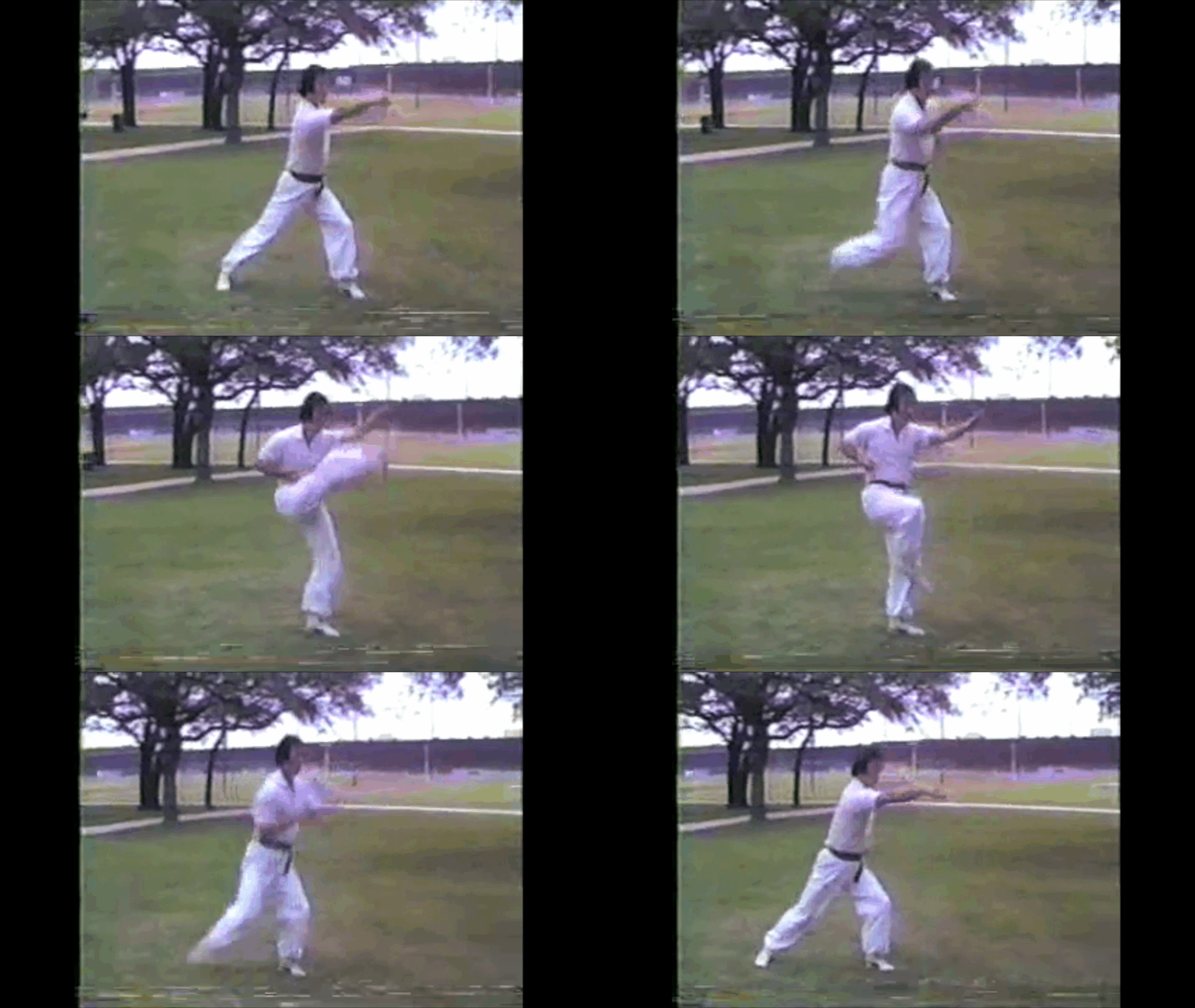
When you stand like this, you should lift your heels up and only stand on the ball of your feet. This way, you can enhance your toes push kick.
Seeing the video you posted (This looks a lot like Tantui #5) I was surprised that you used a toes push kick. Do you find toe push kicks more effective in this case?
 
Back
Top