Appledog51 4
Purple Belt
It is very hard to know what is natural!What are you chasing, just follow what’s natural., nothing real comes from illusions.
Follow along with the video below to see how to install our site as a web app on your home screen.
Note: This feature may not be available in some browsers.
It is very hard to know what is natural!What are you chasing, just follow what’s natural., nothing real comes from illusions.
The hard part is getting your brain to let the body do what is natural.It is very hard to know what is natural!
The hard part is getting your brain to let the body do what is natural.
The inaction that creates the action, in other words, the down leg creates the kick. This was very difficult to understand when I was a young man with strong muscle and even stronger will. Generally speaking, boys can’t let go of the muscle tension and girls can’t find it. I think it is sometimes easier to teach women. Once people really let go of tension and embrace the art of stacking and folding the learning can begin in earnest. Similarly, my teacher only had one small mirror in the back of the room. People chase a look and watch themselves instead of feeling it in themselves. It’s hard to convince some that there is something else there to be gained from practice. Something not so easily explained, something of far greater value.Yes it is — very interesting in that:
You can burn in movement and reactions until they feel natural…
Or
you can practice in a way that lets your innate nature appear.
Two very different paths.
The second one aligns with the three core principles I work with:
空 (kōng) – Emptiness
Letting go of unnecessary tension and habit so the body can reorganize itself.
無為 (wúwéi) – Effortless Action
Movement is not forced — it arises naturally once interference is removed.
自然 (zìrán) – Naturalness
What is so of itself.
True naturalness in Taiji isn’t randomness — it’s the deeper order that appears when ego and will stop getting in the way.
The same question has been asked about CMA in general:
Why train one skill set if it never seems to show up in a fight?
That’s something every CMA practitioner eventually has to answer for themselves.
I spent many years working through my own questions on this.
Marin is on my Top Three List of tjq guys who knows how to put Chen tjq into the body. His training is deep and brutal. But not suited for certain body-types so I don't agree with his blanket statements on the physical/mechanical aspects.Marin is a Chen stylist, his view reflects that method — he teaches that relaxing the kua is a mistake and that real usage can’t be developed through that approach.
I think that it should be noted all this talk of "naturalness," including my post, is predicated on learning and having learned the proper biomechanics over many thousands of repetitions. The seeds of naturalness can be planted for the beginner and quicken the learning curve, but only after the work is put in can they really bear fruit. Just being "natural" is NOT a shortcut or substitution for putting in the work over years of dedicated practice. IMO, one can only set the stage for naturalness to appear. When it does, a transformation takes place and one's art reaches a new level.空 (kōng) – Emptiness
Letting go of unnecessary tension and habit so the body can reorganize itself.
無為 (wúwéi) – Effortless Action
Movement is not forced — it arises naturally once interference is removed.
自然 (zìrán) – Naturalness
What is so of itself.
True naturalness in Taiji isn’t randomness — it’s the deeper order that appears when ego and will stop getting in the way.
That's actually a pretty easy thing to get beginners doing right from the get-go. It's almost as easy to get initiates of any MA to do with the right approach. The most important step in finding what's natural is testing the material that's been worked through immediately afterward.The hard part is getting your brain to let the body do what is natural.
That's actually a pretty easy thing to get beginners doing right from the get-go. It's almost as easy to get initiates of any MA to do with the right approach. The most important step in finding what's natural is testing the material that's been worked through immediately afterward.
I outlined a couple of exercises here at MT that open the door to finding what's natural without the brain being able/allowed to interfere with the body. Did you try em?
Here's one from the Wu/Hao style taiji I practice, in case anyone wants to try:
Awareness Drill #1:
[schnipps]
On whose authority? You used to be such a fairminded person, then you started looking down on people who disagreed with you. I'd rather not argue with you, but you are often extremely confrontational; I would rather try and understand your position. After all, didn't you once say, "I think there's room at the table for everyone. One man's treasure is another man's trash. I don't view anyone's work as 'laughable' or unworthy. I've learned as much here from the most raw beginners as I have from the most seasoned vets."? When did you change?And contrary to the straight up lie that this work isn't from Wu/Hao style.
RepetitionI think that it should be noted all this talk of "naturalness," including my post, is predicated on learning and having learned the proper biomechanics over many thousands of repetitions. The seeds of naturalness can be planted for the beginner and quicken the learning curve, but only after the work is put in can they really bear fruit. Just being "natural" is NOT a shortcut or substitution for putting in the work over years of dedicated practice. IMO, one can only set the stage for naturalness to appear. When it does, a transformation takes place and one's art reaches a new level.
I dont claim to know the origins of this exercise, but I did learn something very similar, not exactly the same, but with much the same outcome.On whose authority? You used to be such a fairminded person, then you started looking down on people who disagreed with you. I'd rather not argue with you, but you are often extremely confrontational; I would rather try and understand your position. After all, didn't you once say, "I think there's room at the table for everyone. One man's treasure is another man's trash. I don't view anyone's work as 'laughable' or unworthy. I've learned as much here from the most raw beginners as I have from the most seasoned vets."? When did you change?
"These ideas have too many layers to just parrot one phrase or set of principles and walk away thinking that covers it." "Do I consider myself an authoritative source? Absolutely not!" Instead of brushing aside the conversation you started, why not share a bit?
You see, I don't doubt for a moment that someone taught you this exercise, I just don't think it's part of Wu/Hao style for the reasons I posted. This means I'm not a liar -- i'm making an educated conclusion. And you, attacked me pretty hard over that. So I'd really like to know, who taught you this exercise, or how do you know it is a part of Wu/Hao style Tai Chi?
At some point, or in a similar exercise with no knee or ankle tension, are you screwing the bubbling well point down into the ground with the right foot torque clockwise and the left foot counterclockwise? To be clear, the feet don’t actually move. I’m just curious because in my training there were additional exercises that came after the one you just described here. Remember I was trained on a polished and waxed concrete floor with cotton soled slippers on, in case that matters.Anyway, as was already mentioned, finding what's natural for the body requires testing.
After working through the awareness drill and feeling the involuntary engagement of the tendons and the range of motion/degree of bend that can be achieved and explored while the legs remain 'slack', the next step is to work through the subtleties of determining substantial and insubstantial.
And contrary to the straight up lie that this work isn't from Wu/Hao style. It is the first bit of work that is done in beginning to explore and understand those subtleties mentioned above. It starts the body off as 'all empty' (important in Wu/Hao) before the second awareness drill.
While standing in a state of 'all empty', focus on feeling the Bubbling Well and pay attention to how your body naturally aligns and positions itself over the feet as it searches for that connection with the floor. Once that connection can be maintained, it's time to test it it in the next awareness drill.
![]()
Awareness drill #2:
Standing as before and with the legs slack, slowly and gently turn the shoulders and hips together (not twisting the torso) to the left, and at the same time, let the left foot turn outward on the heel and slide on its sole 45 degrees to the left, The right leg with naturally take up weight as its patellar tendon and muscles engage. Check the left leg that its patellar tendon is not engaged and the foot is connected to the floor through Bubbling Well. The right is substantial and the left leg is insubstantial, but not completely empty (that's important) because the Yongquan point is lively and connected.
See how far you can shift your weight forward onto the left leg before the tendon and muscles engage. Without losing awareness and connection of Yongquan in the feet, move the weight slowly and carefully between the feet to find a spot where both feet are connected to the floor, and both patellar tendons are disengaged. Be careful not to tilt the body forward or backward (Standing up straight) or twist the torso between the shoulders and hips.
Return to the starting position and do the same exercise with the right foot turned 45 degrees to the right.
Those drills are part of the foundational work of Wu/Hao style in developing awareness of fang song, Yongquan, substantial/insubstantial legs, and keeping the body light and square. They're similar to the Kneecap Release Technique and other therapies that address specific knee issues and overall knee health.
The intention given to the knees in Wu/Hao is to keep them together. Kind of like lightly squeezing a beach ball between them while having a powerful elastic band pulling them toward each other - if that makes sense. Not isometric per se. The style stands tall and moves small (one's foot placement is rarely wider or longer than the width of their shoulders), so if you stand tall with your feet parallel between shoulder and waist width and try to slide your feet together, you can feel the kua wanting to 'close'.At some point, or in a similar exercise with no knee or ankle tension, are you screwing the bubbling well point down into the ground with the right foot torque clockwise and the left foot counterclockwise? To be clear, the feet don’t actually move. I’m just curious because in my training there were additional exercises that came after the one you just described here. Remember I was trained on a polished and waxed concrete floor with cotton soled slippers on, in case that matters.
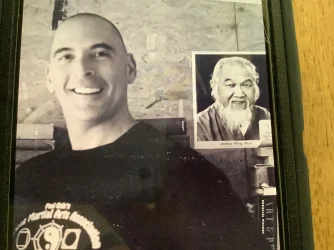
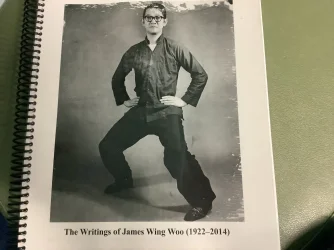
Thank you for the compliment to my teachers. RIP James Wing Woo and Paul Gale, my Sigung and Sifu respectively whom I spent many years with. I’m very grateful for what I got. I was also taught the “beach ball/elastic bands” idea using exactly those terms. The suction cup vs screw down was also taught in exactly those terms. I live less than a mile from Dr Yang Jwing Ming and meet with him at his house to train a couple times a week in addition to teaching my Wing Woo Gar classes. Although my original teachers eschewed the methods of others, I’m having a good time exploring the depths of Chin na nuances and some opposing viewpoints regarding certain applications of Tai Chi Chuan. Several of my training brothers from nearly 30 years in Wing Woo Gar accompany me to Dr Yangs house each week where we test things in open forum with each other and occasionally a few YMAA instructors that come through. It’s a very informal setting and Dr Yang has become a good friend of mine over the last few years.The intention given to the knees in Wu/Hao is to keep them together. Kind of like lightly squeezing a beach ball between them while having a powerful elastic band pulling them toward each other - if that makes sense. Not isometric per se. The style stands tall and moves small (one's foot placement is rarely wider or longer than the width of their shoulders), so if you stand tall with your feet parallel between shoulder and waist width and try to slide your feet together, you can feel the kua wanting to 'close'.
The follow-up from the exercise I outlined is to practice it in isolation all day every day whenever there's a little time to spare. The idea, of course, is not to have the legs slack like that during any kind of actual day-to-day activities. It's to develop awareness of one element of body method that is made more obvious and clear through that practice. In keeping with the idea that the body naturally knows what to do without the mind getting in its way, the exercise illustrates that quite nicely.
The intent of maintaining bubbling well is more like a suction cup than a screw or torquing the feet with the knees because of the way the knees are regarded as a unit. The Yongquan connection has a more vertical attitude in Wu style than in Yang style. What you describe and the 'handicap' you were working with is an excellent test of rootedness already, and foregoes some of the foundational work that would need to be done without that built in testing - structuring a training method of simultaneously developing and testing attributes takes an eclecticism that only comes from a great depth of understanding. You had a good teacher.
You lucky #@$?>&#!Thank you for the compliment to my teachers. RIP James Wing Woo and Paul Gale, my Sigung and Sifu respectively whom I spent many years with. I’m very grateful for what I got. I was also taught the “beach ball/elastic bands” idea using exactly those terms. The suction cup vs screw down was also taught in exactly those terms. I live less than a mile from Dr Yang Jwing Ming and meet with him at his house to train a couple times a week in addition to teaching my Wing Woo Gar classes. Although my original teachers eschewed the methods of others, I’m having a good time exploring the depths of Chin na nuances and some opposing viewpoints regarding certain applications of Tai Chi Chuan. Several of my training brothers from nearly 30 years in Wing Woo Gar accompany me to Dr Yangs house each week where we test things in open forum with each other and occasionally a few YMAA instructors that come through. It’s a very informal setting and Dr Yang has become a good friend of mine over the last few years.
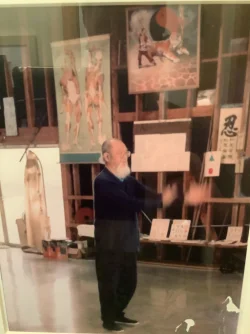
You can kinda see Sifu Woos floor in bottom right…You lucky #@$?>&#!
You can kinda see Sifu Woos floor in bottom right…