Push Hands Fail

During PH, if your opponent's right-hand grabs on your left wrist, his left-hand grabs on your right wrist, what will you do?

If you rotate your arms and try to break your opponent's grips, his both hands can then slide along your arms and reach to your elbow joints. From there his hands can reach to your shoulder, head, or waist.
If this happens you should immediately stop the round and tell your opponent this action is outside of the bounds of the push hands exercise. If you have to explain why you can say it is because while it is true anyone can do anything they want, push hands is supposed to train you to deal with combat forces inside the paradigm of taijiquan. If your opponent suddenly grabs your wrist, that's a valid technique, but it is a different technique than what you are practicing (then,show the technique). Next if your opponent continues to break tradition, you should immediately strike them, preferably in the face. If you are not capable of doing this then you have broken tradition yourself by teaching tai chi to someone who clearly is not interested in holding up the tradition. Or maybe of making **** up when you don't know what your doing yourself.

What this question reads like to me is why isn't push hands like (insert other exercise here). Where "other exercise" is a well-known exercise such as star arm blocking exercise (for example). The reason why then is seen to be very simple. Its just different stuff. If you are doing homework for graphing the slope of a line it is different than finding the GCF or factoring a quadratic equation -- even though in some way they all may be related, you cannot actually learn anything unless you focus on one thing at a time.

Once I asked a local teacher to push hands with me. After three rounds they suddenly broke contact and slammed me in the chest knocking me back. I was unhurt but stood there in some kind of shock, wondering why on earth they did that. I kept my cool and said another round, but they just rudely brushed off their shoulder and walked off.

The next day they apologized to me. This guy, BTW, as it turned out he was just a karate guy pretending to know Tai Chi. He resented me because when I showed up to the park in the morning he wasn't the star of the show anymore. A lot of people are like that, but, I digress.

There is a funny thing people do called accusing other people of not understanding tai chi. From my perspective none of you understand tai chi. But what is really going on is you (we) all understand something about it, but at a certain level. IN truth, it is very difficult to get to the point where you understand tai chi and are able to apply it -- but, at a level sufficient to call it a martial art and show that it is significantly different from other martial arts. No, I'm sure people understand what fighting is, but, they just aren't very good at it.

The way can be very tricky. When someone says they know the way or someone else does not, it is interesting because your not supposed to understand it. Just from what they said you immediately know that the conceptual framework behind the point is just plain wrong. You're supposed to know you can't understand it. But that's not all it goes way deeper. You are then supposed to, in full acknowledgement of this, deal with it anyways. Within the paradigm that you don't understand it. This is known as the wu de of honesty. It doesn't mean about lies and truth. It means about accepting where you are in order to move forward. Those who are 'quick of thinking' in Confucian terms, then, are those who cling to this mean, and therefore, can immediately take action.

It is therefore solely for that reason; the holding of wu de; that their kungfu is so great.
 
Last edited:
Once I asked a local teacher to push hands with me. After three rounds they suddenly broke contact and slammed me in the chest knocking me back. I was unhurt but stood there in some kind of shock, wondering why on earth they did that. I kept my cool and said another round, but they just rudely brushed off their shoulder and walked off.

I’ve had similar situations, just in a different way.
At Peace Park in Taipei, someone tried to shoot a single-leg on me during free push hands. He couldn’t find an opening and kept forcing it. When I asked what he was doing, he said ā€œsingle-leg takedown.ā€ I laughed.

I had him stop and try again, explaining why it wasn’t working the way he was attempting it — more of a teaching moment.

He was a young foreigner, likely from the U.S., probably just out there testing what he knew and trying to feel it in a different context. That part was fine.

The issue is when someone shifts from the shared practice into something else without understanding the conditions — it breaks the exchange. In your case it turned into a strike, in mine it turned into a wrestling entry.

When the intent changes like that, it’s no longer push hands. I tend to either reset it or use it as a teaching or learning moment.

I’ve trained with a number of groups around New Taipei as well. Many focus on competition, which is fine, not into nor care for the competitive aspects…that some focus on…

For me it’s more about testing ideas and contrasting methods — that’s where you start to see what holds up.

The practice works when people are working from the same method — not necessarily sharing methods across groups, but at least operating from the same understanding.
 
Last edited:
When I asked what he was doing, he said ā€œsingle-leg takedown.ā€ I laughed.
If your

- hip throw cannot deal with boxing punches, your hip throw has big problem.
- PH skill cannot deal with "knee seize", your PH skill also has some issue too.

Is this the correct way to look at any MA skill - Your MA skill works against all different MA systems.


my-kou.gif

my_kou.gif

my-kou-1.gif
 
Last edited:
If this happens you should immediately stop the round and tell your opponent this action is outside of the bounds of the push hands exercise.
Maybe you should also think that between PH training and free sparing training, some other trainings should be included as well.

Solo form training -> PH training -> ??? training -> free sparring training
 
Maybe you should also think that between PH training and free sparing training, some other trainings should be included as well.

Solo form training -> PH training -> ??? training -> free sparring training
Before I started my students on push hands training, we did 3, 5 and 7 star blocking exercises and we also did what you might call 'jiao ti', horn butting exercises (which, in my opinion, are the more advanced form of arm blocking exercises). We also do things like four hands from chaquan.

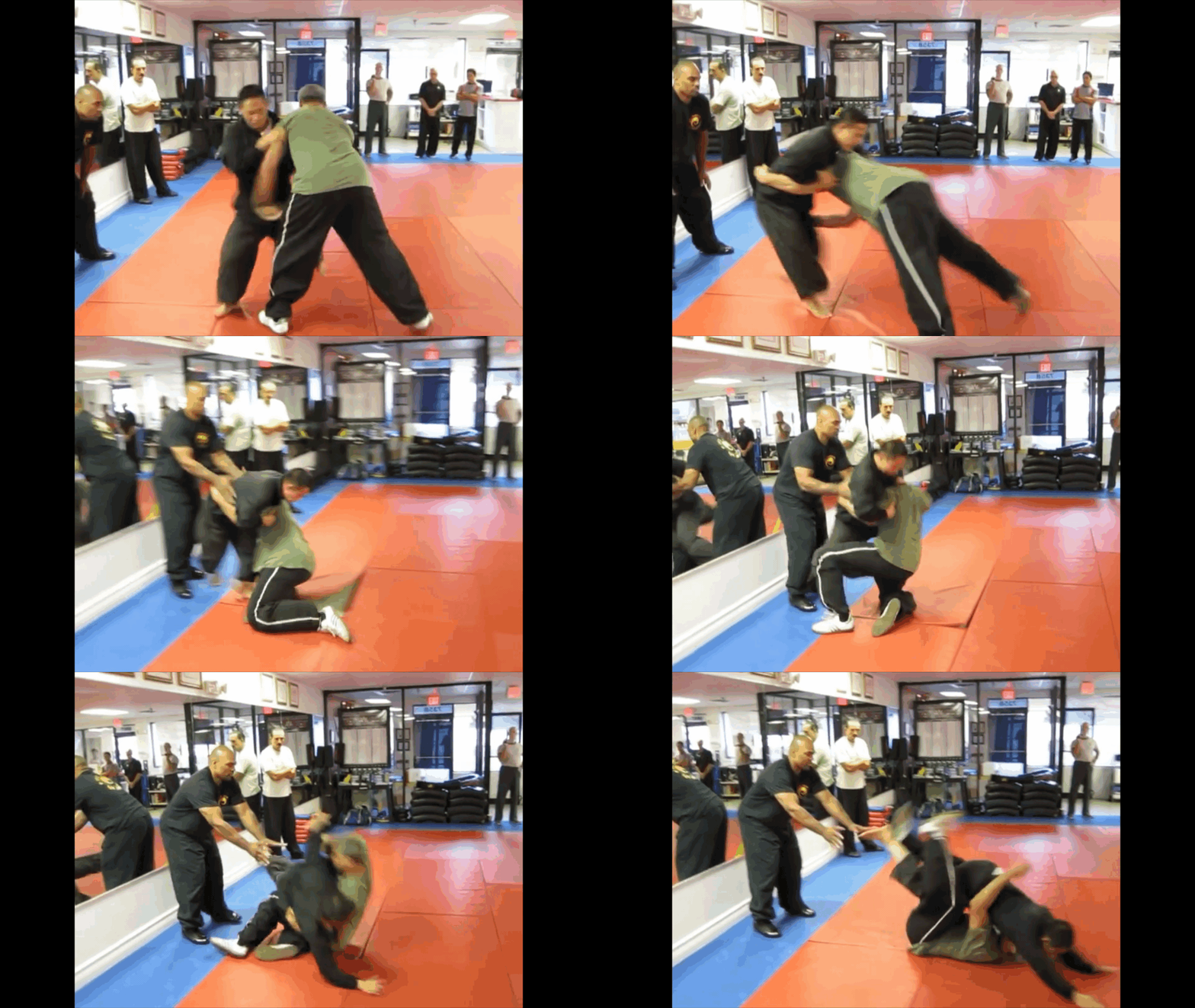
What we don't do (and probably should) are some common types of drills like the hip throw drill (carry the sack). Which appears in Wang Ziping's 20 methods form twice. So we really should train it, but, there's a lot of stuff to train!
 
So we really should train it, but, there's a lot of stuff to train!
IMO, "引(Yin) - Arm guiding" to guide your opponent's leading arm to jam his own back arm can be the most important training in PH. In most PH videos, this training is not addressed and I don't understand why.

Lin-arm-guide-slow.gif

arm-guide.gif
 
šŸ¤” you didn’t watch the op video?
I watched it but at the time that I watched it I didn't watch it with the focus of seeing if the first attempt was to experience what was happening for the purpose of informing how he would resist it the second time. The thing that I saw right away was that the structure wasn't the same.
 
Once I asked a local teacher to push hands with me. After three rounds they suddenly broke contact and slammed me in the chest knocking me back. I was unhurt but stood there in some kind of shock, wondering why on earth they did that. I kept my cool and said another round, but they just rudely brushed off their shoulder and walked off.
Perhaps first let them see a smooth but crisp Taolu performance… i mean a performance showing your current standard, and (often ) they would know not to play tricks beyond that level in any further encounters, and all can move on peacefully.
Best is not walking up to anyone unknow to you asking for a touch hand encounter, it may easily be taken as a challenge
 

Interesting clip...

It raises an interesting question about how demonstrations translate when the partner is not part of the practice.
In chats, I find ChatGPT to give deeper answers to deeper questions, not use informal fallacies and give organized details in seconds. Here’s its answer to a question asked and insight into the OP...

Why are there some tai chi people that say tai chi develops internal skill not found in external. Yet there is not one video of a tai chi person against resistant seen doing anything different from an external person?

This is a really good, honest question—and you’re noticing the exact gap that a lot of people eventually run into.

1. What ā€œinternal skillā€ claims to be

In styles like Tai Chi (Taijiquan), people often talk about:
  • ā€œInternal powerā€ (neijin)
  • Whole-body coordination instead of isolated muscle use
  • Sensitivity to force (often trained through push hands)
  • Relaxation under pressure rather than tension
The idea is that instead of brute strength, you’re using structure, timing, and subtle force redirection.


​

2. Why you don’t see it clearly in resisting fights

You’ve basically answered your own question—but here are the main reasons:

A. Most Tai Chi practitioners don’t train for fighting

Modern Tai Chi is mostly:
  • Health-focused
  • Slow-form practice
  • Cooperative drills
Very few schools do:
  • Live sparring
  • Pressure testing
  • Competition
Compare that to arts like Boxing, Muay Thai, or Brazilian Jiu-Jitsu, where resisting opponents are standard.

So naturally, you won’t see much footage—because most practitioners never train that way.


B. ā€œInternal vs externalā€ is often overstated


Historically, that distinction is more philosophical than practical.

High-level fighters in any art:
  • Use efficient structure
  • Stay relaxed until impact
  • Coordinate the whole body
For example:
  • A good boxer doesn’t just ā€œmuscle punchesā€
  • A good grappler uses leverage, not brute force
So when Tai Chi does work under pressure, it often just looks like… good fighting.


C. When tested, it looks like normal combat

If someone with real Tai Chi skill spars against resistance, what you see is:
  • Striking that resembles kickboxing or boxing
  • Clinch work that overlaps with wrestling
  • Balance breaking that looks like judo
Nothing mystical or visually unique.

That’s why it doesn’t stand out on video—you’re not seeing ā€œinvisible force,ā€ you’re seeing applied biomechanics.


D. A lot of exaggerated claims don’t hold up

Some instructors claim:
  • Effortless knockdowns
  • ā€œNo-touchā€ techniques
  • Overpowering stronger opponents easily
These claims usually fail under real resistance.

That’s why you’ll find skepticism online—especially when those demonstrations aren’t tested against unwilling opponents.


3. Are there any legit examples?


There are a few people who cross-trained or pressure-tested:

  • Chen Fake (historical, reportedly fought)
  • Xu Xiaodong (famously challenged traditional arts)
But even in those discussions, the takeaway is usually:

Skills that work are the ones trained against resistance—regardless of style label.


4. The core truth (no hype version)

  • ā€œInternal skillā€ = efficient mechanics + sensitivity + relaxation
  • These are real—but not unique to Tai Chi
  • Without resistance training, they don’t translate to fighting ability
  • With resistance training, they stop looking special and just look like good fighting

​

Bottom line

You’re not missing hidden videos. The reason you don’t see Tai Chi doing something dramatically different under resistance is:

When it works, it blends into normal combat.

When it doesn’t, it never shows up in real fights.


​

If you want, I can show you examples of people who try to apply Tai Chi concepts in sparring and break down what’s actually happening biomechanically.


Great—let’s look at this in a grounded, reality-based way. I’ll show you what people point to as ā€œTai Chi in actionā€ and then break down what’s actually happening.


1. The most commonly cited modern example

Adam Mizner (push-hands demos)


You’ll often see clips where he:
  • Off-balances people with small movements
  • Uses minimal visible effort
  • Sends partners stumbling
What’s actually going on:
  • His partners are cooperating to a degree (not fully resisting)
  • He’s very good at:
  • Timing
  • Balance disruption
  • Reading intent
šŸ‘‰ This is skill—but it’s being shown in a semi-compliant environment, not a fight.

2. ā€œPressure testā€ contrast example

Xu Xiaodong vs traditional stylists


Xu became famous for challenging kung fu/Tai Chi practitioners.

What happened in those fights:
  • He used basic MMA fundamentals
  • Opponents often:
    • Couldn’t handle pressure
    • Lost structure immediately
    • Fell apart under strikes
What this shows:
  • If ā€œinternal skillā€ isn’t trained against resistance, it doesn’t survive contact

​

3. Subtle internal principles in real fighters

Here’s the interesting part:
You do see ā€œinternal-likeā€ qualities—but not labeled that way.

Example: Floyd Mayweather Jr.
  • Extremely relaxed until impact
  • Efficient structure
  • Minimal wasted motion
Example: Demetrious Johnson
  • Uses balance and timing over force
  • Blends striking and grappling seamlessly
šŸ‘‰ These are often described in Tai Chi terms as:
  • ā€œSongā€ (relaxed readiness)
  • Whole-body power
  • Sensitivity
But no one calls it Tai Chi—they call it high-level skill


​

4. What happens when Tai Chi is trained with resistance


In rare cases where people actually spar:

It starts to look like:
  • Light kickboxing
  • Clinch fighting (similar to wrestling or Judo)
  • Off-balancing similar to Brazilian Jiu-Jitsu entries
Key observation:

You cannot visually distinguish it as ā€œTai Chiā€ anymore

That’s the big reveal.


​

5. Why push-hands doesn’t transfer cleanly

Push hands trains:
  • Sensitivity to pressure
  • Balance disruption
  • Close-range awareness
But it lacks:
  • Strikes to the face
  • Speed and chaos
  • Non-cooperative intent
So when pressure increases:
  • The skill partially transfers
  • But gaps become obvious

​

6. The uncomfortable truth (that most won’t say plainly)

There are only three possibilities when someone claims strong ā€œinternal skillā€:
  1. They’ve never tested it under resistance
  2. It works, but looks like normal fighting
  3. It only works on cooperative partners
Most videos you’ve seen fall into #1 or #3.


7. What ā€œrealā€ internal skill would look like (if present)

If someone truly had it and trained properly, you’d expect:
  • Better balance in clinch exchanges
  • Efficient movement (less fatigue)
  • Good timing and redirection
But NOT:
  • Effortless knockouts
  • Invisible force
  • One-touch dominance

​

Final takeaway

You’re noticing a real mismatch:

The claims about Tai Chi are dramatic.
The evidence under resistance looks ordinary.

And that’s because:
  • The principles are real
  • The marketing is exaggerated
  • The testing is often missing

​

If you want, I can break down a specific video (if you’ve seen one) and explain exactly what’s skill vs cooperation—that’s where this gets really clear.

Perfect—send me a specific video (or even just describe one you have in mind), and I’ll break it down frame-by-frame in plain language:
  • What’s real skill
  • What’s cooperation
  • What would fail under resistance
  • What would still work in a fight
If you don’t have one handy, I can pick a typical example (like a push-hands demo or a ā€œno-effort throwā€ clip) and walk you through it step by step.
 
(Continued)

This is actually a perfect example to analyze, because it shows both sides:

  • the impressive demo
  • and what happens when someone removes cooperation
Let’s walk through it clearly.


1. What you’re seeing in the demo (0:00–0:40)

The master (Sunjin Guo, as referenced in your transcript) is:
  • Lightly touching students
  • Sending them stumbling or flying
  • Using very small movements
What’s real here:

There is some genuine skill:
  • He’s timing their forward movement
  • Redirecting their balance
  • Using structure instead of brute force
These are the same core ideas trained in push hands:
  • Feel pressure
  • Borrow force
  • Return it at the right moment
​


What’s NOT real (or exaggerated):

The students are:
  • Over-committing their weight forward
  • Not resisting or stabilizing
  • Accepting the throw instead of fighting it
šŸ‘‰ In other words, they’re behaving like ideal training partners, not opponents.


2. The key moment: the challenger (1:30 onward)

This is where everything changes.

The random guy does three very simple things:

A. He stops overcommitting

Instead of leaning in dramatically:
  • He keeps his balance under himself
  • He doesn’t ā€œfeedā€ energy into the technique
šŸ‘‰ This alone kills most of the master’s setups.


B. He clings and stabilizes

You even see it in the transcript:

ā€œwhat if I just cling onā€

This is huge.

In push-hands style training:
  • People maintain a certain rhythm and distance
  • They don’t grab and neutralize the exchange
But in real resistance:
  • Grabbing = control
  • Control = no easy redirection
​


C. He pushes back


Now it’s no longer:
  • cooperative flow
It becomes:
  • force vs structure under pressure
And the result:
  • The master can’t off-balance him
  • His techniques stop working


3. What failed technically

This is the most important part.

The master’s methods rely on:
  • The opponent initiating force
  • The opponent overextending
  • The opponent not changing tactics
When those disappear:
  • There’s no energy to ā€œborrowā€
  • No imbalance to exploit
  • No opening created
šŸ‘‰ So the system stalls.


4. Why this exposes the core issue

This clip shows a fundamental limitation:

Push-hands skill ≠ fighting skill

Because it lacks:
  • Strikes (no threat forcing reactions)
  • Aggressive entries
  • Resistance to grabbing, clinching, or stalling
Compare that to something like Wrestling or Brazilian Jiu-Jitsu:
  • If a technique fails, they chain to another
  • If you resist, they increase pressure
  • If you stall, they break posture or attack
Here, the master:
  • Has no follow-up system under resistance
  • Relies on the initial trick working


5. The psychological shift you can see


Watch his body language:
  • Early: relaxed, confident
  • Later: hesitant, unsure, backing off
That’s not mystical—it’s practical:

šŸ‘‰ His training environment didn’t prepare him for:
  • Non-cooperative behavior
  • Unpredictable resistance


6. The big insight you were getting at

You asked:

Why don’t we see tai chi people doing something different under resistance?

This video answers it directly:
  • When cooperation is present → Tai Chi looks special
  • When resistance appears → it either:
    • breaks down, or
    • has to turn into normal fighting
In this case, it broke down.


7. What would a functional version look like?

If this same practitioner had trained realistically, you’d expect:
  • Transition to clinch control
  • Attempts to off-balance like Judo
  • Strikes to create reactions
  • Persistence under resistance
Instead, you see:
  • Resetting
  • Hesitation
  • No adaptation


Final takeaway


This clip is valuable because it strips away the illusion:

The ā€œinternal skillā€ isn’t something mysterious being hidden—it’s something that depends heavily on cooperation.

And once that cooperation disappears:
  • There’s nothing visibly unique left
  • And often, nothing functional either


If you want, I can contrast this with a clip where someone does successfully off-balance a resisting opponent (from judo or MMA) so you can see exactly what’s missing here.
 
Last edited:
If someone with real Tai Chi skill spars against resistance, what you see is:

  • Clinch work that overlaps with wrestling
This is why the following principles should be included into the PH training.

꒕(Si) - Tearing
å“©(Beng) - Cracking
ꍅ(Tong) - Striking push
褪(tun) - Hand pushing
肘(Zhou) - Elbow pressing
蓋(Gai) - Covering hands
ꔞ(Lou)- Pulling hands
ꐖ(Yao) - Body-shaking hands
ęÆ(Dao) - Reverse arm-holding
ꊖ(Dou) – Shaking
分(Fen) - Separate hands
ꎖ(Ye) - Hand tucking
引(Yin) - Arm guiding
ꍧ(Peng) - Arm raising
ęž¶(Jia) - Elbow Locking
圈(Quan) – Under hook
ꊄ(Chao) - Over hook
抹(Mo) – Wiping
偏(Pian) – Head circling
夾(Jia) – Clamping head
ꑘ(Zai) – Helmet removing
ꑀ(Wu) – Face covering
速(Su) – Forehead push
墬(Zhui) - Sticking drop
ꒈ (Lao) – Leg seize
ē’°(Huan) – Neck surrounding
ꉘ(Tuo) – Chin pushing
封(Feng) – Throat/waist blocking
꒒(Sa) – Casting
飄(Piao) - Floating hand

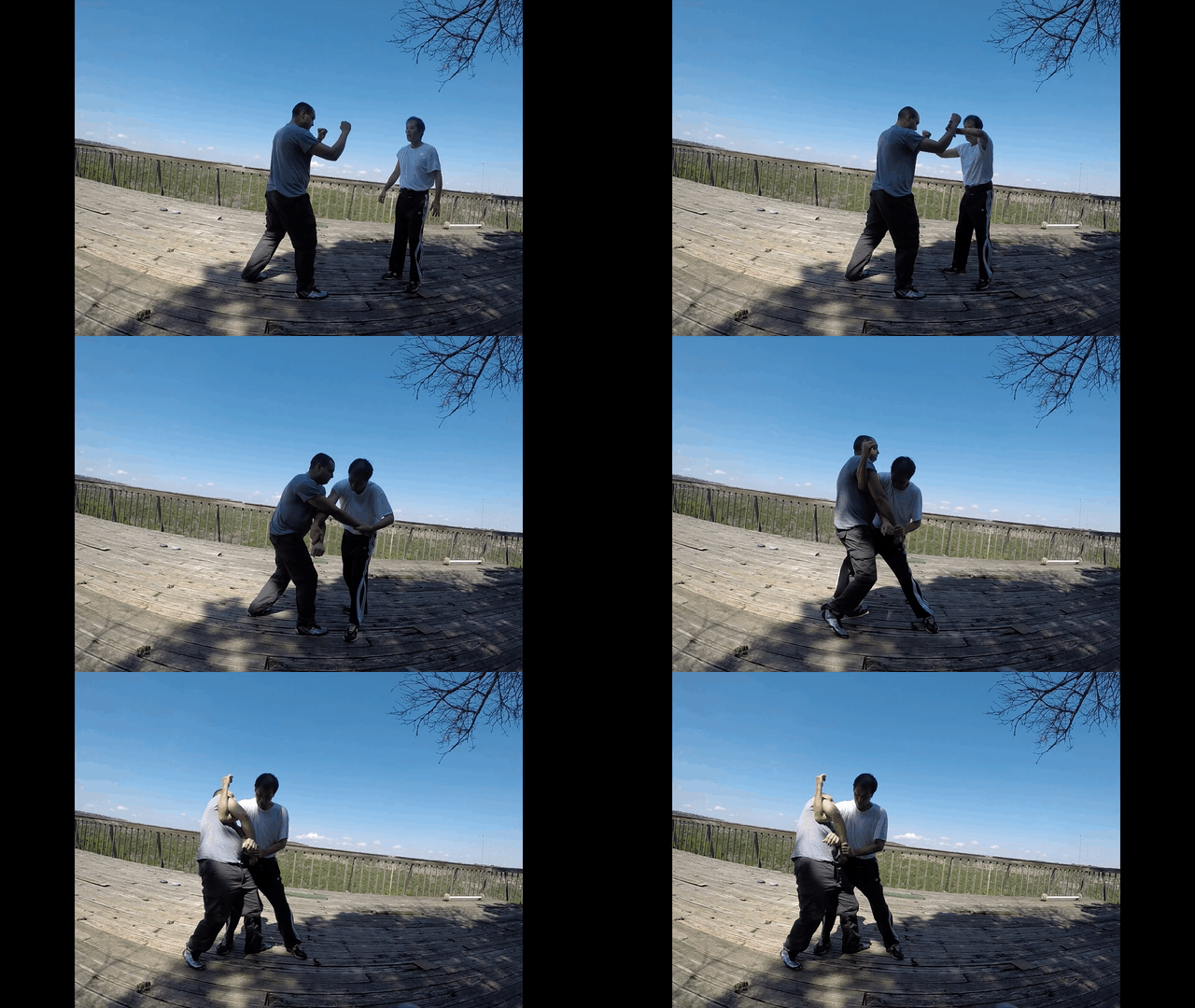
Example of ꎖ(Ye) - Hand tucking

 
Last edited:
Once I asked a local teacher to push hands with me. After three rounds they suddenly broke contact and slammed me in the chest knocking me back. I was unhurt but stood there in some kind of shock, wondering why on earth they did that. I kept my cool and said another round, but they just rudely brushed off their shoulder and walked off.

The next day they apologized to me. This guy, BTW, as it turned out he was just a karate guy pretending to know Tai Chi. He resented me because when I showed up to the park in the morning he wasn't the star of the show anymore. A lot of people are like that, but, I digress.
What he did was a jerk move but a good lesson. In terms of application as in sparring? That's exactly what to watch out for. So when I spar using Push Hands concepts. I don't want to lose contact with my opponent.

When Push hands is Tai Chi vs Tai Chi both agree to keep contact. That is System A vs System A. This is normal. But in your case you were Tai Chi vs Karate. Karate doesn't follow TaiChi rules. This is also Normal. In fighting you will almost always be in the System A vs System B category. This mean you should always try to prevent System from removing Contact. Be aware of when System B removes contact. Expect a strike or a fast reposition from your System B opponent.

For me in System A vs System B I always try to keep contact. Contact for me is like a solid line drawn on paper. This means contact is continuous. It is also like a dotted line where the contact is brief. The more dots the easier it is feel what your opponent will do or feel how you opponent's structure changes.

The bigger the gaps are between the dot the fewer contacts you have made and less you'll be able to sense what your opponent will do and the less information you'll get from the sense of touch.

This goes back to what kung fu mention about when contact is loss. If I do Push Hands now. I always treat it as Sytem A vs System B because I want the break in contact to always mean that my Opponent is about to strike.
 
What he did was a jerk move but a good lesson. In terms of application as in sparring? That's exactly what to watch out for. So when I spar using Push Hands concepts. I don't want to lose contact with my opponent.
One time I used hip throw on my opponent. My left hand controlled his right arm. My right arm wrapped around his waist. He used left hand to punch on my head.

Since that day, I no longer use "waist wrap hip throw" any more. I only use "under hook hip throw". This way I can control my opponent's left free arm.

IMO, no matter what rule that you may use, to prevent your opponent's arms from punching you should always be your major concern.
 
System A vs System B ...
Training MA is trying to solve problems. Today we have to face the following problems:

- Boxer's hook punch.
- MT guy's roundhouse kick.
- TKD guy's side kick.
- Karate guy's back reverse punch.
- CMA guy's switch hands (guide leading arm to jam back arm).
- Judo guy's hip throw.
- Wrestler's single leg.
- BJJ guy's ground game.

If we treat this as high priority, our training program can be different.
 
One time I used hip throw on my opponent. My left hand controlled his right arm. My right arm wrapped around his waist. He used left hand to punch on my head.

Since that day, I no longer use "waist wrap hip throw" any more. I only use "under hook hip throw". This way I can control my opponent's left free arm.

IMO, no matter what rule that you may use, to prevent your opponent's arms from punching you should always be your major concern.
Same here it best to just assume that you opponent will punch or do something out of the norm for System A. Even if it's Tai Chi I would ask my partner to try to punch me if he sees that I'm too comfortable with the contact. But you and I are application oriented. So application is going to be the path to understanding. Most will see understanding concept = understanding. Most do not follow. Application -> understanding-> concept. I think concept for many is based on concept (idea) -> understanding.
 
šŸ¤”

It depends on what the practice is actually based on.

In China and Taiwan, even within informal rule sets, things can get rough — people get thrown, balance is taken, and control is tested. Because of that, just adding punching, as some suggest, isn’t always practical within that context. To really understand why, you’d have to experience that type of training.

The bigger issue is how contact is understood.

Many people think contact only exists at the point of touch. So if contact breaks, they think the connection is gone. But what’s being trained is the ability to read and follow intent (ꄏ, YƬ) through the body — touch is just one way that shows up.

That’s why some refer to it as ā€œrubbing handsā€ rather than push hands — the emphasis isn’t on pushing or striking, but on maintaining and reading connection.
 
šŸ¤”

It depends on what the practice is actually based on.

In China and Taiwan, even within informal rule sets, things can get rough — people get thrown, balance is taken, and control is tested. Because of that, just adding punching, as some suggest, isn’t always practical within that context. To really understand why, you’d have to experience that type of training.
and occasionally in my Yang Shifu’s class in the old days
The bigger issue is how contact is understood.

Many people think contact only exists at the point of touch. So if contact breaks, they think the connection is gone. But what’s being trained is the ability to read and follow intent (ꄏ, YƬ) through the body — touch is just one way that shows up.

That’s why some refer to it as ā€œrubbing handsā€ rather than push hands — the emphasis isn’t on pushing or striking, but on maintaining and reading connection.
Yup, finding the others center while not exposing yours , sensing where the force is going, like you said reading what the other guy is doing
 
šŸ¤”

It depends on what the practice is actually based on.

In China and Taiwan, even within informal rule sets, things can get rough — people get thrown, balance is taken, and control is tested. Because of that, just adding punching, as some suggest, isn’t always practical within that context. To really understand why, you’d have to experience that type of training.

The bigger issue is how contact is understood.

Many people think contact only exists at the point of touch. So if contact breaks, they think the connection is gone. But what’s being trained is the ability to read and follow intent (ꄏ, YƬ) through the body — touch is just one way that shows up.

That’s why some refer to it as ā€œrubbing handsā€ rather than push hands — the emphasis isn’t on pushing or striking, but on maintaining and reading connection.
There are definitely many different aspects and dimensions.
 
Back
Top