My faded memory - is there a significance to the knot in the belted systems?

JowGaWolf

Sr. Grandmaster
MT Mentor
Max login streak
8 day(s)
I faintly remember what it was like to tie my first karate belt at 6 years old. I'm curious if there is any significant meaning to the belts and the type of knot that is used in the belted systems..
 
In my experience in Taekwondo, there wasn't meaning to the knot itself. It was just we wanted everyone uniform. Someone else may have a different answer. If they do, 50% chance it's a historical fact that there was a reason for the knot, 50% chance that it's just some mythical fact made up by their school. And even if it was a historical fact, there's a good chance there's another "fact" that's different. Same as what you see for example with nunchaku that there's a bunch of different myths about why they were used: were they specifically created as ninja weapons, originally farm tools, were they created as a hand-eye coordination game? Different folks have different ideas.

In BJJ, I think it's more about keeping your belt on than anything else. There's a few different ways people tie their belt. Most common I feel is similar to what we did in TKD, although they're less concerned with getting an even double-wrap than we were in TKD. However, there's a few other interesting knots. The first is done by folding the belt in half, and then looping the tails through the bend, which is a weird way of getting to the double wrap and doesn't look as good, but it's easier to get the belt even that way. The other is the "Judo knot" (as we call it in my gym) which feeds the tails not just through the knot, but also through the middle of the belt. This results in a more secure knot, but neither of these tend to look as crisp as the TKD knot.
 
Yes and no. In traditional Japanese karate (Okinawans didn't wear belts for karate), the knot should be a "flat knot" that makes is look like a "fortune cookie". The belt should be crossed over in the back "x" with the left side on top of the right side of the knot.

This was more in line with "how" things should be done properly and their aesthetics as opposed to a symbolic meaning. Although, I'm sure people have given the knot a meaning.

So, "yes" there was meaning in the manner it was supposed to be tied "properly", but "no" there was no symbolic meaning to the knot itself.

Today, there are various ways to tie the knot based on personal preference and the knot staying tight and tied.
 
Yes and no. In traditional Japanese karate (Okinawans didn't wear belts for karate), the knot should be a "flat knot" that makes is look like a "fortune cookie". The belt should be crossed over in the back "x" with the left side on top of the right side of the knot.

This was more in line with "how" things should be done properly and their aesthetics as opposed to a symbolic meaning. Although, I'm sure people have given the knot a meaning.

So, "yes" there was meaning in the manner it was supposed to be tied "properly", but "no" there was no symbolic meaning to the knot itself.

Today, there are various ways to tie the knot based on personal preference and the knot staying tight and tied.
I am an Extreme lefty. I have never tied my belt quite 'right', but I have also never been corrected on it either.
 
I've heard a couple of styles have traditions or rules about where the knot sits or what knot to use. For example, many basically use a square knot to tie the belt, but have women face the "open" side of the knot to one side, and men to the other. A couple of styles place the knot off to the side after tying it -- again sometimes by gender. I know some that encourage long "tails" but I like shorter ones that aren't so easy to use as a handle when in-fighting. Some schools have their own traditions, on top of any system tradition.
 
For those who have belts do the belts have significant meaning for you beyond Martial Arts?
 
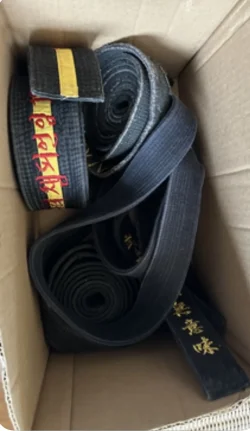
Are belts ever passed down? For example, when the time comes a Sifu may pass down a weapon or documents to a trusted student.
 
Are belts ever passed down? For example, when the time comes a Sifu may pass down a weapon or documents to a trusted student.
My current belt is half my first black belt and half my GM’s 9th Dan belt.
Out of the blue he took it off in the middle of a class and handed it to me and proceeded to give a short talk about the past and the future of martial arts. It Really resonated with me and I felt having one have beginning and one half (near the) end is very meaningful.
Makes me tear up thinking about it.
 
Are belts ever passed down? For example, when the time comes a Sifu may pass down a weapon or documents to a trusted student.
Yes. I don't want to say that it is "common", but it happens enough that it isn't odd or questioned when it happens.

Many times a Sensei to their top student, especially in the case of taking over or inheriting. I have also seen Fathers/Mothers pass their blackbelt on to their children when they achieve it.
 
I've heard a couple of styles have traditions or rules about where the knot sits or what knot to use. For example, many basically use a square knot to tie the belt, but have women face the "open" side of the knot to one side, and men to the other. A couple of styles place the knot off to the side after tying it -- again sometimes by gender. I know some that encourage long "tails" but I like shorter ones that aren't so easy to use as a handle when in-fighting. Some schools have their own traditions, on top of any system tradition.
Yes, American Kenpo would actually slide the belt knot itself to the left/right of the person. It actually started in the 70's when many men had long hair and it was sometimes tough to tell at a glance from across the room if it was male/female (as the story goes).

I have not heard of any traditional karate styles doing this though.
 
For those who have belts do the belts have significant meaning for you beyond Martial Arts?
I think this is also one of those east/west things.

In Japan, the belt is just a piece of cloth and if it gets dirty you wash it.

In the USA, the belt is seen more and you will get traditions like, "your belt can never touch the ground" or "you can never wash it" because of all the ki you have infused into it from your practice/training. It almost becomes reverent like how we treat the American flag.

Then there are the stories of the colors on how everyone started as a white belt and through the years of training it got dirtier until it turned brown and then black. See my previous point that in the Asian culture this would have been gross and disgusting and not an encouraged practice and they would have washed their belt long before then. It must be remembered that to them, the belt just held their jacket closed and the colors were eventually started to show someone's experience level at at a glance.
 
Yes. I don't want to say that it is "common", but it happens enough that it isn't odd or questioned when it happens.

Many times a Sensei to their top student, especially in the case of taking over or inheriting. I have also seen Fathers/Mothers pass their blackbelt on to their children when they achieve it.
Sound like a lot of hardwork put into something. I'm not a big fan of belts but this is definitely something that would make me want to earn a belt.

Very inspiring to hear. My grandsons take BJJ and I would take BJJ to have the opportunity to pass a belt down.
 
An extreme lefty? I didn't realize Karl Marx had opinions on how belts should be tied!
Extremely left handed. I hope you are trying to make a joke, but not a person anyone wants to be associated with.
 
Belts smelts, instructors hand them down to you, you hand them down to students.
Like the song says, “Will it go round in circles..”
 

Attachments

  • IMG_9493.webp
    IMG_9493.webp
    74.6 KB · Views: 55
Extremely left handed. I hope you are trying to make a joke, but not a person anyone wants to be associated with.
We can make jokes, no? Can't tell if you are saying nobody wants to associate with me or Marx, the former would be more logical, plenty more people like Marx then they like me :)
 

Latest Discussions

Back
Top