Front stance has the back leg straight and heel on the ground. Why?

skribs145 166

Grandmaster
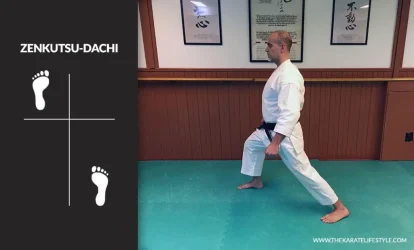
In pretty much every martial art with forms, the basic front stance looks something like this:

1792339453627.webp


The front knee is bent to put the weight on that leg and power in the forward direction. But the back leg is straight, with the heel planted on the mat. I've seen this in pretty much every style I can think of. I've watched videos of various Karate styles, Taekwondo styles, Tang Soo Do, and even Kung Fu, and invariably there is a front stance that looks like this. Other details of the stance may be different, such as the exact length and width, or the posture of the upper body. But the back leg is always straight or nearly straight. The back foot is always flat.

However, I'm struggling to think of a situation where I would have my leg like this in a fight.

If you're punching, you typically have your weight on the opposite foot. Whenever you put your weight on your front foot, your back heel comes up. When we trained forms in TKD, we did our forms with a traditional front stance. But when we drilled punches specifically, we picked up our heel to get the body rotation, as in this boxing drawing.

1792339658742.webp


In grappling, the wrestlers stance has some commonalities with the front stance. However, the back leg is bent significantly more, even compared to the boxing image above.

1792339963101.webp


So the question becomes two-fold:
  1. Is there a practical fighting application for this specific detail of the most basic of stances?
  2. Is there any other benefit to this specific detail as to why it makes sense to train forms with the back foot flat in a front stance position?
 
This thread was a thought experiment I had while driving. Got home, wrote it out, then started to play around with it.

I found that the traditional front stance feels better for front-hand techniques when I want to be square. But I do feel picking up the heel makes sense on a reverse punch or rear-hand technique.

My understanding is there's a lot more forward force when you are on the ball of your foot. Your muscles are much more engaged.
I think the heel up as you punch engages the calf muscles more, giving a spring effect giving the body motion behind the punch a little more "punch." At the same time, sliding that back foot up a bit while punching delivers additional mass.
 
  1. Is there a practical fighting application for this specific detail of the most basic of stances?
  2. Is there any other benefit to this specific detail as to why it makes sense to train forms with the back foot flat in a front stance position?


1. Development establishes the movement organization.

A stance establishes particular relationships between the feet, legs, torso, and the rest of the body. These relationships reflect the requirements of a particular method, including how it develops and generates power, while maintaining the ability to transition between movements without losing the organization necessary to express that power.


Dempsey's falling step is an excellent comparison because it demonstrates how a different method of power generation requires a different organization of movement.


2. Training makes that organization functional.

Forms depending on method aren't necessarily rehearsals of fighting techniques.
They can be a means of developing awareness of relationships throughout the body until those relationships become habitual.

Eventually, the practitioner no longer needs to consciously think about the position of the heel, the angle of the knee, or how the torso moves. The organization becomes part of how the person naturally responds.
 
why it makes sense to train forms with the back foot flat in a front stance position?
When a 250 lb guy runs toward you and tries to knock your head off, you try to use back reverse punch to punch on his chest to stop his forward momentum and knock him down, you will need to secure your back foot on the ground so your opponent's body weight won't push you back. It's used for defense and not for offense.

When a student freeze in punch with bow-arrow stance (front stance), teacher always uses his chest to push back on student's punch to make sure student's punch has strong back rooting.

Ancient soldiers secured spears on the ground to stop horse soldiers for the same reason.

spear.webp
 
Last edited:
energy flow.webp


If your opponent's energy follows the path of the red line- mainly by your body mechanics directing it, it goes directly into the ground; through your heel. If your heel is raised, then your calf muscle better be strong enough to spring back or support that force. The issue with this picture, is the torso is not united with the lower half of the body; it is broken at the waist. Having a heel up or being on the balls of your feet allows for mobility. When striking, the feet are planted; this is what I've been taught.
 
Tk-D it is designed to provide stability for an attack from the front or rear. In a fight the opponent may very well rush you and if their force unbalances you and moves you backward and you have to "Back Pedal" It's difficult to generate power and mount a successful defense or attack while being shoved backward, The Tk-D Front / walking stance is shallower than some with the front of the lead leg kneecap in line with the back of the heel of that leg. It has a 50/50 weight distribution. This makes it easier to kick with the lead le, than the illustration in the op.
 
It's a drill to teach you how to walk and how to generate power.

Go to the mall, or the park, or anywhere where there are a lot of people. Watch how they walk. When you pick up one foot, you will fall to that side, unless you do something to stop that. People have very "interesting" ways to not fall over. Some people will rock there body side to side, to move their weight onto the supporting foot. Many people have refined this, so that they just lean their head side to side. Some people tip themselves forward, so that one foot has to come out to catch their fall... these people don't rock side to side much, but they do lean forward when they walk. There are many variations to accomplishing this, some better than others. Some people actually move their hips to adjust their weight so that they can walk without falling. This is what the front stance is trying to train.

When you get into the front stance, where the feet are shoulder width apart and reasonably separated forward and back, with the heel down, you get to study this. It's not so much in the stance as it is when you walk forward and backward in the stance. In this type of wide stance, no amount of rocking side to side will prevent you from falling over. You must move your hips. In the C-Step version, you back foot comes forward and next to your front foot... before stepping forward to become the front foot. This moves your hips and your center over the front foot. You initiate the movement by moving you hip first towards the front foot, so that you move without tipping forward or backward. You then learn to pull yourself forward with that front foot. In order to move forward slowly, you need to coordinate the foot pull with the hip lead. Once the feet come together, you drive forward to drive the new front foot into its position, driving you center as well.

Yes, when you punch in sparring, you transfer your weight to the front foot, so that your body weight is behind the punch. Yes you push off the back leg to add power. But, this front stance training teaches you how to also add the front foot pulling, to the back leg pushing. So, instead of punching with one leg pushing... you are punching with both legs, one pushing and one pulling. Now you have two legs generating the power, instead of one... and both of them are driving you body weight forward.

Just like boxers don't jump rope when they fight, the front stance is about training how you move your center. You take the things it trains you to do into the fight, even though you don't jump rope during the fight. It's an over exaggeration, to teach you how to move and to strengthen the muscles used in that type of movement and to teach you how to coordinate those muscles to accomplish this. Once you get it, it happens without the big wide stance. But practicing the big wide stance helps you first learn this way of moving and helps you refine and improve this way of moving.
 

Stances and stance training can be thought of as adaptations or deviations from normal walking, which is itself an extraordinarily complex process that humans develop naturally.

Walking develops to satisfy everyday locomotion, not specifically to deliver punches, absorb contact, control another person, or rapidly change relationships under combative pressure.

Different martial methods attempt to modify or enhance this natural organization of movement to meet particular combative requirements.

What may initially feel unnatural is developed through training until it becomes a natural, ingrained way of moving and responding.

The stance, along with the transitions between stances, helps develop the functional awareness and coordination necessary to support the particular method's strategies, tactics, and means of generating power.

This is also why different methods are not necessarily interchangeable. Each may develop a different organization of movement, and those differences may not always be compatible.
 
It's a drill to teach you how to walk and how to generate power
Stance is static - it's the starting and ending position of a technique/step; stepping is dynamic - it entails all the stuff inbetween. They are two different things, though the stance does affect one's movement options, making some easier and others more difficult.

Stance affects directional stability, the deep front stance being discussed good in forward-backward linear stability but less so from side to side. It allows a strong lunge or reverse punch, but it's not good for circular strikes like a hook which are aided by a shorter stance. It also dictates the vertical and horizontal center of gravity.

Froward movement (or rear leg kick) from a deep stance, while forceful, is slower as the rear foot has a longer distance to travel. And lateral motion is substantially more difficult. This, and weight distribution will also affect which techniques can be efficiently executed such as front leg kicking as Mr. Weiss pointed out.

The stance, along with the transitions between stances, helps develop the functional awareness and coordination necessary to support the particular method's strategies, tactics, and means of generating power.
A good summation of stance, here. The particular MA system's reliance on it's one or two predominate stances reflects the above and are a part of that style's personality. Within a system, a variety of stances exist to facilitate a variety of techniques.
 
1792429799734.webp


In normal walking, the heel generally contacts the ground first, followed by the rest of the foot, with the toes leaving the ground last.

In martial arts, heel-first, forefoot-first, or flat-footed stepping may be deliberately trained to serve different purposes.

Heel-first contact can facilitate controlled weight transfer and progressive loading.


1792429883977.webp

Forefoot-first contact can facilitate quick adjustments, changes of direction, and spring-like movement.


1792430339308.webp

The illustrations generated by ChatGPT attempt to show some of these differences and how they might relate to stance and form training.

Comments, corrections, or additional insights from those who practice these methods are welcome, particularly regarding how these principles are developed and applied in their own training.

Getting back to the original question of why the rear leg is straight and the heel remains planted in a front stance...

Different martial methods develop particular ways of organizing movement, including how the feet contact the ground, weight is transferred, and power is generated.

In normal walking, the heel generally contacts first. Martial arts may deliberately train heel-first, forefoot-first, or full-foot contact, each involving different relationships throughout the body.

Stance and form training help develop these relationships until they become ingrained, allowing the practitioner to maintain the movement organization required by the method through transitions.
 

Attachments

  • 1792429972902.webp
    1792429972902.webp
    43.4 KB · Views: 5
Last edited:
Getting back to the original question of why the rear leg is straight and the heel remains planted in a front stance...
I believe the thinking is that it provides a very strong base (front/back) to withstand/deliver an attack. In the case of delivering a punch, the back foot being firmly planted on the ground additionally provides a "stiffness" preventing the body to give and absorb some of the power. The force of contact goes down the back leg and meeting the ground and having no place to go, bounces back into the punch. Thus no power is lost.
 
In pretty much every martial art with forms, the basic front stance looks something like this:

View attachment 34662

The front knee is bent to put the weight on that leg and power in the forward direction. But the back leg is straight, with the heel planted on the mat. I've seen this in pretty much every style I can think of. I've watched videos of various Karate styles, Taekwondo styles, Tang Soo Do, and even Kung Fu, and invariably there is a front stance that looks like this. Other details of the stance may be different, such as the exact length and width, or the posture of the upper body. But the back leg is always straight or nearly straight. The back foot is always flat.

However, I'm struggling to think of a situation where I would have my leg like this in a fight.

If you're punching, you typically have your weight on the opposite foot. Whenever you put your weight on your front foot, your back heel comes up. When we trained forms in TKD, we did our forms with a traditional front stance. But when we drilled punches specifically, we picked up our heel to get the body rotation, as in this boxing drawing.

View attachment 34663

In grappling, the wrestlers stance has some commonalities with the front stance. However, the back leg is bent significantly more, even compared to the boxing image above.

View attachment 34665

So the question becomes two-fold:
  1. Is there a practical fighting application for this specific detail of the most basic of stances?
  2. Is there any other benefit to this specific detail as to why it makes sense to train forms with the back foot flat in a front stance position?
I’ve always considered that stance a training stance to teach inexperienced martial students their base and posture, as opposed to it being a fighting stance.

But I have had my ash handed to me on numerous occasion by people using that stance.
 
But I have had my ash handed to me on numerous occasion by people using that stance.
Me too. I faced a Shotokan guy who stood as steady and patient as a rock - make that a boulder. He didn't respond to any of my brilliant tactics. I tried a spinning backfist. His timing was impeccable and landed a simple reverse punch to my kidney. It felt like I got stabbed in the back.

The deep forward stance limits mobility but this guy did fine without that. Typical fighting style of old time Shotokan. The new guys seem to bounce around a lot - very irritating to deal with though it does provide some counter opportunities.
 
I’ve always considered that stance a training stance to teach inexperienced martial students their base and posture, as opposed to it being a fighting stance.
Agree! In CMA, when you punch, you are wrong if you are at the

- beginner level, if your back heel is off the ground (you train static punch).
- intermediate and advance level, if your back heel is on the ground (you train dynamic punch).

When you are moving forward many steps in fast speed, you just don't have the luxury to keep your back heel on the ground.

 
Last edited:
A stance is a point of stability between steps. Steps are transitions between stances. That particular front stance can root against force coming in from in front of you, channeling it to the ground through the back leg, or it can drive power from the ground as you move onto the front foot. After the weight is transferred forward, the back leg can be free even if appearing flat on the ground.
 
To generate force into the hips to create power, both calf and thigh muscles are used. As an experiment, lift the heel of the back foot high off the ground. You will now notice that the back thigh muscles have gone soft and is not engaged. Likewise the back heel is about a finger off the ground. If it's down flat, you will not be able to move backwards.
 

Latest Discussions

Back
Top