Intent Yi (意)

Do you have any video to show "push/fly" is used in boxing ring or Judo/wrestling mat?

On the mat, I had pushed and made my opponent fly. But I pulled my opponent first. When he resisted, I then borrowed his resistance force, added in my push. In one SC tournament, I had pushed my opponent's body to fly horizontally backward over 10 feet distance. But that was "borrow force" and not "push/fly".

You seem to miss the point — any video gets treated the same way: accepted only if it confirms what some already conclude, dismissed otherwise.


It also overlooks the fact that many of us had extensive training in other systems before finding something different. I dropped mine after feeling what my teacher showed, and have spent decades since working only on that.

In Taiwan, I once showed a video I found interesting to someone who practices with me, when visiting / living there.
He said, “I don’t like that fake stuff,” which surprised me given what we were working on together.
I had him try, and he reacted exactly the same way as in the clip. When I asked why he was “faking it,” he laughed and said, “I’m not!”

That’s the point — there’s a reason these things work, and also a reason why sometimes they don’t.
The reactions are real,

The OP post

"Have looked at the older threads on "intent"

Thought it might be interesting to discuss common reactions people have,
if any when used."

 
I dropped mine after feeling what my teacher showed, and have spent decades since working only on that.
Doer your Yi training also include stick, follow, guide, borrow force, ...? Do you intend to apply your Yi training in combat?

MA training includes 3 stages:

1. A attacks B.
2. A attacks B. B counter attacks A.
3. A attacks B. B counter attacks A. A then counter attacks B again.

We just don't see any Yi training videos that address 2 and 3.
 
Last edited:
Doer your Yi training also include stick, follow, guide, borrow force, ...? Do you intend to apply your Yi training in combat?

“This is called Yi (意) — don’t think about it, don’t try to practice it, don’t force it. In time, it will come, and you will know it.”
That was the answer I was given years ago in my teacher’s group when I asked about something I had felt. The sensation was unmistakable, yet difficult to define.

We may have different viewpoints on this. In my teacher’s practice there was no separate ‘Yi training’ — everything was hands-on. The approach was simply: try it, see what happens.

From my experience, people with high skill — like many here — often already touch on these things, even if they dismiss them. With a little coaching, most could probably reproduce what they see in the video. Whether it fits into their current training is another question.


We just don't see any Yi training videos that address 2 and 3.

Would not agree — it’s training designed to isolate a concept so one can develop it.

How it’s used after that is another kind of training. Similar to throwing arts, where learning breakfalls is taught before throwing. Application comes later — but without isolating the principle first, there’s nothing to apply.

Really nothing more to say on this... an interesting discussion.
 
Last edited:
Because it's an exercise meant to isolate a specific skill to make traninig it simpler. When you teach your students, you don't let them fight full on and tell them to apply your advice on the fly. Same here. The skill is actually quite subtle and needs that constrained environment because it taps into subconscious movement and requires great effort, intense concentration and, most importantly, radical honesty.
Taiji has limited itself to the pus
Thanks

My questions to Woo Wing Gar were about the nuts and bolts of the method of understanding the 'external' harmonies as a physical practice, and what types of instruction raw beginners would get toward that aim.

I just figured that if someone really understands something, they should be able to explain it in plain and simple terms without a lot of "mumbo jumbo".
what are the “nuts and bolts” in your exercise of stake standing ?
 
I did not call the man a charlatan, I called the demonstration video charlatanism. It’s clear as day.
Yes you’re right. I didn’t mean it to sound you pointed toward a specific person, I’m sorry it came on that way, I commented “windwalkers” post and didn’t have your previous post in mind……also I blame my swenglish
 
Taiji has limited itself to the pus

what are the “nuts and bolts” in your exercise of stake standing ?
This came off strangely, I was first going to reply another post but decided to not, but somehow that hanged on to the next post I was replying, strange !

The “pus” is the beginning of “push hands” I was thinking to write
 
what are the “nuts and bolts” in your exercise of stake standing ?
This post will save you at least $120 for attending a "13 Tai Bao 十三太保" workshop.

The "13 Tai Bao 十三太保" posture training is to develop

- flexibility,
- balance,
- endurance, and
- body unification.

1. 旱地拔葱 (Han Di Ba Cong) Pull onion off a dry ground
2. 李奎磨斧 (Li Kui Mo Fu) Li Kui sharps the axe
3. 仙人照鏡 (Xian Ren Zhao Jing) Angle look at mirror
4. 钝链割谷 (Dun Lian Ge Gu) Dull sickle cut rice
5. 烏龍戏水 (Wu Long Xi Shui) Black dragon plays with water
6. 魁 星点斗 (Kui Xing Dian Dou) Kui Xing points at star
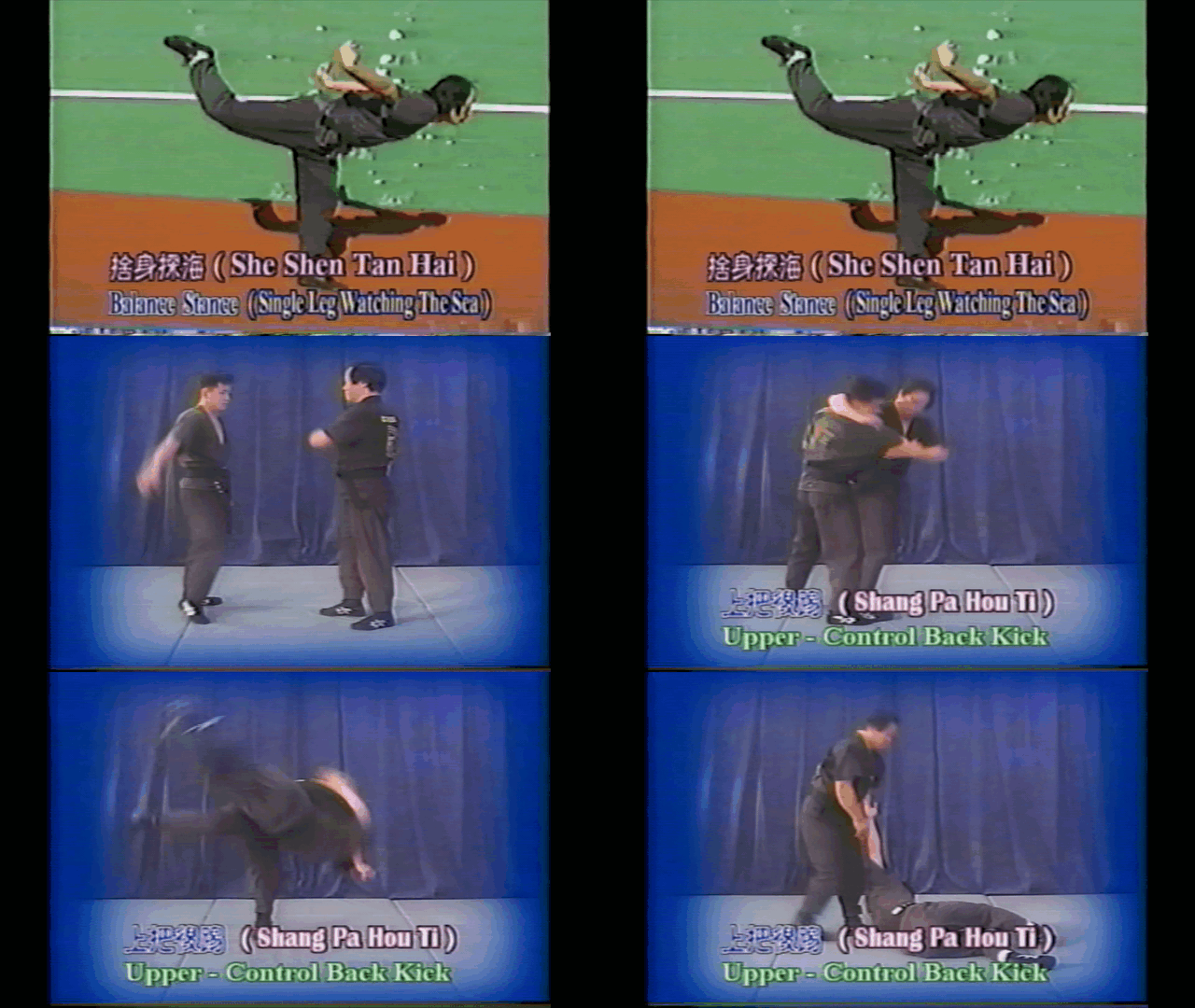
7. 舍身探海 (She Shen Tan Hai) Sacristy body and dive into ocean
8. 羅漢观天 (Luo Han Guan Tian) Lou Han looks at sky
9. 燕子超水 (Yan Zi Chao Shui) Swallow skips water
10.合卧 (He Wo) Combine stance
11. 古樹盤根 (Gu Shu Pan Gen) Old tree twist the root
12. 托天式 (Tuo Tian Shi) Lift the sky
13. 三平 (San Ping) Three plains


Some postures are so difficult to do it perfectly, and picture is used.

He_Wo_Dang.webp


Each posture has its combat application. For example, the combat application of 9. 燕子超水 (Yan Zi Chao Shui) Swallow skips water is:


Not sure about the purpose of the "tree hugging" posture is for. I just don't see any combat application there.

hug_tree.webp
 
Last edited:
Ok, easy enough to play with intent as I understand it from that frame of reference.

This is just a basic exercise that allows you to GET a physical sense of how you can play with intent for some "navel gazing" fun, and not necessarily for application of fighting, although, the method itself will put power into your Karate if you get creative with the idea in your overall continued practice of the method.

You have just snapped into soto uke and are at the terminus of the blocking action (as though you just blocked) as you would in kata. Hold that posture and relax everything while remaining in that stance. Start with your hands relaxing while forming fists but it's like you have a round wooden dowel in each of your hands, about the size of your index finger.

Let your elbows feel like they're sinking toward the floor like they have weights hanging from them, but don't actually lower them with any kind of effort or let their positioning alter your overall stance. Relax your shoulders so your scapulae drop toward your hips. You're holding soto uke but in a relaxed, soft manner.

Focus on your fingertips touching your palms. If you're right side forward, focus on the fingertips of your right hand as they rest against your palm. With all the intent you can apply to opening your right hand, don't. Hold your fingers in their softened state while you focus every bit of your intent to open your hand while keeping it closed. Focus on your fingertips softly touching your palm and check yourself for any tension throughout your body and release it before it's allowed to build.


Try it for a few minutes and switch sides.

Now for some really fun "navel gazing"

Stand in soto uke in the same relaxed manner as you did while working on your hands. Imagine a cable attached to your forward elbow and forward knee. With all the force of intent you played with earlier, lift your forward knee with your forward elbow. You don't need the arresting/opposing hold against the intent of lifting the knee because it's pretty much impossible to physically do that. The same 'resistance' you felt while working the hands is what you're trying to dial in with lifting your knees.

You can do a simpler exercise while sitting on a kitchen chair.

Place your hands on your thighs while seated, and relax your entire body while sitting up straight. Let your elbows and shoulders 'drop' as you did in soto uke ,while holding your elbows slightly forward. Now stand up with the full force of your intent to do so.

There will inevitably be tension as you work through the exercises and it's important to let it happen a little bit so you can modulate it and allow it to show itself so as to understand how it networks in your body because it's different for everyone. The modulation and conscious directing of tension into the 'channels' through which it travels is at least as important to explore and understand as the idea of being relaxed.

It isn't all there is to it, but it's a glimpse into the kinds of work I'm familiar with in exploring the solo work of applied intent.

Look forward to reading your feedback if you're willing to share it here.
In what way does this directly apply to the martial application of the Soto Uke?
 
This post will save you at least $120 for attending a "13 Tai Bao 十三太保" workshop.

The "13 Tai Bao 十三太保" posture training is to develop

- flexibility,
- balance,
- endurance, and
- body unification.

1. 旱地拔葱 (Han Di Ba Cong) Pull onion off a dry ground
2. 李奎磨斧 (Li Kui Mo Fu) Li Kui sharps the axe
3. 仙人照鏡 (Xian Ren Zhao Jing) Angle look at mirror
4. 钝链割谷 (Dun Lian Ge Gu) Dull sickle cut rice
5. 烏龍戏水 (Wu Long Xi Shui) Black dragon plays with water
6. 魁 星点斗 (Kui Xing Dian Dou) Kui Xing points at star
7. 舍身探海 (She Shen Tan Hai) Sacristy body and dive into ocean
8. 羅漢观天 (Luo Han Guan Tian) Lou Han looks at sky
9. 燕子超水 (Yan Zi Chao Shui) Swallow skips water
10.合卧 (He Wo) Combine stance
11. 古樹盤根 (Gu Shu Pan Gen) Old tree twist the root
12. 托天式 (Tuo Tian Shi) Lift the sky
13. 三平 (San Ping) Three plains


Some postures are so difficult to do it perfectly, and picture is used.

View attachment 33311

Each posture has its combat application. For example, the combat application of 9. 燕子超水 (Yan Zi Chao Shui) Swallow skips water is:


Not sure about the purpose of the "tree hugging" posture is for. I just don't see any combat application there.

View attachment 33310
Thank you. Yes if the stake standing have martial application they are worthwhile exercises for the martial arts.
The tree hugging work on a more broader sense and not directly toward a specific martial application. In its basic work it work on forces(visualized) from six directions,(up/down, front/back, side to side) that either pull or press on the body simultaneously with equal force.
Within this visualization one pull against the pull and press against the press(while keeping body relaxed in the posture)
Aim and gain is enhancement of one’s overall sensing and reaction mode + strength
 
Imperial Yang Taijiquan...really!?
Below quote is from here


Top
Yes, the imperial Taiji thing was a fad and with it so was Wei Shurens teachings. Sure Wei Shuren got some good info from his teacher Wang Yongquan, but at the time Wang was almost not able to walk and was teaching while sitting in a chair even teaching applications/push hand from that position.

I know the claim of Wei Shuren is that before he began study for Wang Yongquan(Yang Taiji) he had mastered Chen TJQ , but I recall reading back in the 90’s that his background before meting Wang Yongquan was just in the standardized 24 form that’s based on Yang Taiji, nothing wrong with that, I think that exercise have value but it’s hardly “Imperial”
 
On the mat, I had pushed and made my opponent fly. But I pulled my opponent first. When he resisted, I then borrowed his resistance force, added in my push. In one SC tournament, I had pushed my opponent's body to fly horizontally backward over 10 feet distance. But that was "borrow force" and not "push/fly".
yes this borrow force is same in taiji, some Taiji teachers have a “refined” take on this, especially during set performance demonstrations
 
“This is called Yi (意) — don’t think about it, don’t try to practice it, don’t force it. In time, it will come, and you will know it.”
That was the answer I was given years ago in my teacher’s group when I asked about something I had felt. The sensation was unmistakable, yet difficult to define.

We may have different viewpoints on this. In my teacher’s practice there was no separate ‘Yi training’ — everything was hands-on. The approach was simply: try it, see what happens.

From my experience, people with high skill — like many here — often already touch on these things, even if they dismiss them. With a little coaching, most could probably reproduce what they see in the video. Whether it fits into their current training is another question.


Would not agree — it’s training designed to isolate a concept so one can develop it.

How it’s used after that is another kind of training. Similar to throwing arts, where learning breakfalls is taught before throwing. Application comes later — but without isolating the principle first, there’s nothing to apply.

Really nothing more to say on this... an interesting discussion.
I had similar experiences with my teachers, I was told almost exactly those words. When I asked how he could do that, he said “ that’s why my name is on the sign outside”.
 
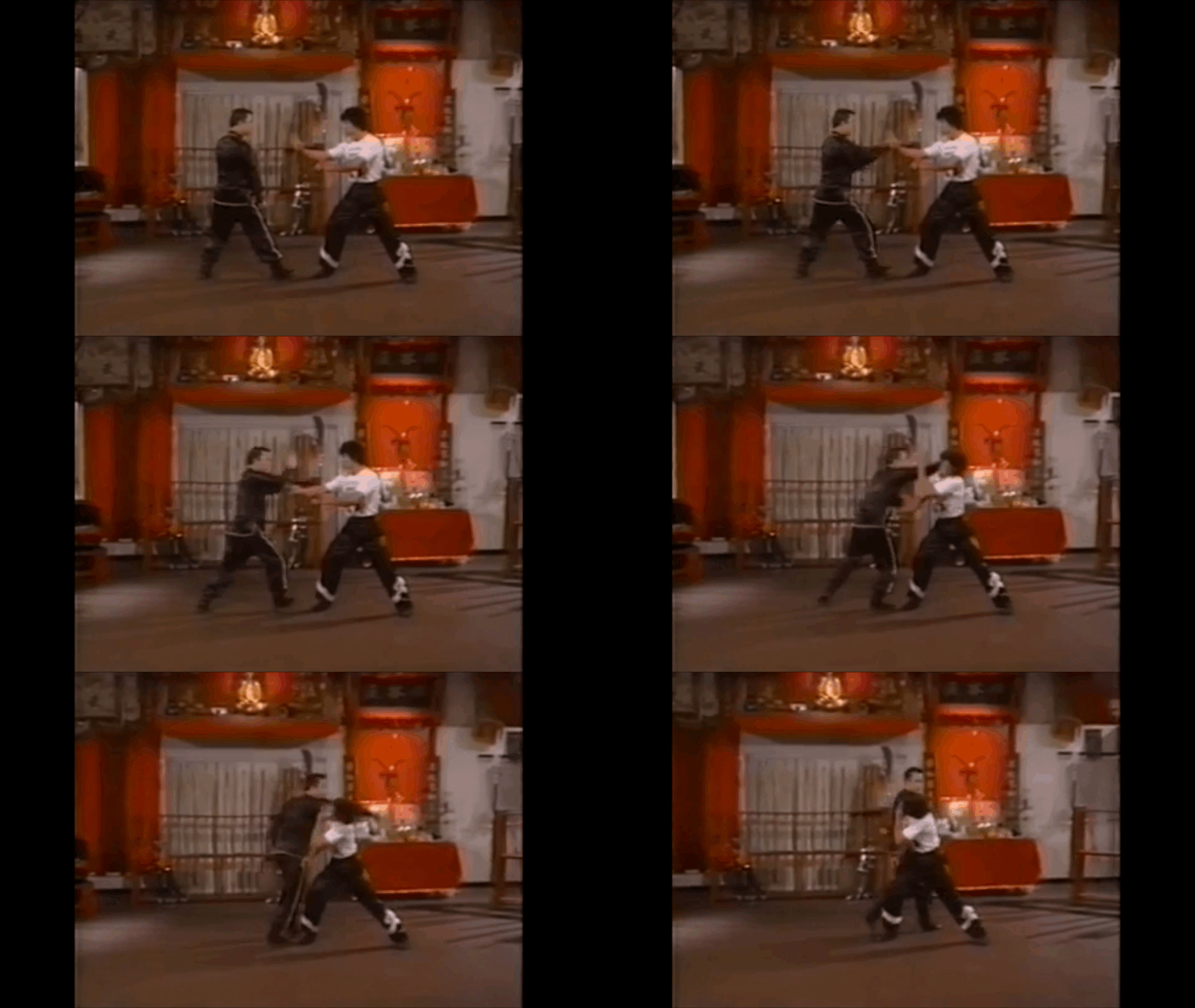
probably something like this:
iu


"navel gazing"otoh is a term I've appropriated from WWG's dismissive remark made earlier. On the topic of this discussion, and in my reply to O'Malley's post in particular, it loosely refers to the exploration of intent as a means of developing lower dantian.
Lower.
 
Would not agree — it’s training designed to isolate a concept so one can develop it.
MA training has 4 different stages:

- develop (your opponent gives you that opportunity),
- test (your opponent won't give you that opportunity),
- polish,
- enhance,

Without testing, how do you know what you have just developed will work in combat? So, how do you test your Yi in combat?
 
I dropped mine after feeling what my teacher showed, and have spent decades since working only on that.
Why did you switch from some practical combat art into an abstract Taiji art?

I'm the opposite. I started my Taiji training when I was 7. After I have cross trained other CMA systems, I feel other CMA systems are much more combat effective.

Today when I look back, I regret that I didn't learn "jab-cross-hook-uppercut-overhand" 5 moves punching combo and "front kick-roundhouse kick-side kick-back kick" 4 moves kicking combo when I was 7. IMO, those 9 skills are the most important combat skill that everybody should learn during their 1st year of MA training.
 
Last edited:
Without testing, how do you know what you have just developed will work in combat? So, how do you test your Yi in combat?
The way in which one tests the combat readiness of their skills development would follow the type of combat they are trained to conduct against the enemy. If it's an insurgency type combat, intent might involve ambush and direct contact along the lines of guerilla warfare whereas the intent of a recon action is generally focused on gathering intel, observation and extraction while avoiding and evading the enemy while being prepared to stand ground and fight if needs be. Then there's direct action combat where the intent would primarily be to know one's place in the chain of command and to follow orders.

In single combat, one would have to consider their situation as the determining factor in their chosen action as per their 'role' in that conflict. It may involve defensive or protective action and the variables of the situation can include any and all kinds where force multipliers might be improvised or environmental, as well as more conventional purpose-specific weapons. Intent is often considered in weighing what is legal and lawful, and where the demarcation lies between the two in the 'eyes of the law'.

If you're asking about sport fighting, that isn't combat. It's nothing more than sparring, albeit with a different level of contact and resistance within a standard rule set. In that case, one is testing the integration of skills and traits that accord with their personality and style. Intent is as variable as the athletes involved and is only a small part of the whole package. Thinking one should step in with a trained athlete and only test a single attribute while stripping away everything else is ridiculous.

Fixating on the finger and ignoring the moon.
 
The way in which one tests the combat readiness of their skills development would follow the type of combat they are trained to conduct against the enemy. If it's an insurgency type combat, intent might involve ambush and direct contact along the lines of guerilla warfare whereas the intent of a recon action is generally focused on gathering intel, observation and extraction while avoiding and evading the enemy while being prepared to stand ground and fight if needs be. Then there's direct action combat where the intent would primarily be to know one's place in the chain of command and to follow orders.
You may make combat training too complicate.

- A and B both have right side forward.
- A try to use right hand to touch on B's right shoulder.
- B try to block A's attack with his right arm.

If A's right hand can touch on B's right shoulder, A's Yi training has combat value. If not, A still need more Yi training.

Of course, A and B can use kick to replace their Yi training.

When A and B train and test their Yi by using this method, they both can kill 2 birds (Yi training and Yi application) with 1 stone.

It's much more fun to train Yi as in this video.

 
Last edited:

Latest Discussions

Back
Top