The Two Karate's: Self-Defense & Sport

I think or guess if having a specific focus of seriously hurting people while practicing kata would be a limitation to the practice and oneself , I mean the hurting ppl thing is already conveyed there with all the strikes and kicks so no need to consciously dwell deeper in such dark thought abyss
You are sadly mistaken if you equate mere physical skill and technique with the ability to put them to use in actual combat (a "dark abyss"). As the renowned master, Chibana Chosin, wrote, "...If you strike, then you strike to kill the enemy. This is the spirit you need in training." Mental preparation to engage on an extreme level must be cultivated like any other MA skill.
 
Last edited:
If you strike, then you strike to kill the enemy.
In CMA, if you strike, you should draw blood. This sounds uncivilized. Actually, this kind of thinking is very civilized. If you don't hate your opponent that much, you have no reason to start that fight.

99% of fighting can be avoided because you truly don't hate your opponent that much and want to kill him.
 
You are sadly mistaken if you equate mere physical skill and technique with the ability to put them to use in actual combat (a "dark abyss"). As the renowned master, Chibana Chosin, wrote, "...If you strike, then you strike to kill the enemy. This is the spirit you need in training." Mental preparation to engage on an extreme level must be cultivated like any other MA skill.
Mmm, Chosin Chibana tested this out in what ways ?
 
You are sadly mistaken if you equate mere physical skill and technique with the ability to put them to use in actual combat (a "dark abyss"). As the renowned master, Chibana Chosin, wrote, "...If you strike, then you strike to kill the enemy. This is the spirit you need in training." Mental preparation to engage on an extreme level must be cultivated like any other MA skill.
Not exactly karate but the gentlemanly “fight” principles of Bartitsu should perfectly fit karate’s self defense aim for the civilized world -


Bartitsu as a fighting philosophy can be summarised by these 3 principles:

1. To disturb the equilibrium of your assailant.
2. To surprise him before he has time to regain his balance and use his strength.
3. If necessary to subject the joints of any parts of his body to strains that they are anatomically and mechanically unable
to resist.”


About - The Bartitsu Club


As for the Taikyoku kata(s) as I mentioned previously one just need to look at the name of the kata to understand it’s not singlemindedly a method to maim and kill
 
I cannot agree that everything is rules bound. Legality goes out the window when laws are broken. Social & societal structures are broken minute by minute. Can you expand on "this heirarchy of abstractions"?
I do take issue with tippy-tappy points sparring. Worse than unrealistic. Keeping score can have unforeseen benefits. Assuming all is fair and (somewhat) equal, being scored on can be a good motivator and definitely sharpen the mind. Or expose a weakness.
You last statement would be against someone who is Expecting you to try to hit them. Many, many scenarios are quite the opposite if at all possible.
Conversely, if I can hit you in the face (through repeated practice) odds are at least better that I can gouge the eye.
Every form of TRAINING is rules bound. Obviously, in a broader sense, it's possible for people to break rules, laws, etc.

The hierarchy of abstractions is an idea I'm rejecting. NONE of us are actually doing the thing. We're not gouging eyes or breaking necks or cutting throats or restomping the groin in training. We're simulating the thing in one way or another. It's an abstraction. A compromise. Necessarily.

I'm rejecting the notion that one form of abstraction is inherently better than another. Here's an example from both sides:

- A martial artist blocks an incoming attack then counters with a shuto knife hand to the throat. He has intent. His hand is formed in a proper shuto. His target would indeed be likely to incapacitate someone if hit. But the technique is pulled. Nobody contends with doing that to another person. Nobody contends with having it done to them.

- A combat athlete lands a solid jab cross round kick combination on his opponent's face and thigh. Both are experienced at facing well-conditioned fighters deeply committed to knocking them out. Solid contact on each. He's wearing gloves. Maybe shin guards too. The other guy has headgear. All of which means they can continue this bout longer.

Now, if each were to apply their approaches in a real situation, each would have to make changes. Adjustments in their delivery. The first guy would have to follow through. The second guy would lose the gear and shift his targeting.

So why is the former superior to the latter? Why is it more likely that the first person is prepared to crush someone's trachea than it is for the second person to point their fingers on that jab or land that big kick on a knee joint instead of the thigh?

I think we all agree that modern point fighting is not what we're talking about. Anymore than modern tournament forms are a reflection of traditional technique training.

I've asked a couple of times now what "free sparring" is. How free are we really talking? Because, whatever the case, it falls somewhere short of reality. Again, necessarily.
 
Mmm, Chosin Chibana tested this out in what ways ?
Do you mean did he kill anybody? Probably not. I would guess most police and military combat instructors/experts haven't either. You ask many ridiculous questions.

Are you implying that practicing with both physical and mental intent in self-defense training is not worthwhile in preparing oneself for possibly lethal combat?

Chibana was Chief Instructor for the Shuri police dept., first president of the Okinawan Karate Federation and recipient of the Order of the Sacred Treasure from the emperor of Japan. He was known as the Last Warrior of Shuri. So, likely he didn't know much about MA.
 
Do you mean did he kill anybody? Probably not. I would guess most police and military combat instructors/experts haven't either. You ask many ridiculous questions.

Are you implying that practicing with both physical and mental intent in self-defense training is not worthwhile in preparing oneself for possibly lethal combat?

Chibana was Chief Instructor for the Shuri police dept., first president of the Okinawan Karate Federation and recipient of the Order of the Sacred Treasure from the emperor of Japan. He was known as the Last Warrior of Shuri. So, likely he didn't know much about MA.
Its possible. Defensive instructors are judged purely on image.

At one point the Navy seals trained S.C.A.R.S.


Which Aparently included the Harduken.
Screenshot_20260508_051210_YouTube.webp
 
Last edited:
Every form of TRAINING is rules bound. Obviously, in a broader sense, it's possible for people to break rules, laws, etc.

The hierarchy of abstractions is an idea I'm rejecting. NONE of us are actually doing the thing. We're not gouging eyes or breaking necks or cutting throats or restomping the groin in training. We're simulating the thing in one way or another. It's an abstraction. A compromise. Necessarily.

I'm rejecting the notion that one form of abstraction is inherently better than another. Here's an example from both sides:

- A martial artist blocks an incoming attack then counters with a shuto knife hand to the throat. He has intent. His hand is formed in a proper shuto. His target would indeed be likely to incapacitate someone if hit. But the technique is pulled. Nobody contends with doing that to another person. Nobody contends with having it done to them.

- A combat athlete lands a solid jab cross round kick combination on his opponent's face and thigh. Both are experienced at facing well-conditioned fighters deeply committed to knocking them out. Solid contact on each. He's wearing gloves. Maybe shin guards too. The other guy has headgear. All of which means they can continue this bout longer.

Now, if each were to apply their approaches in a real situation, each would have to make changes. Adjustments in their delivery. The first guy would have to follow through. The second guy would lose the gear and shift his targeting.

So why is the former superior to the latter? Why is it more likely that the first person is prepared to crush someone's trachea than it is for the second person to point their fingers on that jab or land that big kick on a knee joint instead of the thigh?

I think we all agree that modern point fighting is not what we're talking about. Anymore than modern tournament forms are a reflection of traditional technique training.

I've asked a couple of times now what "free sparring" is. How free are we really talking? Because, whatever the case, it falls somewhere short of reality. Again, necessarily.
I can certainly see the knee/thigh conundrum because it is really, really hard to get the majority of people to wrap their head around truly practicing a 'Martial Art'. Martial sport, martial art (little m), generic kickboxing or even modern taekwondo, karate, or Judo? Sure. But I have seen too many peoples eyes change, get real big and start getting figity when I go into detail on one/three-steps and finishing moves. Or even in depth about where the knee and the foot goes relative to a person head (when used descriptively for the target).
For the majority in ALL styles and nearly ALL schools the mindset is for fitness and somewhat casual. Even when we are going balls out, much harder than the cross-fit classes we also have in our building. I even see this is some of the kids in competition classes. They have not been really hurt yet and have little fear. They know/think they are protected by the rules, so when I start talking about 'exploiting' the rules to their advantage, they become a blank slate.
Absolutely, all organized martial arts classes are rules bound. Buuuut, there is no limit to how far a person can push themselves. And it is damn hard to offer classes that make that possible. No, I am not talking about continuously practicing carnal techniques, no school does, even if they really, really think they do. But there is a way to practice the mental component so that a person can go there when they need to. And more importantly, they will usually know they need to before the actual moment is upon them. Lot's of more current buzzwords out there but I firmly subscribe to S.A.
 
I can certainly see the knee/thigh conundrum because it is really, really hard to get the majority of people to wrap their head around truly practicing a 'Martial Art'. Martial sport, martial art (little m), generic kickboxing or even modern taekwondo, karate, or Judo? Sure. But I have seen too many peoples eyes change, get real big and start getting figity when I go into detail on one/three-steps and finishing moves. Or even in depth about where the knee and the foot goes relative to a person head (when used descriptively for the target).
For the majority in ALL styles and nearly ALL schools the mindset is for fitness and somewhat casual. Even when we are going balls out, much harder than the cross-fit classes we also have in our building. I even see this is some of the kids in competition classes. They have not been really hurt yet and have little fear. They know/think they are protected by the rules, so when I start talking about 'exploiting' the rules to their advantage, they become a blank slate.
Absolutely, all organized martial arts classes are rules bound. Buuuut, there is no limit to how far a person can push themselves. And it is damn hard to offer classes that make that possible. No, I am not talking about continuously practicing carnal techniques, no school does, even if they really, really think they do. But there is a way to practice the mental component so that a person can go there when they need to. And more importantly, they will usually know they need to before the actual moment is upon them. Lot's of more current buzzwords out there but I firmly subscribe to S.A.
I want to be very clear that my argument is that they're both compromises. Not that sport training is superior. As I've said many times here and elsewhere, I was never much of a competitor myself.

I imagine you're right that there's no limit to how far someone could push themselves. But the hows and whys are, I suspect, more complicated than all that. Describing a gruesome act is very different from actually committing one. And I don't believe that people who talk about such things automatically fair better in actually doing them. I think it's probably more complex than that.

I remember about 25 years ago training in a kali class and looking around thinking how casually we were all simulating cutting someone's throat. Just didn't ring true to me, despite many years of training for such a thing.

I've spent a bit of time boxing (poorly) and kickboxing (likewise). And it occurs to me that people who compete in those formats are already closer than many martial arts practitioners. They're actually engaged in the practice of disabling an attacker. What is a TKO if not doing to an opponent enough to make them incapable or unwilling to continue?

I think there are probably a lot of personality and experiential factors not being accounted for in this dichotomy. And it'll be a properly long thread before we got anywhere near consensus on that one.

You know what I'm saying though, I think. Talking about how you'd do it in reality is a valid form of mental training. There's psychology to back that up. But it's still clearly a step back from reality for the sake of training.
 
I can certainly see the knee/thigh conundrum because it is really, really hard to get the majority of people to wrap their head around truly practicing a 'Martial Art'. Martial sport, martial art (little m), generic kickboxing or even modern taekwondo, karate, or Judo? Sure. But I have seen too many peoples eyes change, get real big and start getting figity when I go into detail on one/three-steps and finishing moves. Or even in depth about where the knee and the foot goes relative to a person head (when used descriptively for the target).
For the majority in ALL styles and nearly ALL schools the mindset is for fitness and somewhat casual. Even when we are going balls out, much harder than the cross-fit classes we also have in our building. I even see this is some of the kids in competition classes. They have not been really hurt yet and have little fear. They know/think they are protected by the rules, so when I start talking about 'exploiting' the rules to their advantage, they become a blank slate.
Absolutely, all organized martial arts classes are rules bound. Buuuut, there is no limit to how far a person can push themselves. And it is damn hard to offer classes that make that possible. No, I am not talking about continuously practicing carnal techniques, no school does, even if they really, really think they do. But there is a way to practice the mental component so that a person can go there when they need to. And more importantly, they will usually know they need to before the actual moment is upon them. Lot's of more current buzzwords out there but I firmly subscribe to S.A.
Ok. But training an eye poke and then stopping short of poking someone in the eye.

Is a rule.

Or you would just poke them.

In the carpark.

 
Do you mean did he kill anybody? Probably not. I would guess most police and military combat instructors/experts haven't either. You ask many ridiculous questions.

Are you implying that practicing with both physical and mental intent in self-defense training is not worthwhile in preparing oneself for possibly lethal combat?

Chibana was Chief Instructor for the Shuri police dept., first president of the Okinawan Karate Federation and recipient of the Order of the Sacred Treasure from the emperor of Japan. He was known as the Last Warrior of Shuri. So, likely he didn't know much about MA.

The ”strike as to kill” you attribute to Chosin Chibana no doubt comes from Jigen-Ryu ”one cut, one kill” ”motto”.

I found this source on Chosin Chibana, he had many sayings that seemingly balance up the -

Chibana Sensei often said, “Ippon kowashi
no waza,” which means “one technique,
total destruction
.”


https://liuchiuan.com/wp-content/uploads/2013/08/cfachibana.pdf


I actually think CC saying is on a broader/larger/higher level of understanding than the pinpointing like you presented -


isshinryuronin said:

The "intent" during solo drills it to prepare you to follow through in actual situations when causing harm is required. It's a type of mental conditioning, visualizing an opponent before you and you striking his throat and breaking his arm.”


Karate is a civil martial art not designed for battlefield ….But many into it seemingly want to imagine a battle hardened warrior aura to it.. the closest one may come to such a thing might actually be through the sportive side of the matter
 
I want to be very clear that my argument is that they're both compromises. Not that sport training is superior. As I've said many times here and elsewhere, I was never much of a competitor myself.

I imagine you're right that there's no limit to how far someone could push themselves. But the hows and whys are, I suspect, more complicated than all that. Describing a gruesome act is very different from actually committing one. And I don't believe that people who talk about such things automatically fair better in actually doing them. I think it's probably more complex than that.

I remember about 25 years ago training in a kali class and looking around thinking how casually we were all simulating cutting someone's throat. Just didn't ring true to me, despite many years of training for such a thing.

I've spent a bit of time boxing (poorly) and kickboxing (likewise). And it occurs to me that people who compete in those formats are already closer than many martial arts practitioners. They're actually engaged in the practice of disabling an attacker. What is a TKO if not doing to an opponent enough to make them incapable or unwilling to continue?

I think there are probably a lot of personality and experiential factors not being accounted for in this dichotomy. And it'll be a properly long thread before we got anywhere near consensus on that one.

You know what I'm saying though, I think. Talking about how you'd do it in reality is a valid form of mental training. There's psychology to back that up. But it's still clearly a step back from reality for the sake of training.
Fully agree. If you choose to, I suppose you could say talking about carnal, finishing moves as baby steps. But at least it is a starting point. Especially for polly-anna's who have never had to think about the things that could happen to them and what their response should be.
After all, at it's very core everything done in the martial arts is reactionary. Even if we make the first move, it is reactionary to our own pre-planned thoughts and practice.
One of the surprising things I had to adjust to when I learned Kali from Tuhan Bill McGrath back in the '90's is that we started training with a steel blade, went to sticks, then to open hands. Very, very eye opening.
I had always been in sports and my competition and exposure was in contact martial arts. Had a decently good competition run. For me, being close in was always more comfortable than being at distance. I have given and received my fare share of KO's and TKO's so, yeah.
I don't see how there will ever be consensus since the target is never static.
 
I don’t think it matters too much how many times imagine themselves actually attacking someone to the point of permanent injury or past the point the other person being able to defend. Most people will stop when the opponent is unconscious or unable to continue, but not everyone. Context is key. Heightened emotional states can create unusual situations and actions. Emotionless mechanical violence is the exception rather than the rule. People can be pressed into extraordinary behaviors they would not be capable of in normal circumstances. I think most people are unwilling but maybe not unable to put a knife on someone depending on the circumstances. My point is that real violence is never is like we imagine it. No amount of fantasy can prepare a person for being stabbed in reality.
 
Thankfully, I’ve never been in a gunfight. But I’d always be bringing a knife. Every cop I know carries a knife.

Fourteen of my friends/coworkers have been shot, some multiple times, some on multiple occasions. All have survived.

I still work as a cop. I still carry a knife as well as my service weapon. Hopefully, I’ll never be in a gunfight. Or a knife fight.

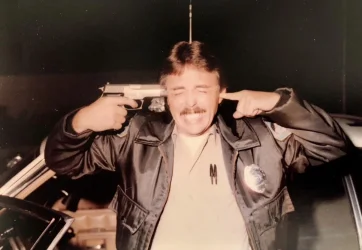
The photo below is a strange attempt at humor. But he’s my buddy and was a coworker for many years. He’s been shot on two occasions. The first time was in Vietnam. He was shot seventeen times. (You read that right) Like he always said, “Getting shot doesn’t really hurt much, your body goes into shock right away. But HEALING from getting shot hurts like a son of a beach.”

He’s retired now, living down south. Still packs a knife, still carries a gun.

It’s a different equation for everyone.
 

Attachments

  • IMG_9730.webp
    IMG_9730.webp
    98.8 KB · Views: 48
Thankfully, I’ve never been in a gunfight. But I’d always be bringing a knife. Every cop I know carries a knife.

Fourteen of my friends/coworkers have been shot, some multiple times, some on multiple occasions. All have survived.

I still work as a cop. I still carry a knife as well as my service weapon. Hopefully, I’ll never be in a gunfight. Or a knife fight.

The photo below is a strange attempt at humor. But he’s my buddy and was a coworker for many years. He’s been shot on two occasions. The first time was in Vietnam. He was shot seventeen times. (You read that right) Like he always said, “Getting shot doesn’t really hurt much, your body goes into shock right away. But HEALING from getting shot hurts like a son of a beach.”

He’s retired now, living down south. Still packs a knife, still carries a gun.

It’s a different equation for everyone.
If you saw me when I was a LEO, I Always had two firearms and at least one blade weapon on my person. Not to mention the longarm(s) in the patrol car. I know guys who used to carry four pistols. Hip, back, ankle and a pocket derringer. I opted for more magazines.
 
Back
Top