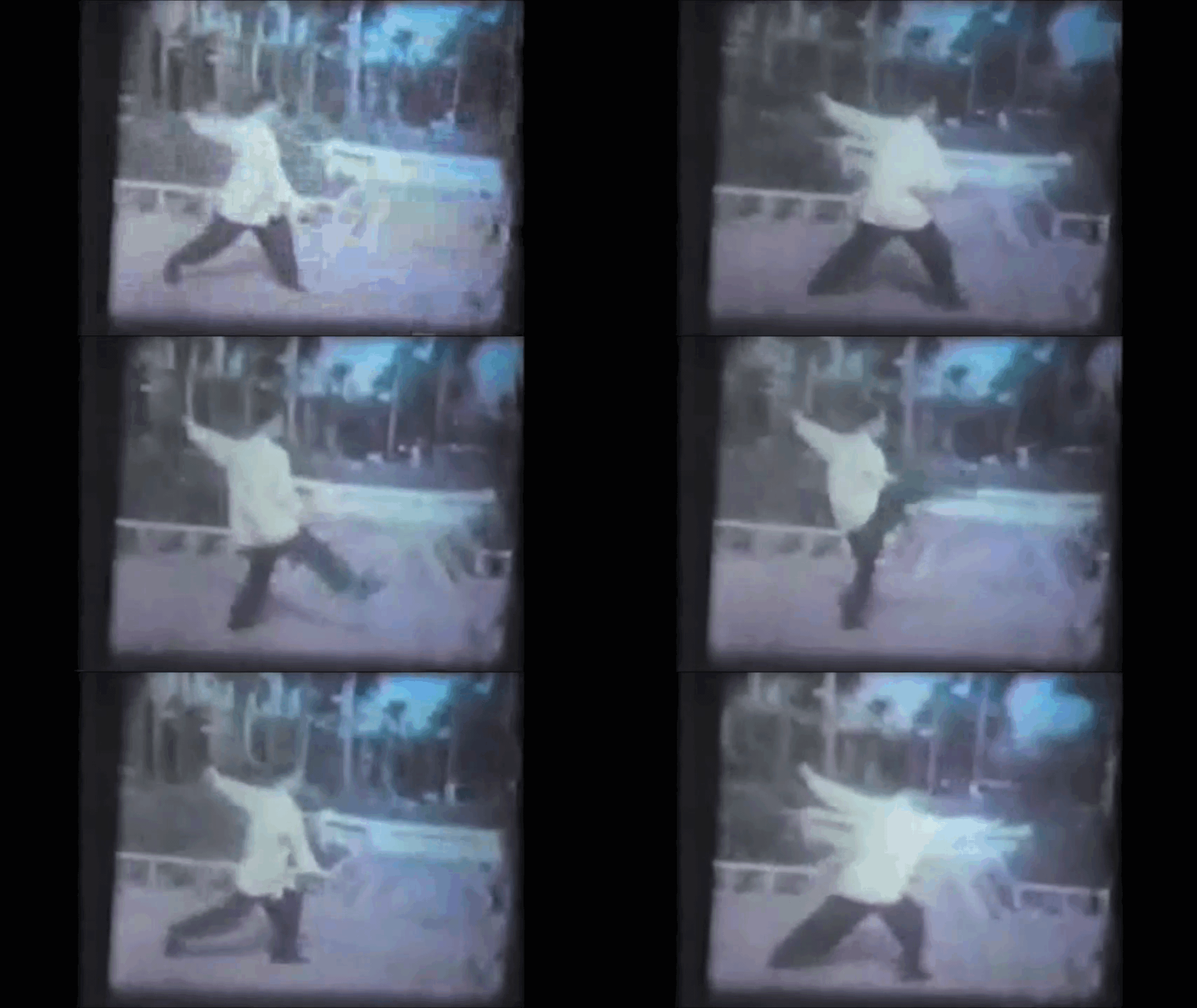
The Difference between Longfist Kicks and Taiji Kicks

what makes it Taiji ...
It's meaningless to compare

- long fist front kick and Taiji front kick.
- Praying mantis uppercut and boxing uppercut.
- SC hip throw and Judo hip throw.
- Eagle claw wrist lock and Aikido wrist lock.

I don't let the term "style" to set up any physical limitation on myself. When I throw a kick, it's my kick. it's not long fist kick, Taiji kick, or ...

I'm talking about MA in general. The term "style" has no meaning to me. If I can land my kick on my opponent's chest and knock him down, I can't careless whether I may use long fist kick, Taiji kick, Karate kick, TKD kick, or MT kick.

IMO, kick/lock/throw are above all MA styles. Even uppercut/hook/overhand are above all MA styles.
 
Last edited:
I'm talking about MA in general. The term "style" has no meaning to me. If I can land my kick on my opponent's chest and knock him down, I can't careless whether I may use long fist kick, Taiji kick, Karate kick, TKD kick, or MT kick.

If style has no meaning to you, why did you enter a thread about the difference between Longfist and Taiji kicks?

Why argue for a Chang Taiji breathing principle?
Why identify your method as Taiji if these distinctions have no meaning?

You asked what differentiates a Longfist kick from a Taiji kick.
Now, when asked what specifically makes the mechanics you describe Taiji, you say that when you kick, it is simply ā€œyour kick.ā€

I actually agree with that—to a point. When a method has been deeply internalized, one no longer needs to consciously identify a movement by style. The method has shaped the practitioner, the movement expresses that method.

But that doesn't make the underlying differences between methods meaningless. It makes the question even more relevant:

What method has shaped the way you move?

If Taiji, Longfist, Karate, TKD and Muay Thai are simply interchangeable ways of producing the same martial result, then what distinguishes the method being trained?

Calling one ā€œcombat Taijiā€ doesn't explain what makes the underlying method Taiji.

You can't use distinctions between styles to establish principles of Taiji and then dismiss those distinctions when asked what makes your own method Taiji.
 
You speak first of ā€œChang Taiji,ā€ and then simply of ā€œTaiji.ā€

Your breathing principle comes from your teacher's Chang Taiji method. Why do you assume that a training method specific to Chang Taiji defines how other Taiji methods should be practiced?

More broadly, you continue to describe Taiji in terms of ordinary mechanics—balance, body mass, waist movement, breath and application. What specifically distinguishes the mechanics you describe from those of any other martial art using coordinated whole-body force?

If there is no fundamental difference in how the force is produced and transmitted, what makes it Taiji rather than simply another martial method performed through a Taiji form?

I think it was Wang Zongyue who once said, ę–ÆęŠ€ę—é–€ē”šå¤š
 
I think the full passage is worth posting,

ę–ÆęŠ€ę—é—Øē”šå¤šļ¼Œč™½åŠæęœ‰åŒŗåˆ«ļ¼Œę¦‚äøå¤–å£®ę¬ŗå¼±ć€ę…¢č®©åæ«č€³ć€‚
There are many side methods in this art. Although their forms differ, generally they amount to the strong overcoming the weak and the slow yielding to the fast.

ęœ‰åŠ›ę‰“ę— åŠ›ļ¼Œę‰‹ę…¢č®©ę‰‹åæ«ļ¼Œę˜Æēš†å…ˆå¤©č‡Ŗē„¶ä¹‹čƒ½ļ¼Œéžå…³å­¦åŠ›č€Œęœ‰äøŗä¹Ÿć€‚
The strong defeating the weak, and the slow hand yielding to the fast hand—these are natural abilities, not the result of learned skill.

åÆŸā€œå››äø¤ę‹Øåƒę–¤ā€ä¹‹å„ļ¼Œę˜¾éžåŠ›čƒœļ¼›č§‚č€„č€‹å¾”ä¼—ä¹‹å½¢ļ¼Œåæ«ä½•čƒ½äøŗļ¼Ÿ
Consider ā€œfour ounces deflect a thousand poundsā€: clearly this is not victory through strength. Observe an old person dealing with many—what can speed accomplish?

ē«‹å¦‚ē§¤å‡†ļ¼Œę“»ä¼¼č½¦č½®ļ¼Œåę²‰åˆ™éšļ¼ŒåŒé‡åˆ™ę»žć€‚
Stand balanced like a scale; move freely like a wheel. When weight settles to one side, one can follow; double-weighting produces stagnation.

ęÆč§ę•°å¹“ēŗÆåŠŸļ¼Œäøčƒ½čæåŒ–č€…ļ¼ŒēŽ‡ēš†č‡Ŗäøŗäŗŗåˆ¶ļ¼ŒåŒé‡ä¹‹ē—…ęœŖę‚Ÿč€³ć€‚
We often see people who have practiced diligently for years yet cannot transform incoming force. Generally, they remain controlled by others because they have not understood the fault of double-weighting.

ę¬²éæę­¤ē—…ļ¼Œé”»ēŸ„é˜“é˜³ļ¼›ē²˜å³ę˜Æčµ°ļ¼Œčµ°å³ę˜Æē²˜ļ¼Œé˜³äøē¦»é˜“ļ¼Œé˜“äøē¦»é˜³ļ¼›é˜“é˜³ē›øęµŽļ¼Œę–¹äøŗę‡‚åŠ²ć€‚
To avoid this fault, one must understand yin and yang. Adhering is yielding; yielding is adhering. Yang does not leave yin, nor yin leave yang. Only when yin and yang mutually complement one another is there understanding of jin.

ę‡‚åŠ²åŽļ¼Œę„ˆē»ƒę„ˆē²¾ļ¼Œé»˜čÆ†ę£ę‘©ļ¼Œęøč‡³ä»Žåæƒę‰€ę¬²ć€‚
After understanding jin, continued practice brings increasing refinement. Through silent recognition and careful investigation, one gradually reaches the point of doing as the heart-mind wishes.

ęœ¬ę˜Æčˆå·±ä»Žäŗŗļ¼Œå¤ščÆÆčˆčæ‘ę±‚čæœć€‚ę‰€č°“å·®ä¹‹ęÆ«åŽ˜ļ¼Œč°¬ä¹‹åƒé‡Œć€‚å­¦č€…äøåÆäøčÆ¦č¾Øē„‰ć€‚ę˜Æäøŗč®ŗć€‚
Fundamentally, it is to give up oneself and follow the other. Many mistakenly abandon what is near to seek what is far away. A difference of a hair's breadth leads to an error of a thousand li. The student must carefully distinguish these things.


å­¦č€…äøåÆäøčÆ¦č¾Øē„‰ — the student must carefully distinguish these things.

indeed šŸ¤”
 
A: I use my kick to knock down my opponent. When I kick, my gravity center is in front of my base.
B: I use my kick to check my own balance. When I kick, my gravity center is within my base.

What you have just said is, "Long fist train for combat. Taiji train for health/self-cultivation".

IMO, whenever the health/self-cultivation appears in any combat discussion (or the other way around), the discussion will end nowhere. After that, it's just like a chicken talk to a duck.

Taiji is a combat art in my opinion. Is Taiji a combat art in your opinion?
So in Chang taiji 108 form one throw the body forward when kicking ?
 
So in Chang taiji 108 form one throw the body forward when kicking ?
Chang Taiji shares the same 108 moves as Yang Taiji has. Only 6 moves are changed in Chang Taiji.

1. Move your gravity center to be outside of your base.
2. Let the gravity to pull you forward.
3. You then regain your balance back.

Step 2 is also missing in Chang Taiji as well.

Without lean body forward, I can't achieve "downward curve" in my front kick.

 
Last edited:
Because I have said there is no difference between long fist kick and Taiji kick.

I find your comments interesting at times...confusing at others
as now. šŸ¤”

You cannot:

Enter a thread about the difference between Longfist and Taiji kicks
Argue for a specific Chang Taiji breathing principle
Identify the method you're discussing as Taiji

And then say:

ā€œThere is no difference between Longfist and Taiji kicks.ā€
ā€œStyle has no meaning to me.ā€

If there is no difference, why argue the distinction?
Why defend a Chang Taiji principle? Why identify the method as Taiji?

Either the distinction has meaning, or it doesn't.
 
Last edited:
Either the distinction has meaning, or it doesn't.
As I have said, there is no "internal" way and external way. There is only the right way and the wrong way.

The long fist system uses "nature breathing" as well. I have always believed it's wrong.

The day when my

- Taiji teacher Chang Tung-Sheng taught me that "The speed of 1 move should be equal to the time of either 1 inhale or 1 exhale".
- long fist teacher taught me that a front kick should contain a "downward curve".

It opened my eyes completely.

If one day these 2-piece information can be fed into AI, I'll be happy for that.
 
Last edited:
If my information can help even just 1 person, I'll be happy for that.

A teacher says: ā€œHere is what I learned. It may or may not apply to you. Test it for yourself.ā€

A preacher says: ā€œHere is the truth. Other methods are wrong.ā€

You are free to decide what is right or wrong for your own practice, but you are not the arbiter of what is right or wrong outside of it. By dismissing other methods as simply ā€œwrong,ā€ you make your own practice the standard by which they are judged.

When I look at other people's practices, particularly when they post videos, I try to look at them through the framework they have described, regardless of whether I agree with it.

In many cases, I don't agree with the basic premises—but it's their practice, and the practice of those who follow that method. The differences you keep dismissing are precisely what distinguish one method from another.
 
You are free to decide what is right or wrong for your own practice,
Master Chang Tung-Sheng said, "Many things are wrong in Taiji and someone has to stand up, tell the truth, and correct it".

- "ęŠ±č™Žå½’å±± Carry tiger back to mountain" should be "é„±č™Žå½’å±± Well fed tiger return back to mountain" (抱 and 鄱 both spell Bao).
- "ꉇ通背 Move arm like fan" should be "č‚©é€ščƒŒ Shoulder extend to arm" (ꉇ and č‚© look similar in Chinese writting).
- "Double pulling" should have 1 hand down and 1 hand up.
- One should not turn his head back when doing "step back and repulse monkey".
- ...

If Master Chang could point out those 4 faults in Taiji, it won't be surprised that he could point out more faults in Taiji as well (such as proper breathing method, leg skill, ...)
 
Last edited:
Chang Taiji shares the same 108 moves as Yang Taiji has. Only 6 moves are changed in Chang Taiji.

1. Move your gravity center to be outside of your base.
2. Let the gravity to pull you forward.
3. You then regain your balance back.

Step 2 is also missing in Chang Taiji as well.

Without lean body forward, I can't achieve "downward curve" in my front kick.

What six moves are that ?
 
Master Chang Tung-Sheng said, "Many things are wrong in Taiji and someone has to stand up, tell the truth, and correct it".

- "ęŠ±č™Žå½’å±± Carry tiger back to mountain" should be "é„±č™Žå½’å±± Well fed tiger return back to mountain" (抱 and 鄱 both spell Bao).
- "ꉇ通背 Move arm like fan" should be "č‚©é€ščƒŒ Shoulder extend to arm" (ꉇ and č‚© look similar in Chinese writting).
- "Double pulling" should have 1 hand down and 1 hand up.
- One should not turn his head back when doing "step back and repulse monkey".
- ...

If Master Chang could point out those 4 faults in Taiji, it won't be surprised that he could point out more faults in Taiji as well (such as proper breathing method, leg skill, ...)
Did Master Chang Tung-Sheng come to notice those ā€faultā€ through his long-fist mastery or wrestling mastery ?( I’m thinking about ā€œdouble pullingā€ and ā€œlooking back in repulse monkey moveā€)
 
As I have said, there is no "internal" way and external way. There is only the right way and the wrong way.

The long fist system uses "nature breathing" as well. I have always believed it's wrong.

The day when my

- Taiji teacher Chang Tung-Sheng taught me that "The speed of 1 move should be equal to the time of either 1 inhale or 1 exhale".
But since the authentic Taiji form is one long continuous flow, there arent any distinct stops and starts within the exercise when exercised, just one flow, the breath can only be natural, cause you can hardly do one inhale/exhale during the 20 or so min it takes to complete the whole authentic TJQ form
 
But since the authentic Taiji form is one long continuous flow, there arent any distinct stops and starts within the exercise when exercised, just one flow, the breath can only be natural, cause you can hardly do one inhale/exhale during the 20 or so min it takes to complete the whole authentic TJQ form
The form is for teaching/learning only. The form is not for training. One should train drills instead.
 
Did Master Chang Tung-Sheng come to notice those ā€faultā€ through his long-fist mastery or wrestling mastery ?( I’m thinking about ā€œdouble pullingā€ and ā€œlooking back in repulse monkey moveā€)
Double pulling - You need to use 1 hand to pull your opponent's wrist joint (face down). You also need to use another to pull his elbow joint (face up).

Step back repulse monkey - Your opponent is in front of you. You can't turn your head.
 
What six moves are that ?
1. No head turning in step back repulse monkey.
2. Use double palm strike instead of double hook punch in twin peaks to the ear.
3. Replace Taiji cross leg by Xingyi Pi Quan with knee kick.
4. Add shin bite into hand play lute.
5. Use hook punch instead of hammer fist in striking tiger.
6. Add palm strike to the head in wide horse splitting mane.
 
Double pulling - You need to use 1 hand to pull your opponent's wrist joint (face down). You also need to use another to pull his elbow joint (face up).

Step back repulse monkey - Your opponent is in front of you. You can't turn your head.
In sense of Taiji one do not pull, one lead in the direction the opposing force goes, in so, there no need for forced pulling .

TJQ wise, Wherever the opposing is situated towards ones own position it’s much a matter of listening rather than locking eyes.
 

Latest Discussions

Back
Top