Re-examining Jukado, the art of Bruce Tegner

1) Bruce Tegner's parents were judo and jujutsu instructors. He was California state champion at 17, and one of the youngest nidan in the U.S> when he advanced in rank at 21.His karate was from Tani-ha shito-ryu, also called Karate Shukokai, and he was awarded a black belt, but his knowledge was probably pretty rudimentary,and the promotion largely to promote the art in the U.S. He actually did study all the arts of his books, and his instructors contributed, but I've no idea how he was ranked in aikido, kung fu or any of the others....but his knowledge was probably as rudimentary as it was with karate.
2) He taught movie stars and choreographed fight scenes, the most famous being the fight between Frank Sinatra and Henry Silva in "The Machurian Candidate."
3) Bob Rosenbaum was a student of his, and posted here as "jukado1," but the last time was five years ago, and he's 81 now, if he's still alive.
Any insights into jukado itself would be welcome
 
So some observations so far. The hand techniques are standard fare that is found in other books by the author. The kicking is much different than the self defense kicks found in his other books. They are actually high kicks in jukado. They are marked as not being useful for self defense and explained as a good exercise.

In each rank there are locks throws and self defense responses that would need to be learned and demonstrated. Initially, I had trouble with this as the locks are shown on one side and that required some thought as to how to train the left side. It couldn't just been done via a "kata" approach as you do need to get that feel when you click the lock with your hands / arms.

I found that if you take a karate belt and tie it around a pole, you can use it to train the locks. Taking a hint from his book on judo and karate exercises, one can also tie a karate belt around a free standing heavy bag to practice throws. with that said depending on one's height, you might need to put the heavy bag on a platform to give it height (I used a bucket which allowed me to practice the hip throw). I have not tried a shoulder throw which might be problematic.

If you like to practice using the 3 K's (kihon, kata, kumite) you will have to substitute some things. There are no formal katas in Jukado, however, the self defense responses could be used as a kata. One would have to make sure they are done on both sides.
One could also use the demonstration photos to build a "kihon kata" in order to practice the basic techniques. For kumite, if there is no one available then one would need a BOB or heavy bag. I have toyed with the idea of paying a fee to practice kumite with a karate studio down the street but have not investigated that further.

The blocking techniques are limited. It really doesn't go into using the normal UKE's but it does cover using knife edge for blocks and for parries. I actually think that the blocks and parries found in his Complete Book of Self Defense covers this better.
This may be because this is Jiu Jitsu rather than karate.

I found the given strikes and kicks to be very minimal. I actually added handstrikes / kicks from Mas Oyama's kyokushin book "Vital Karate". But lets look at other works in comparison, The chuck Norris Karate System, has very similar handstrikes with the addition of the ridge hand. Same for Hidy Ochiai's "Living Karate". In adding strikes or kicks, you might feel the need to figure out which rank should these strikes be included.

I also found having his other books (Complete Book of Karate, Complete Book of Self Defense) are useful for filling in the gaps and one could use the kata's provided in "Complete Book of Karate" sport forms section as a basis for Jukado as there is a lot of overlap. But I also have some real criticisms of his "Complete Book of Karate" as well...

One final thought:
I think this art needs to evolve from where it was back in the 1960's. Most of the hand strikes are ok, but there are some that need to be evaluated for use. Karate really has a lot of handstrikes to choose from and the goal is not to learn everyone of them to a high level but to choose which works for the practitioner. This works fine with someone that has at least some knowledge, but if one is a complete beginner this would be a problem.
 
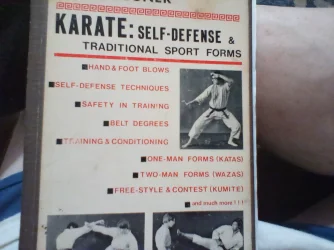
I was looking through another earlier book by tegner: "karate: self defense & traditional sport forms". It turns out that this book also has bob rosenbaum (jukado1) as a demonstrator.
 

Attachments

  • 17647361448037451021816963304733.webp
    17647361448037451021816963304733.webp
    228 KB · Views: 61
Back
Top