Re-examining Jukado, the art of Bruce Tegner

I agree... there are videos of every style that can be bought though one can find youtube videos that have "classes" as a result of covid lockdown.

oh and the book that was used in the karate kid:
"Mastering karate" by Mas Oyama...

there was one error with my post concerning savate:
there are 2 books written by Bruce on savate. The earlier one does have him showing the techniques and appears to be before savate was really organized. The techniques seem to be a bit more street oriented and he was wearing sweat clothes (workout clothes) and tennis shoes.

the later book had savateurs with tights and I think when they had colored rankings for skill level.
and they demonstrated the techniques.

My personal opinion is that the earlier book was better.
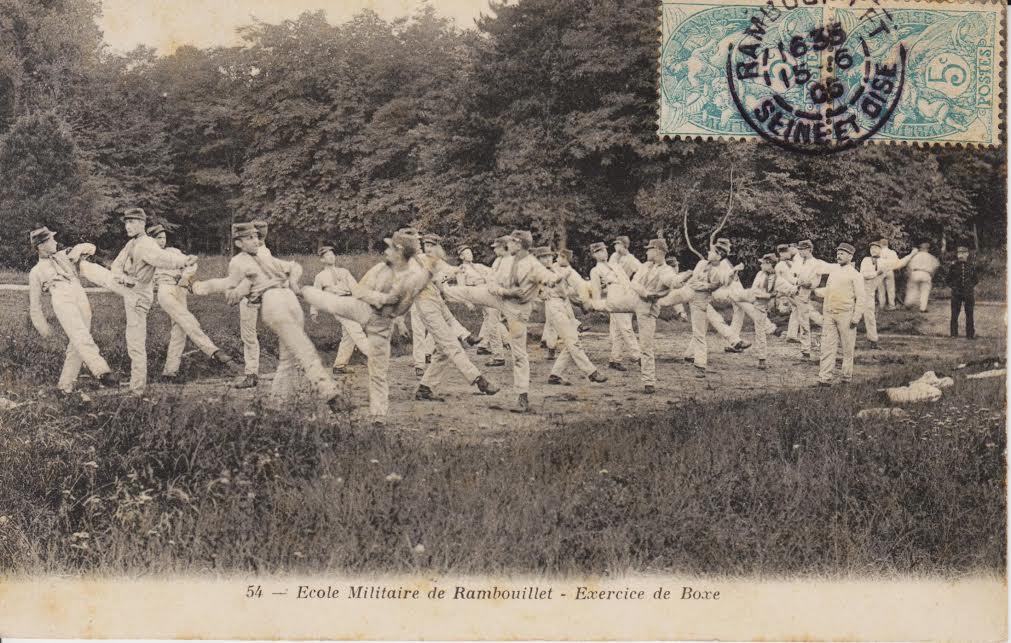
Savate has been part of French foreign legion’s hand to hand combat training since late 19th century, sometimes later adopted by French Army/Navy and also by French police force for a while. So I think it was an organized system from early on
 
Savate has been part of French foreign legion’s hand to hand combat training since late 19th century, sometimes later adopted by French Army/Navy and also by French police force for a while. So I think it was an organized system from early on
Yes, savate was around in the late 1800's as "dirty" fighting by the tough guys on the waterfront. I also think that it was organized in some fashion in the early 1900's with acknowledged "masters," many of whom died in the battles of WWI (this from an old Black Belt Magazine article around 1968). But like the Okinawan martial artists who suffered great loss of life in WWII's bombing and invasion (along with great loss of TMA historical writings) the art survived.
 
Savate has been part of French foreign legion’s hand to hand combat training since late 19th century, sometimes later adopted by French Army/Navy and also by French police force for a while. So I think it was an organized system from early on
True but I think there were different styles of savate during this time. And actually savate changed Japanese karate. Gichin funakoshi's son added kicks from savate , changing karate.
All I was saying was that the later version of the savate book had a more polished look by the models which made it look more sport oriented compared to the earlier one that had different versions of kicks that looked more street oriented. But I guess I'm hitting my limits on what I know about it.
 
True but I think there were different styles of savate during this time. And actually savate changed Japanese karate. Gichin funakoshi's son added kicks from savate , changing karate.
All I was saying was that the later version of the savate book had a more polished look by the models which made it look more sport oriented compared to the earlier one that had different versions of kicks that looked more street oriented. But I guess I'm hitting my limits on what I know about it.
Found this interesting article. Scroll down a little and it talk about Savate -
 
Found this interesting article. Scroll down a little and it talk about Savate -
that is very interesting... especially about the early forms using slaps. I believe that early form of boxing (fisticuffs) used both fists and palm heel strikes (the cuffs part) before it became more sports oriented as well.
 
so to correct an earlier post of mine. In the book "Complete book of jukado self defense" in the black belt training there are a sequence of photos showing Bob Rosenbaum (jukado1) doing a self created form (part of what was needed to acquire black belt).
 
so to correct an earlier post of mine. In the book "Complete book of jukado self defense" in the black belt training there are a sequence of photos showing Bob Rosenbaum (jukado1) doing a self created form (part of what was needed to acquire black belt).
Haaa! So I was kinda, sorta half right. Between the two of us (with help from others) we'll get this figured out.
 
so this was about karate specifically and one that is more traditional than his later books. If we are limiting ourselves to Jukado, the book was an interesting break with his other books. This one builds a system that is broken down into belt degrees or ranks. Some of the techniques are actually new that I have not seen demonstrated in any of the other books I have with karate. I have books by mas oyama, ashihara, ochiai, bong soo han, etc. but I will get back to that as I have gotten ahead of myself...

The book starts with white belt with one stripe.
The topics covered:
balance and exercises to improve balance,
fighting stances and street on guard stances,
the boxing stance and t-stance and slide stepping / leaping in those stances.
Breath control (KIAI and how that can concentrate power)
Hand positions for striking (basically showing the contact point of the strikes)
+ edge of hand
+ fist using the two large knuckles
+ extended knuckle (fist) blow
+ heel of palm blow
+ finger stab

foot positions for kicking
+ toe
+ ball of foot
+ edges of foot
+ bottom of foot
+ heel of foot

It does not go over elbow or knee contact points.

basic beginner falls (as this system does use throws)
all of these are discussed without Japanese terminology.

There is some information on breath control to concentrate power (kiai)
body reactions as taught in judo
even some info on using distractions and feinting

The final part describes how the one stripe gets awarded.

As an additional note, these are the ranks of the system:
-white (everyone starts here)
-white with one stripe
-blue
-brown 1
-brown 2
-brown 3
-black

As a side note, I think brown with one stripe seems redundant... should be: brown, brown - 1 stripe, brown - 2 stripe but supposedly, this is old style ranking under japanese jiu jitsu.
 
so this was about karate specifically and one that is more traditional than his later books. If we are limiting ourselves to Jukado, the book was an interesting break with his other books. This one builds a system that is broken down into belt degrees or ranks. Some of the techniques are actually new that I have not seen demonstrated in any of the other books I have with karate. I have books by mas oyama, ashihara, ochiai, bong soo han, etc. but I will get back to that as I have gotten ahead of myself...

The book starts with white belt with one stripe.
The topics covered:
balance and exercises to improve balance,
fighting stances and street on guard stances,
the boxing stance and t-stance and slide stepping / leaping in those stances.
Breath control (KIAI and how that can concentrate power)
Hand positions for striking (basically showing the contact point of the strikes)
+ edge of hand
+ fist using the two large knuckles
+ extended knuckle (fist) blow
+ heel of palm blow
+ finger stab

foot positions for kicking
+ toe
+ ball of foot
+ edges of foot
+ bottom of foot
+ heel of foot

It does not go over elbow or knee contact points.

basic beginner falls (as this system does use throws)
all of these are discussed without Japanese terminology.

There is some information on breath control to concentrate power (kiai)
body reactions as taught in judo
even some info on using distractions and feinting

The final part describes how the one stripe gets awarded.

As an additional note, these are the ranks of the system:
-white (everyone starts here)
-white with one stripe
-blue
-brown 1
-brown 2
-brown 3
-black

As a side note, I think brown with one stripe seems redundant... should be: brown, brown - 1 stripe, brown - 2 stripe but supposedly, this is old style ranking under japanese jiu jitsu.
so my comments / opinions on the instruction given for white belt to white one stripe.
fairly basic instruction so no real problems with this.
The T-Stance is found in kyokushin (Mas Oyama), Isshinryu, boxing uses it
The slide stepping is also found in other styles. I found a description of it from Karate: the art of "Empty hand" fighting.
I think Isshinryu also uses slide stepping in the T-Stance.

The leaping is something that I have not seen in other styles. It is a way to adjust distance quickly. Examples are to get closer, or further and for a quick side step either way.
While I haven't found it in books, if one looks at old school karate competitions one can find the competitors bouncing before doing attacks. Tae Kwon Do seems to really use this approach.

The fighting stances shown seem to be similar to what you would find in Mas Oyama's books though not found in other
works such as "Karate: the art of "Empty hand" fighting", "Dynamic Karate", The stances shown in these works tend to be the attention (a few flavors of that), front leaning, back leaning, cat stance etc.

There is a ad hoc training device of a rubber ball attached to a rope which can be used to practice combinations. I have tried it and I do include it as it is harder to hit than a heavy bag in terms of targeting.

The safety training deals with how to fall, tapping when put in a lock and could be useful if one decides on a dojo.

that is all that I have on the instruction for this rank.
 
Jukado blue belt (basic degree)
-10 basic hand blows
+ edge of hand: palm down, palm up, vertical, high to rear, low to rear
+ cupped finger stab
+ palm heel
+ foreknuckle (fist) blow
+ side of fist (hammer fist)
+ elbow straight back

In my opinion, this is where one needs to think about the basic strikes and think about how they
can be used to fit your needs. An example is that the edge of hand can be very flexible in use such as shown
in Mas Oyama's kyokushin shows a "driving edge of hand" which i included.
Another example is the hammer fist, which is shown only as a vertical strike but is the same as an edge of hand, can be thrown
as palm up, palm down, vertical down.
The foreknuckle fist blow is used to soft areas like eyes and neck... It is taught with the middle knuckle extended but there are flavors found in other systems where the index knuckle could be used, I favor the index knuckle extended.
The palm heel can be used in more ways than shown in the book.
- the way shown in the book where it is thrown as a punch.
- If one is close to the assailant, one can do a chin jab (bread & butter for combatives)
- can be thrown as a hook to jaw or side of neck or rear neck or head.
 
ukado blue belt (basic degree)
-10 basic kicks

high kicks
+ front kick (ball of foot)
+ side kick (directed to front, using bottom of foot)
+ side kick (directed to front, using foot edge)
+ round kick (using ball of foot, instep is not discussed)
+ side kick (directed to rear, bottom of foot)
+ side kick (directed to rear, foot edge)
+ round kick (directed to rear, ball of foot)

low kicks
+ edge of foot (front, rear, side)

The kicks directed to the front are not very different from other karate styles.
Also due to the age of the program the shin is not considered for low round kick to leg or knee.
However, those same kicks directed to the rear are a bit odd. I have never seen a round kick
directed to the rear. In fact, I find it very difficult to execute the rear kicks as presented.
If one had no other experience with karate, I would think they would have a real problem
understanding how to do these kicks.

The low kicks are easy to perform and are recommended by the author to use for real self defense
 
1) Bruce Tegner's parents were judo and jujutsu instructors. He was California state champion at 17, and one of the youngest nidan in the U.S> when he advanced in rank at 21.His karate was from Tani-ha shito-ryu, also called Karate Shukokai, and he was awarded a black belt, but his knowledge was probably pretty rudimentary,and the promotion largely to promote the art in the U.S. He actually did study all the arts of his books, and his instructors contributed, but I've no idea how he was ranked in aikido, kung fu or any of the others....but his knowledge was probably as rudimentary as it was with karate.
2) He taught movie stars and choreographed fight scenes, the most famous being the fight between Frank Sinatra and Henry Silva in "The Machurian Candidate."
3) Bob Rosenbaum was a student of his, and posted here as "jukado1," but the last time was five years ago, and he's 81 now, if he's still alive.
 
1) Bruce Tegner's parents were judo and jujutsu instructors. He was California state champion at 17, and one of the youngest nidan in the U.S> when he advanced in rank at 21.His karate was from Tani-ha shito-ryu, also called Karate Shukokai, and he was awarded a black belt, but his knowledge was probably pretty rudimentary,and the promotion largely to promote the art in the U.S. He actually did study all the arts of his books, and his instructors contributed, but I've no idea how he was ranked in aikido, kung fu or any of the others....but his knowledge was probably as rudimentary as it was with karate.
2) He taught movie stars and choreographed fight scenes, the most famous being the fight between Frank Sinatra and Henry Silva in "The Machurian Candidate."
3) Bob Rosenbaum was a student of his, and posted here as "jukado1," but the last time was five years ago, and he's 81 now, if he's still alive.
Yes understood. The OP was going to do an analysis of jukado but seems to have left the building... So I thought I would take a crack at it...
 
Back
Top