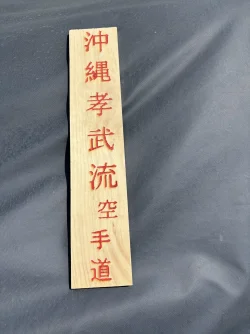
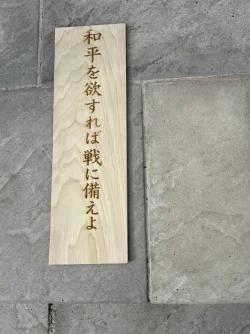
More translation help requested 2

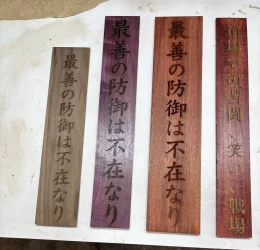
I put two coats of clear outdoor polyurethane of the three pieces. It really had no impact on the stained poplar. And I have included a picture of the purpleheart after the coating.

Tomorrow I have another appointment at the library and will etch a piece of the walnut. we will see how it looks.
That's really beautiful, love that!!!
 
Health issues got in the way of my making my appointment today. Next appointment is Monday evening. Health issues interfering with quality of life now.
 
Well, I made my Monday appointment.

First I had a 1/4"x6"x18" poplar board I had stained with red barn stain. The machine refused to etch the board. Staff said it was to wet.

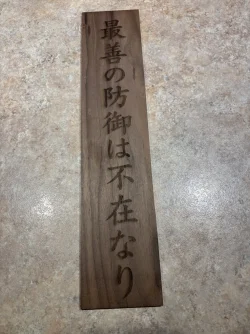
Next I tried a 1/4"x3"x18" piece of walnut. I was pleased with it. see picture.

Lastly, I tried another piece of poplar, a different piece. Machine rejected it also.
 

Attachments

  • best defense.webp
    best defense.webp
    603.7 KB · Views: 3
I liked the purple heart etching so much that I decided to order two more board 5" wide for the wide side of the column. They came today, however, the boards were not purple hear but were blood boards. Very red. I checked the order invoice and I had checked the wrong box. However, I really like them. We'll see how the engrave. I will post picture later.
 
Bloodwood Tree — Scientific Names by Region
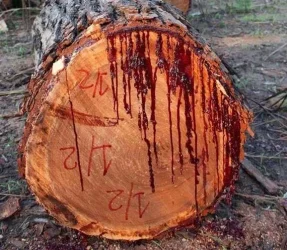
There is no single “bloodwood tree” — the name applies to several unrelated species, and the scientific name depends on the region and context WikipediaWikipedia+1

Bloodwood Tree — Scientific Names by Region​

There is no single “bloodwood tree” — the name applies to several unrelated species, and the scientific name depends on the region and context WikipediaWikipedia+1.

Common examples by region​

  • Southern AfricaPterocarpus angolensis (also called Kiaat, Mukwa, Muninga) WikipediaWikipedia+1
    Native to Angola, Mozambique, Namibia, South Africa, Zimbabwe, and nearby countries. Known for releasing a deep red sap when cut, due to high tannin content TalkAfricanaTalkAfricana.
  • Central & South AmericaBrosimum rubescens (also called Satine) The Wood DatabaseThe Wood Database
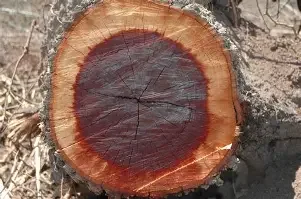
    A large tropical tree with bright red heartwood, widely traded in the lumber industry.
  • Australia – Several Corymbia species, such as:
    • Corymbia gummifera (Red bloodwood)
    • Corymbia intermedia (Pink bloodwood)
    • Corymbia ptychocarpa (Swamp and Spring bloodwood) WikipediaWikipedia+1
      These are Myrtaceae trees formerly in the genus Eucalyptus.
  • Other regionsBaloghia spp. (Australia), Casuarina equisetifolia (Southeast Asia/Northern Australia), Cyrilla racemiflora (Neotropics), Gordonia haematoxylon (Jamaica), Haematoxylum campechianum (Central America/Caribbean), Lagerstroemia speciosa (Indian bloodwood) WikipediaWikipedia.

Why the name varies​

The term “bloodwood” refers to trees that either:

  • Bleed red sap (e.g., Pterocarpus angolensis), or
  • Have red heartwood (e.g., Brosimum rubescens), or
  • Produce red kino (a resinous exudate) when damaged (e.g., some Corymbia species)
Who knew?
 

Attachments

  • 03-trees-tree.webp
    03-trees-tree.webp
    82.3 KB · Views: 0
  • bloodwood-sealed-400x400.webp
    bloodwood-sealed-400x400.webp
    18.7 KB · Views: 0
  • O02 treeIP.webp
    O02 treeIP.webp
    14.4 KB · Views: 0
Back
Top