Makiwara Wood.

opr194597

Master Black Belt
Last login streak
7 day(s)
Max login streak
54 day(s)
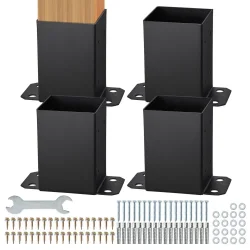
I have an outdoor cement patio upon which I would like to make a Makiwara. I have a bracket to use to attach it to patio. I have plans to make one using sever 1x4, of shorter lengths. However, the type of wood is not mentioned. I usually use white pine for projects, but I have acess to harder wood like oak. Obviously its flexibility will be affected. Suggestions? txs
 

Attachments

  • us_QBLZDZTG4J44INMMHV0_goods_img_big-v1_post-base-m100-1.2.webp
    us_QBLZDZTG4J44INMMHV0_goods_img_big-v1_post-base-m100-1.2.webp
    51.5 KB · Views: 98
  • composite-makiwara-post.webp
    composite-makiwara-post.webp
    9.8 KB · Views: 107
I don’t know what would be a good wood, but I think pine would not be it. Pine isn’t all that durable and I suspect would break down fairly quickly. The surface would dent when struck with knuckles, and it splits easily. Pine is typically what is used in breaking demos.

Some types of oak can be somewhat brittle and will crack, but I don’t know if that would be an issue under these circumstances.

In North America, hickory is a tough and durable wood. It is often used for axe and maul handles, and there is a safety issue in that when it breaks, it does so gradually and the fibers tend to hold together so it doesn’t simply fly apart. This is an issue for things like staff work that involves impact/partner training. Again, I don’t know if it would be an issue as a makiwara.

I think the makiwara plank on which the striking pad is mounted is typically tapered in thickness. This creates flexibility that may not exist in a plank of uniform thickness. Perhaps start with a hickory 2x4 or larger, figure out how much of it needs to be secured into the ground in concrete to make it firm, and have it extend about five feet up. Of that upper five feet, thin the plank from the middle to the top, so it is half thickness at the top. Fasten the striking pad/rope wrappings onto the top 8-12 inches.

I’ve never made one, but this seems reasonable off the top of my head.
 
I’m not a fan of the images you posted. I don’t know about using multiple planks together, it might work or might not. But I think those mountings are not a great idea. Looks like they would bolt onto a wooden decking floor? I think eventually, with repetitive impact those bolts are going to tear up out of the flooring and then you have a repair job. Look for a way to sink it directly into the ground. If the makiwara wears out, you can dig it up to replace it without needing to repair decking.

Maybe dig a hole and fill it with concrete, leaving a central space cleared that is the size of a Home Depot orange Homer bucket. This would be a permanent base/foundation. Then, plant your makiwara plank in a Homer bucket and encase in concrete. When dried, cut away the Homer bucket and you have a plank encased in concrete. Drop that concrete into the space in the permanent foundation. When the makiwara plank wears out, simply pull it out and replace it.
 
I agree mounting it to a wood deck is probably not a good idea. A plain old #2 ground contact rated 4x4 will last for years in the ground. The design I've been using for many years- an eight foot 4x4 post. Mark it at the three foot mark. Make another mark at the top 3/4 of an inch in. Pop a chalk line to run a circular saw down the post. Then rip the post down that line. You'll have to do it on both sides with a standard saw as it won't cut all the way through with one cut. Bury the first three feet in the ground, so that your rip starts at ground level. So you end up with a post that is 3.5x3.5 inches at ground level, tapers to 3.5 x 3/4 inch at the very top, post will be 5ft tall.
The rot generally kicks in at ground level, you can buy a post sleeve at Lowe's for less than $10.00 that'll protect the bottom from rotting at ground level.
It's a quick $30.00 project that'll last for 7-10 years.
There's all kinds of padding out there, I just use old karate belts or dock line (like you use to tie off a small boat to a dock) wound around the top.
2x4's are fine, but they don't give a whole lot of resistance. A tapered 4x4 will still flex but has good resistance.
Whatever design you use, hope you enjoy it!
 
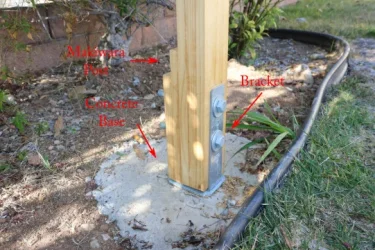
I am not attaching to a wooden deck. My plan right now is to 4'x8' cement slab 2" or 3" thick except the area where the makiwara will be. That area will be about 12" x 12" and at 25" deep, located at the edge of the lab on the 8' side. I willsink 6" bolts with fender washers at the head of the bolt and with about 2" sticking up from the cement nd then bolt the 4"x4" bracket shown in my first post. then insert 4 1"x4" of progressively shorter length ( and shims) into the bracket.

The dojo I attend has this type of arrangement mounted to the cement floor of one of the rooms. The sensei says they have been there for years. Of course the cement floor of the room is about 15'x25'.

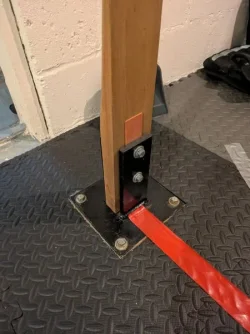
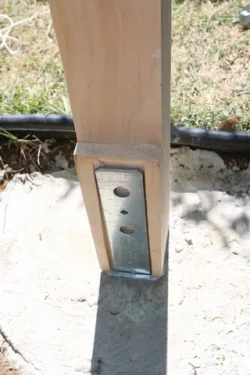
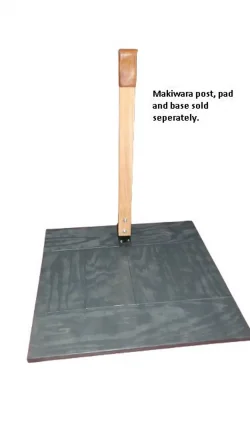
These pictures are similar to what I plan. The bracket I have is a square tumb in whic to inser the wood instead only contcting the wood on two sides. Mine ha a flange on the bottom like the bracket with the red stripe. See brcket in first picture on mine is for a 4x4 post.
 

Attachments

  • 481062251_10164944616448625_4268268738471132937_n.webp
    481062251_10164944616448625_4268268738471132937_n.webp
    43.8 KB · Views: 61
  • Composite-Makiwara-Tie-Recess.webp
    Composite-Makiwara-Tie-Recess.webp
    27.3 KB · Views: 51
  • il_1588xN.3844040322_r7k2.webp
    il_1588xN.3844040322_r7k2.webp
    54.9 KB · Views: 107
  • Makiwara-Retaining-Bracket.webp
    Makiwara-Retaining-Bracket.webp
    67.4 KB · Views: 59
Slight change of plans. I got in contact with the guy who made the bracket with the red stripe and I am purchasing one from him.
 
I just searched the web for pictures of brackets used for attaching 4x4 to cement and found the ones i posted. Later I looked further in to the piocture with the red stripe nd it turns out the guy who made them lives about 4 miles from me! Strange world.

Still looking recommendations about what type of wood to use. Thanks.
 
Proptip: Leylandii wood is the right sort of strength, lasts for years in the soil without pitch or charring, and people will pay you to cut it down and take it away. They're literally like 'I will actually pay you real money to take this horrible tree out of my life'.
 
Last edited:
In the spirit of using AI for martial arts questions, I offer the following from google's AI:

"
Growing Leylandii and losing your mind are strongly correlated due to their extreme, unmanageable growth rate (up to 75-90cm per year) which requires frequent, difficult, and potentially costly maintenance to prevent disputes, property damage, and unappealing brown patches. The trees quickly outgrow their space and can become a source of conflict and significant upkeep, especially if pruning is neglected, making them a generally problematic choice for many homeowners, according to Excelsior Tree Surgery.

Why Leylandii Can Be a Source of Despair
  • Rapid, Overwhelming Growth:
    Leylandii trees are one of the fastest-growing evergreen hedging plants, adding up to 75-90cm (approx. 2.5-3 feet) of growth per year.

  • High Maintenance Demands:
    To control their size, they require regular, frequent trimming, often 2-3 times a year, which can be a demanding and expensive ongoing task.

  • Irreversible Brown Patches:
    If you cut back into the brown, inner sections of the branches, these areas will never regenerate, leaving unsightly, permanently brown patches on the hedge.

  • Property Disputes:
    Overgrown Leylandii can lead to disputes with neighbours due to shading, loss of space, and potential root intrusion causing damage.

  • Potential for Damage:
    Their fast growth can cause structural damage to properties or underground utilities if not properly contained.
When the Will to Live is Lost
The feeling of losing your will to live when dealing with Leylandii stems from the overwhelming nature of their upkeep. You're not alone in finding them a problematic choice; many homeowners experience frustration with the constant need for pruning, the fear of creating brown patches, and the potential for neighbourhood conflicts, notes Hedging UK.

If You Must Grow Them
  • Consider Alternatives:
    There are many other, less demanding hedging plants available.

  • Allow Ample Space:
    Plant them far enough from fences and other structures to accommodate their eventual height and spread.

  • Commit to Regular Pruning:
    Be prepared to trim them multiple times a year from an early age to keep them manageable and prevent permanent brown areas.

  • Consult Professionals:
    If your Leylandii are already out of control, hiring a professional tree service can help with safe and effective removal or significant pruning, suggests Excelsior Tree Surgery. "
 
I had to look up what a leylandii tree is, google said it's Leyland cypress. Leyland cypress are very popular trees where I live! Very much used for privacy hedges around here. Also popular for Christmas trees, most tree farms around have a section with Leyland cypress you can cut yourself for around $10.00 per foot of height.
 
I had to look up what a leylandii tree is, google said it's Leyland cypress. Leyland cypress are very popular trees where I live! Very much used for privacy hedges around here. Also popular for Christmas trees, most tree farms around have a section with Leyland cypress you can cut yourself for around $10.00 per foot of height.
Yeah I mean they're magnificent trees- in their proper environment.
 
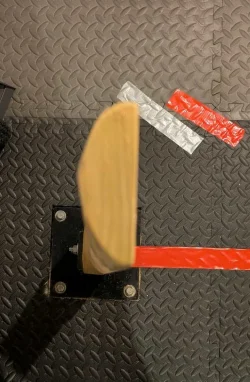
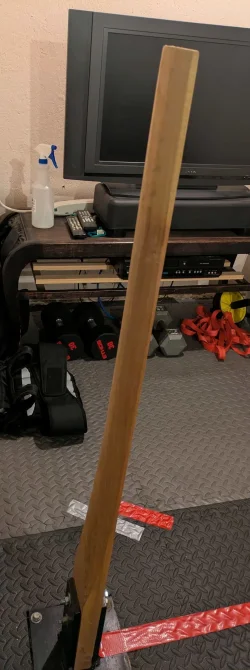
I picked up the bracket shown in the picture with the rede stripe. I also got a ready makiwa post for the same person. It is poplar. I never thought of poplar (cottonwood family) as appropiate. The poplar I am familiar with are small trees whose wood is very light weight and not very strong. This board is 2x4 and it feels very solid. He said he has been using Poplar for years with no problems and found it to more durable than many other woods he has used. The original bracket I was going to use fit a 4x4 while this one fits a 2x4. Currently it has no taper, however, he said he always makes them with a taper. And curves the back sides so that from the top it appears a half circle shape. Interesting..
 
View from top and side.
 

Attachments

  • maki.webp
    maki.webp
    164.6 KB · Views: 109
  • mki2.webp
    mki2.webp
    255.9 KB · Views: 115
I just priced a poplar 2x4x8

Swaner Hardwood​


2 in. x 4 in. x 8 ft. Poplar S4S Board $79.50​


Yellow Pine 2 in. x 4 in. x 96 in. #2 Premium Grade KD-HT Stud $3.85​

WOW!!!
 
I just priced a poplar 2x4x8

Swaner Hardwood


2 in. x 4 in. x 8 ft. Poplar S4S Board $79.50​


Yellow Pine 2 in. x 4 in. x 96 in. #2 Premium Grade KD-HT Stud $3.85​

WOW!!!
Maybe it is less common where you live, but it is very common and reasonably cheap here. It is the softest of what it considered hard wood. I think it would be an okay wood to use but I would prefer my board Not b made out of 4" strips. Do you have a sawmill close to you?
 
I got an 8 ft. 4x4 cedar post from the local "big box" home improvement store. It has good strength and flex to it. On the plus side, it keeps bugs away and doesn't rot since it is outside.
 
I hqve decided to put the poplar one inside my garage. and make another one for outside. So I am back to figuring what wood to use for it. LOL thanks.
 
I hqve decided to put the poplar one inside my garage. and make another one for outside. So I am back to figuring what wood to use for it. LOL thanks.
What would be bad about your basic pressure-treated pine board?
 
Back
Top