If Internal Skill Is Internal, How Can a Form Have “Missing Movements”?

windwalker099106

Master of Arts
Last login streak
136 day(s)
Max login streak
136 day(s)

blind-men-and-elephant.webp

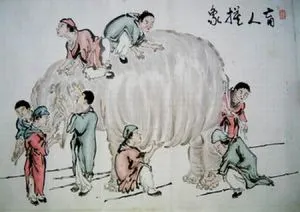
People often argue that:
  • “The 24-step is missing movements.”
  • “The 37-step removed important material.”
  • “Simplified forms destroyed Taiji.”
  • “Short forms don’t have the real stuff.”

thoughts ?
 

Most Taiji forms don't have "肘 elbow" and "靠 shoulder". You may find "肘 elbow" and "靠 shoulder" in this video. But you won't find it in the 24 form.


Some Taiji for health people even changed "採 pull to the right" and "挒 pull to the left" with both palms facing down which lost the meaning of pulling.

Taiji for health people made Taiji a big mess. Someone really needs to clean it up and bring the combat application back.

CMC-double-pull.gif
 

blind-men-and-elephant.webp

People often argue that:
  • “The 24-step is missing movements.”
  • “The 37-step removed important material.”
  • “Simplified forms destroyed Taiji.”
  • “Short forms don’t have the real stuff.”

thoughts ?

It's not so simple. Sometimes a shorter form can be used as a beginner's training tool. The idea that everything has to be in one form has no historical precedent and is in fact an anti-precedent. Saying that a short form isn't good enough is like saying the first 30 moves of the 108 aren't internal enough to provide a benefit. Doesn't make any sense to me. What if you did it 3 times in a row for 111 movements? Thats 3 movements more than 108. Does that suddenly make it ok?

If someone's argument is that the 108 has a more balanced set of moves, I'm not so sure, it may be six of one and one half dozen of the other. Maybe that idea is on the right track and maybe it is close but no cigar. People have a lot of reasons but most of it, really, is just speculation.

Short forms are great. They can be a useful teaching tool or they can be for casual players. It would be very arrogant of me to criticize someone for doing a short form. There are all kinds of reasons why someone would want or need a short form.
 
Last edited:
Montague says, “I hear from so many who have been practicing shortened forms of Tai Chi for many years who are beginning to get ill for no apparent reason. Then when I tell them about shortened forms and why they shouldn’t do them, they begin one of the original longer forms and hey ho, they get well again.””


Cheng Man-ch’ing’s Short Form and the Yang-Style Long Form: Differences and Relative Benefits


Mmm, don’ really know about this statement since I’ve not been a purely short Taiji forms guy..

Should be noted Montaigue as a long form practitioner was just 62 years young, maybe his BGZ stuff wasn’t compatible?
 
Can you put all 230 throws into 1 form? That form will have 230 moves. So, to expect a form to contain everything is not realistic. You just need to train more than 1 short form.

I do have issue with the long Taiji form. The long Taiji form has many duplicate combo sequences such as ward off, pull back, press forward, push, double pulling (pull to the left, pull to the right), single whip. If you only keep 1 set of these moves, the 108 moves can be shorter. If you remove all the duplicated combo sequences, a 108 moves form can be reduced into about 48 moves that still contain all elements in the original 108 moves form.
 
Last edited:

blind-men-and-elephant.webp

People often argue that:
  • “The 24-step is missing movements.”
  • “The 37-step removed important material.”
  • “Simplified forms destroyed Taiji.”
  • “Short forms don’t have the real stuff.”

thoughts ?

I think some people believe that "Internal Skill" and "Principles" magically gives a practitioner unlimited access to martial usages.

But, if we look at those practitioners, we often find the complete opposite.

If I list 5 different CMC videos demoing something, they're all the same thing, push someone far away.

If we look at mainstream Tai Chi videos showcasing usages..., there's not a lot of diversity.

So we can flip the question around: If those practitioners were not missing any movements, why don't we see a diverse set of usages from different genres befitting of Traditional Chinese Martial Arts which are said to have Ti, Da, Shuai, Na?

Now, some Tai Chi practitioners may criticize those who are "technique-based" that just repeatedly practice the same "technique".

The irony is that those Tai Chi practitioners do exactly that... they practice pushing someone repeatedly in the same silly manner.

I don't think the removal of repetitions is a big problem. But, I think the motivation behind shortened forms was to cater towards those who were never interested in the martial art of Taijiquan. Details that have martial reasons are irrelevent towards the masses who don't care about martial arts. They care about health and well being, so all they care about is how not to hurt themselves.
 
I think some people believe that "Internal Skill" and "Principles" magically gives a practitioner unlimited access to martial usages.

But, if we look at those practitioners, we often find the complete opposite.

If I list 5 different CMC videos demoing something, they're all the same thing, push someone far away.

If we look at mainstream Tai Chi videos showcasing usages..., there's not a lot of diversity.

So we can flip the question around: If those practitioners were not missing any movements, why don't we see a diverse set of usages from different genres befitting of Traditional Chinese Martial Arts which are said to have Ti, Da, Shuai, Na?

Now, some Tai Chi practitioners may criticize those who are "technique-based" that just repeatedly practice the same "technique".

The irony is that those Tai Chi practitioners do exactly that... they practice pushing someone repeatedly in the same silly manner.

I don't think the removal of repetitions is a big problem. But, I think the motivation behind shortened forms was to cater towards those who were never interested in the martial art of Taijiquan. Details that have martial reasons are irrelevent towards the masses who don't care about martial arts. They care about health and well being, so all they care about is how not to hurt themselves.
Agree with you 100% on what you have said.

Taiji people may say, "A step is a kick, a kick is a step". But if one just walks all his life, he still doesn't know how to kick. Abstract principle needs to be mapped in concrete technique.

When you train Taiji "採 pull to the right" and "挒 pull to the left", you will feel that something is missing there. What's the missing part? The missing part is the leg skill. When you pull your opponent to your right, if you use your right foot to block his leading leg knee, you can take him down effortless. Why that kind of leg skill doesn't exist in the original Taiji form? I can only say it might be taken out by some "Taiji for health" people in our previous generation, or the generation before that.

People may say that "leg skill" is not in the Taiji form doesn't mean that "leg skill" is not in Taiji. Again, it's missing in the Taiji form and that's a fact.
 
Last edited:
So we can flip the question around: If those practitioners were not missing any movements, why don't we see a diverse set of usages from different genres befitting of Traditional Chinese Martial Arts which are said to have Ti, Da, Shuai, Na?

Now, some Tai Chi practitioners may criticize those who are "technique-based" that just repeatedly practice the same "technique".

The irony is that those Tai Chi practitioners do exactly that... they practice pushing someone repeatedly in the same silly manner.

People training the same internal method will naturally show the same type of expression — they’re demonstrating a principle, not a catalog of techniques. That’s why the demos look similar.

It isn’t about missing movements; it’s about how any movement arises from the body. Internal skill tends to express one core method in many situations, rather than showing Ti, Da, Shuai, Na as separate techniques.

So the “lack of diversity” you’re seeing is simply the nature of principle-based training, not an indication that something is missing.
 
Montague says, “I hear from so many who have been practicing shortened forms of Tai Chi for many years who are beginning to get ill for no apparent reason. Then when I tell them about shortened forms and why they shouldn’t do them, they begin one of the original longer forms and hey ho, they get well again.””
I don’t have a dog in this fight; I’m not a Taiji guy, I’m not interested in what is being debated here. I will just say that statements like the above I find to be not believable. He says he hears from “so many” people who are mysteriously getting sick? Really? Who are these people who flock to him in large numbers with their illnesses? Is he a licensed medical practitioner? And lo-and-behold, they all practice a short form of Taiji? And learning a long form suddenly cures their illness? I don’t buy it. I don’t know what he thinks to gain by making such a statement, but nothing about it is believable.

Sounds to me like perhaps a couple of anecdotal and coincidental cases suddenly became inflated to “so many” and then he decides that he is on to something. I don’t believe there is any substance there.

In the past, I practiced Taiji. Short forms were a big part of the program, especially for the couple dozen or so older members who were just interested in getting some exercise. Those who had a deeper interest would learn the longer forms. I was with that group for over a decade. I am not aware of any large-scale illnesses that were rampant in the group, nothing unusual compared to the public at large, certainly nobody getting a mysterious “Taiji short forms illness”. So, that is my anecdotal evidence.
 
Last edited:
It isn’t about missing movements; it’s about how any movement arises from the body.

Well, it's too bad they don't showcase the "any" part in those demos.

It's about how "any" movement arises from the body from a tiny, little set of said movements.

Even if take Da Lu Tuishou as an example, one would think that a circular pattern would have multiple usages.

And yet, the number 1 "exit point" of that circle in many Yang style videos is forward!

They practice circle, and use only the forward component of that circle to push the opponent. For many of them, the rest of the circle is kind of just for show.
 
Well, it's too bad they don't showcase the "any" part in those demos.

It's about how "any" movement arises from the body from a tiny, little set of said movements.

Even if take Da Lu Tuishou as an example, one would think that a circular pattern would have multiple usages.

And yet, the number 1 "exit point" of that circle in many Yang style videos is forward!

They practice circle, and use only the forward component of that circle to push the opponent. For many of them, the rest of the circle is kind of just for show.

Most people use Dà Lǚ (大捋) as an entry point in training, applying Taiji ideas, each lineage adjusts it according to its own method. The important thing is not becoming locked into the pattern. When Dà Lǚ is treated as a fixed response, the circular movement turns into choreography instead of function — which is essentially what you’re pointing out.

It may be more accurate to view how Dà Lǚ is practiced according to one's level of practice.


Each line has a “correct” version for its own system, if someone holds too tightly to that version, the drill becomes rigid. Many of the YouTube demonstrations where teachers work with their own students show this problem: the pattern becomes predictable, and when something falls outside that pattern, they usually can’t respond. The public Taiji fails you see on YouTube are unfortunately not a good reflection of what happens in private settings..

This connects back to the main point of the thread. When discussions focus too much on the external pattern or the visible shape of péng (掤), lǚ (捋), jǐ (挤), àn (按), attention shifts away from what’s actually important:

“If internal skill (nèigōng, 内功) is internal, how can a form have ‘missing movements’?”

This is something I’ve wondered about as well — why certain lines of Taiji that emphasize internal development / application, often show very similar movement qualities and scope, even when their forms or sequences are different.
 
Last edited:
When you train Taiji "採 pull to the right" and "挒 pull to the left", you will feel that something is missing there. What's the missing part? The missing part is the leg skill. When you pull your opponent to your right, if you use your right foot to block his leading leg knee, you can take him down effortless. Why that kind of leg skill doesn't exist in the original Taiji form?

🤔

Some application work in Taipei

Cheng Man-ch'ing's 37 form application

"April 27th, 2007. 2-28 Peace Park Taipei, Taiwan. Our master is Jeng Shean Chih (Zheng Xian Qi). His master is Huang Sheng Shyan"

Single whip application


Opening / ending sequence


Each step a kick


This group and others practice in Peace Park Taipei

2-28 Peace Park Taipei, Taiwan 和平公園 (he2 ping2 gong1 yuan2) - Precious' Experience
I've only been to the 2-28 Peace Park 和平公園 in Taipei a few times... but on the rare occasion that I made the 8 hour journey from Taidong to Taipei, the Peace Park Push Hands group was a must stop for me.
 
Last edited:
“If internal skill (nèigōng, 内功) is internal, how can a form have ‘missing movements’?”
"Internal" that you deal with yourself is different from external that you deal with your opponent.

If you stay home all by yourself, you don't need any communication skill. The moment that you walk out of your front door, you have to know how to say, "How are you?"
 
Last edited:
"Internal" that you deal with yourself is different from external that you deal with your opponent.

Interesting viewpoint —🤔

For me, “internal” is a distinction about how force is generated and applied.
It directly shapes the kinds of applications that arise from it.
This isn’t something done in isolation — people who practice this way test it with others, and those who are curious usually come to understand it through hands-on experience.

“External” is also a distinction about how force is generated and applied.
It can be very sophisticated in its own framework, just using a different approach to how the body produces power. In many cases it develops more quickly because it refines patterns that people already use in everyday movement.

With internal work, many of the methods are counterintuitive compared to normal movement or daily habits, which is why the development process feels very different.
 
Last edited:
For me, “internal” is a distinction about how force is generated and applied.
"Apply" is the key word. When you train "leg skill", you also need to train "how to escape a leg attack". When your opponent attacks your leg, whether you

- 跪 bend your knee back, or
- 盘 swing your leg side way, or
- 抽 pull your lower leg back, or
- 过 use outside crescent kick to escape,

it depends on how the direction that your opponent may attack your leg. Your force should be generated differently.

There exist no general force generation that work for all situations. Each and every force generation methods for "leg escape" will need to be trained separately.
 
Last edited:
"Apply" is the key word. When you train "leg skill", you also need to train "how to escape a leg attack".

You seem to have missed my point.
No one said one method works for all situations.
Internal vs external refers to how force is generated, not a list of techniques.
There exist no general force generation that work for all situations.

The distinction between internal and external force generation is clear to people who actually train in that framework.
If someone doesn’t work with it, it naturally won’t make much sense — they’ll try to rationalize it through the methods they do practice.
 
Internal vs external refers to how force is generated, not a list of techniques.
I think you have addressed too much on the term "internal".

When you bend your knee, is there a such thing as

- "internal" way of knee bending, or
- external way of knee bending?
 
Last edited:
I think you have addressed too much on the term "internal".

You seem to be reframing my point.
Talking about how force is generated, not joint movement.
If the focus is different on your side, it might be clearer to open a separate thread for that direction.
 
I think you have addressed too much on the term "internal".

When you bend your knee, is there a such thing as

- "internal" way of knee bending, or
- external way of knee bending?
When you bend your knee will it be because you moved your lower leg or because you moved your upper leg? When you take a step what causes the movement, hip or foot?
 
When you bend your knee will it be because you moved your lower leg or because you moved your upper leg? When you take a step what causes the movement, hip or foot?
Your opponent sweeps your lower leg. So, you move your lower leg. When you do that, your hip is not moving.
 
Last edited:
Back
Top