Hip tilting

windwalker099165 13

Master of Arts

Interesting video

The teacher talks about standing straight and centered vs hip tilting…
suggesting over the yrs standing straight and centered is more of an external practice
vs internal….thoughts ? šŸ¤”
 
That was rather interesting... my understanding of being straight and centered was having good alignment through the body, and even though your "y-axis" orientation can change you still maintain good structure and alignment (ie your hips aren't kicked out at weird angles, body not twisted, knees not caving in etc). Instead of this idea of being rigidly upright and perpendicular to the ground, you're still connected through your frame and can resist and deliver force without it compromising your structure.

Like when people are taught barbell squats to keep a "straight back", alot of people misinterpret that to mean stay completely rigidly upright and vertical, but that ain't it haha.

But it may be more a circumstantial thing anyway.

Regarding it being external vs internal that is interesting.. I think when the particular shape and form of the body is focused on that would be an external understanding. The way it coalesces and organises within your own feeling and subjective understanding experientially to me is the internal aspect... just some musings!

Curious as to your thoughts @windwalker099 šŸ‘ŠšŸ»
 
Regarding it being external vs internal that is interesting.. I think when the particular shape and form of the body is focused on that would be an external understanding. The way it coalesces and organises within your own feeling and subjective understanding experientially to me is the internal aspect... just some musings!


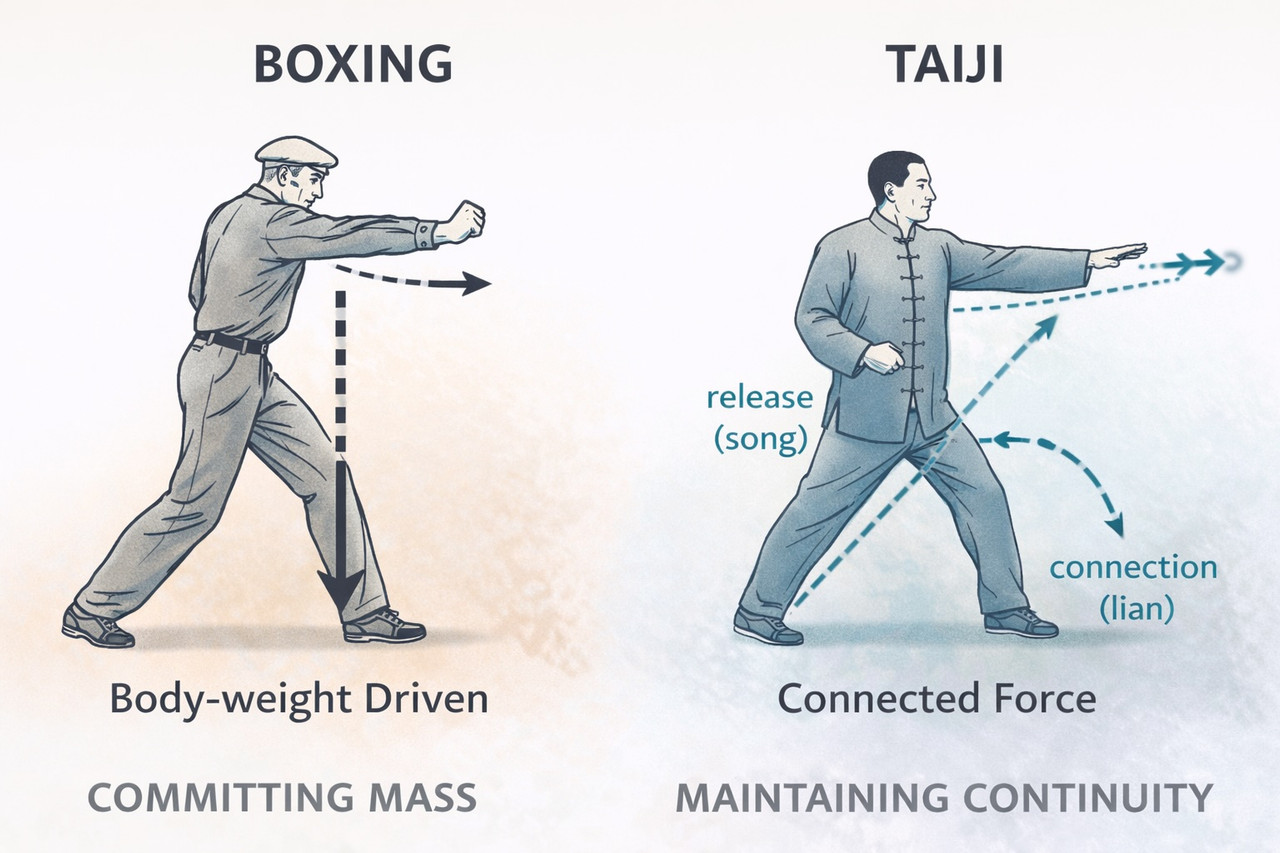
boxing-taiji.jpg


I found the video interesting. The teacher is speaking from his own understanding and experience.

The teacher's concern about "modern upright training" is that it has lost this principle of whole-body mass transfer. Not leaning forward or backward — but the ability to move weight without breaking connection.

Looking at the image comparing Boxing and Taiji, I think the teacher's point becomes clearer.

Boxing is described as "body-weight driven" — committing mass in a linear, directional way. External in the sense that the power is visible, committed, and has a clear point of application.

Taiji is described as "connected force" — maintaining continuity. Not committing mass to a single direction, but keeping the connection alive throughout the movement. It is often not clear how a person is able to generate force.
 
Last edited:
His whole point is moot

Rotation has to happen first.

The pic of the boxer's right cross doesn't follow the lines in the pic or the description of how boxing 'works'.

Then there's rising and dropping with rotation like a screw/helix as with hooks and upper-cuts and overhands...
 
That was rather interesting... my understanding of being straight and centered was having good alignment through the body, and even though your "y-axis" orientation can change you still maintain good structure and alignment (ie your hips aren't kicked out at weird angles, body not twisted, knees not caving in etc). Instead of this idea of being rigidly upright and perpendicular to the ground, you're still connected through your frame and can resist and deliver force without it compromising your structure.

Like when people are taught barbell squats to keep a "straight back", alot of people misinterpret that to mean stay completely rigidly upright and vertical, but that ain't it haha.

But it may be more a circumstantial thing anyway.

Regarding it being external vs internal that is interesting.. I think when the particular shape and form of the body is focused on that would be an external understanding. The way it coalesces and organises within your own feeling and subjective understanding experientially to me is the internal aspect... just some musings!

Curious as to your thoughts @windwalker099 šŸ‘ŠšŸ»
Just to tease you a bit on the subject of structure and power:
 
His whole point is moot

Rotation has to happen first.

The pic of the boxer's right cross doesn't follow the lines in the pic or the description of how boxing 'works'.

Then there's rising and dropping with rotation like a screw/helix as with hooks and upper-cuts and overhands...

šŸ‘

Agree. Also the taiji image is not quite in line with the theory that I was trying to make an illustration of comparing both methods

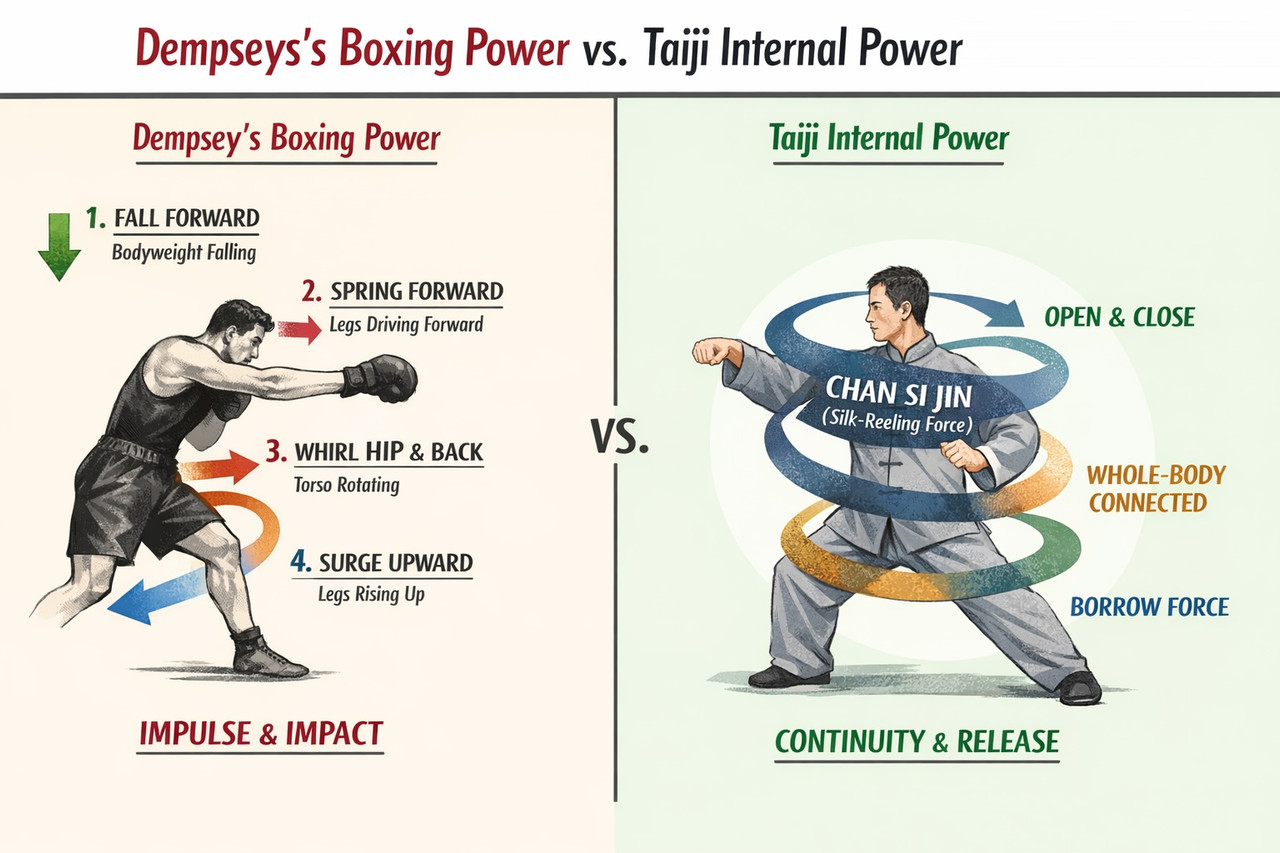
another image generated by AI ....As part of my own research was using it to explore and model different theories of power generation based on what is written.

compare.jpg
 
Last edited:
His whole point is moot

Rotation has to happen first.

Feel it depends on the theory one follows and where one is at in their training — what they can actually do or have actually felt.


3bvj68xxlSX8NpzLchGo8ZiF_CJE-_gc0qRCd3-b639GQEZ0ZmWLdCEuDu7qbZkpvAbBpaX9=s160-c-k-c0x00ffffff-no-rj

I like Teacher Pang's work. His exploration and attempt to align internal martial arts with modern practices and methods — challenging old traditions and practices —


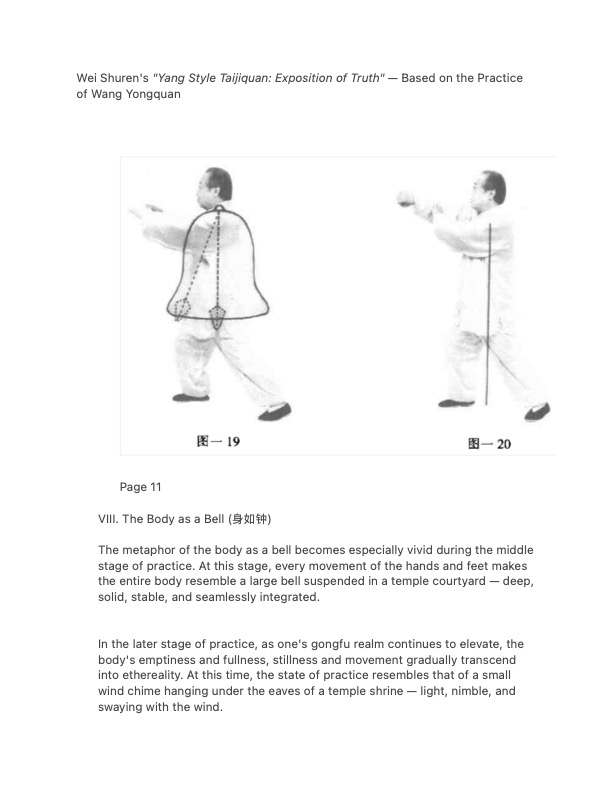
My own work, based on my teacher's practice, aligns more closely with Wang Yongquan's approach.
Outward expressions that may change as one's development changes.

Visible shape, the expression. Internal process, the cause.

Wei-Shuren-s-Yang-Style-Taijiquan-Exposition-of-Truth-Based-on.jpg
 
Last edited:
Back
Top