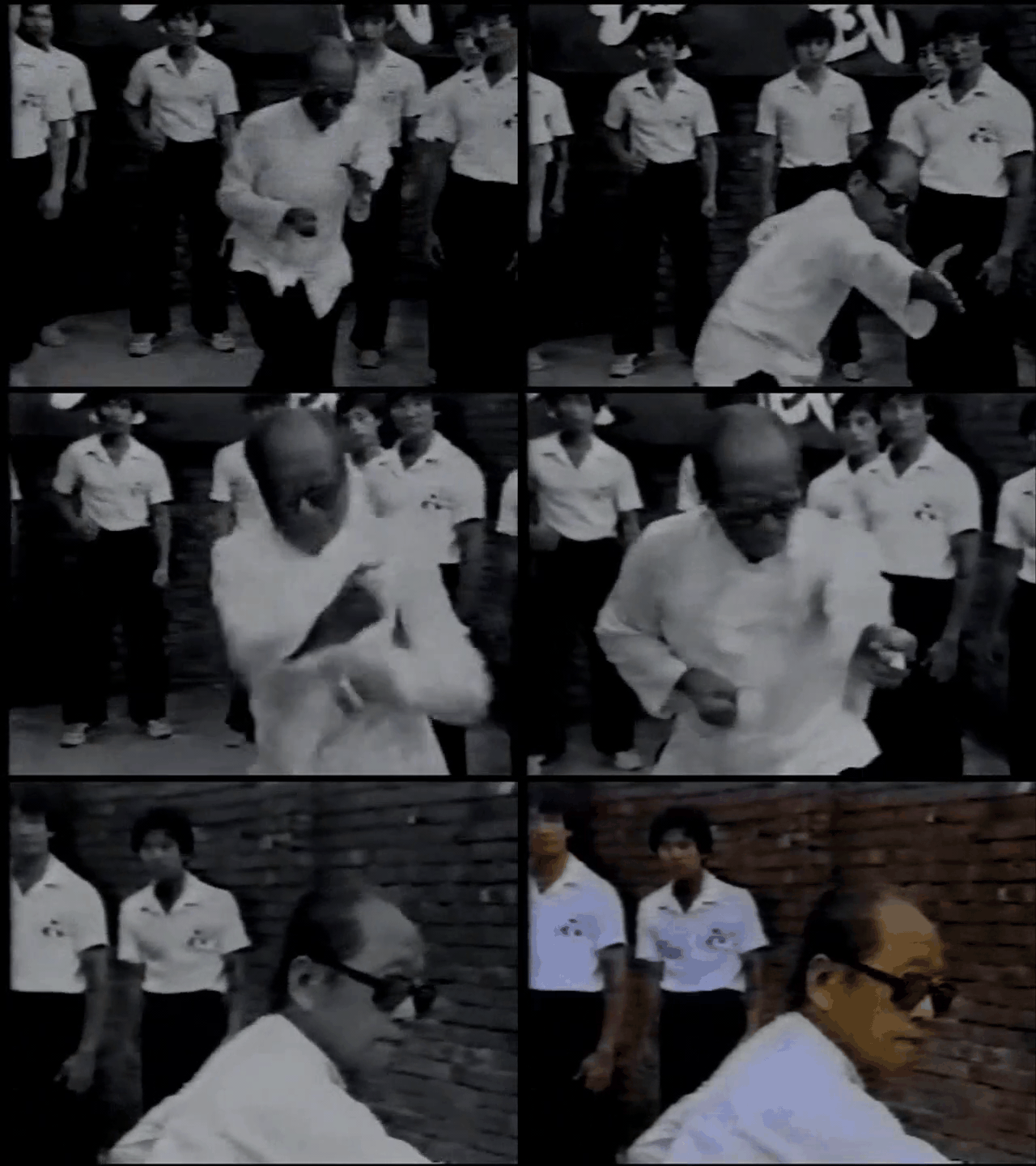
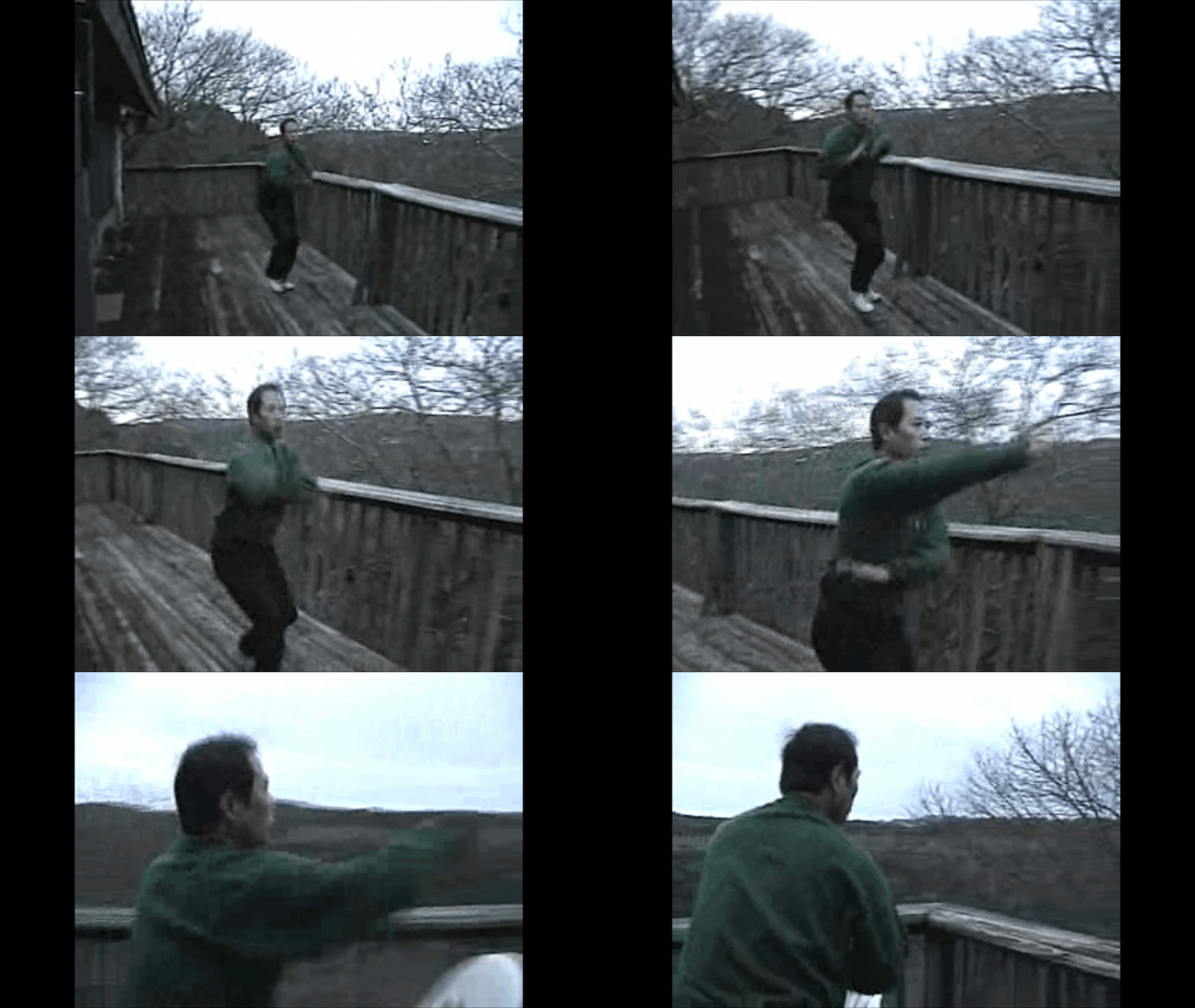
Speed Vs Power

I've long held that F=MA is far too crude a formulation to apply to a complex biomechanical procedure like throwing a punch. It's misleading, and doesn't tell you anything useful for training purposes.
That particular equation takes into account acceleration which is different than speed. Acceleration is pickup.
 
*sings*
The facts lie bare, the thread's going nowhere, not an argument to be seen
A kingdom of acceleration and it looks like you're the queen....
 
Last edited:
Power = compress and release

It takes time to have a full compressing with the whole-body unification. When you compress halfway and release for speed, you will only generate 50% power.

If you watch these 2 "power generation" videos, a punch take about 1 second to complete. In combat, 1 second can be too long.


If you watch these 2 "speed generation" videos, a punch take less than 1/4 second. But those punches may not have enough knock down power because a punch is not fully compressed.


I just want to point out that with the guy in the first video, his hands are reaching higher maximum speeds than those of the guy in the last video.
 
Why has this thread died down? There haven't been any responses for about five months at least.
 
Many thread tend to get confusing and in the end I'm not even sure what we discuss. Some answer is already in the thread, and some of the issues are confusion of terms.
Energy vs Power
Peak Force vs Total Momentum transfer
Speed of limbs? vs speed of technique? as in timing etc
Top-speed or average speed during followthrought is the difference between peak force and total momentum transfer etc

What is the current question?
 
Speed and power are not the same and mathematically you can’t have one without the other
P = Fv, where F is force and v is velocity, and P is power

v = Δs/Δt, where 'v' is velocity, 'Δs' is the change in displacement (or change in position), and 'Δt' is the change in time.

Thanks for giving me the chance to use my 21 college credits of math and 8 credits of physics…. Don’t ever do that again :)
 
I just want to point out that with the guy in the first video, his hands are reaching higher maximum speeds than those of the guy in the last video.
If you mix "slow compression" with "fast release", the "fast release" may seem to be faster.

A friend of mine always liked to do his favor form in Karate tournament form competition. His form started with slow Taiji. After all the judges almost got boring to death, he suddenly jumped in the air, performed a double jumping kicks, and followed with fast long fist form. He always won the black belt first place form competition in Karate tournaments back in the 70s.
 
Many thread tend to get confusing and in the end I'm not even sure what we discuss. Some answer is already in the thread, and some of the issues are confusion of terms.
Energy vs Power
Peak Force vs Total Momentum transfer
Speed of limbs? vs speed of technique? as in timing etc
Top-speed or average speed during followthrought is the difference between peak force and total momentum transfer etc

What is the current question?
Yes it can get confusing especially considering the fact that when you talk about speed in the martial arts there's different types of speed so you have to be specific as to exactly what kind of speed you're talking about.

There's speed in terms of the maximum speed you hand or foot reaches in MPH.

There's speed in terms of how many strikes you can get off in a given amount of time, such as how many punches or kicks you can do per minute.

There's speed in terms of footwork speed, how fast you can move around on your feet and how agile you are.

And so forth.

The kind of speed I was talking about in my first post, and what I've mostly been talking about throughout this whole thread is the first kind, the maximum speed your hand or foot reaches in MPH and how that directly contributes to power, the faster your hand or foot is going in MPH when it makes impact, the harder it will hit.
 
If you mix "slow compression" with "fast release", the "fast release" may seem to be faster.

A friend of mine always liked to do his favor form in Karate tournament form competition. His form started with slow Taiji. After all the judges almost got boring to death, he suddenly jumped in the air, performed a double jumping kicks, and followed with fast long fist form. He always won the black belt first place form competition in Karate tournaments back in the 70s.
Well as I just mentioned there's different types of speed, there's speed in terms of how fast your hand or foot goes in MPH and there's speed in terms of how many strikes you're able to get off in a given amount of time (such as how many strikes you can do per minute) and so forth.

To say that this guy is faster than that guy, you have to specify exactly what kind of speed you're talking about, in what way is he faster?
 
The kind of speed I was talking about in my first post, and what I've mostly been talking about throughout this whole thread is the first kind, the maximum speed your hand or foot reaches in MPH and how that directly contributes to power, the faster your hand or foot is going in MPH when it makes impact, the harder it will hit.
This would be obviously truy if the hand was cut off from the body and propelled into the target. But that isnt how it works.

The technique and how you engage the rest of the body greatly changes the "effective mass" behind the fist. This goes beyond the mass of hte fist itself. If you look at the total technique variation, then a fast hand whip that maximises superficial hand peak speed, but while sacrificing effective mass backing the fist up throughout the impact (via body mass, torso rotational energy and all things and rooting) could possible be less hard.

Ask a boxer, and they will know all about this.
 
Speed and power are not the same and mathematically you can’t have one without the other
P = Fv, where F is force and v is velocity, and P is power

v = Δs/Δt, where 'v' is velocity, 'Δs' is the change in displacement (or change in position), and 'Δt' is the change in time.

Thanks for giving me the chance to use my 21 college credits of math and 8 credits of physics…. Don’t ever do that again :)
At least you ain't wrong!
 
This would be obviously truy if the hand was cut off from the body and propelled into the target. But that isnt how it works.

The technique and how you engage the rest of the body greatly changes the "effective mass" behind the fist. This goes beyond the mass of hte fist itself. If you look at the total technique variation, then a fast hand whip that maximises superficial hand peak speed, but while sacrificing effective mass backing the fist up throughout the impact (via body mass, torso rotational energy and all things and rooting) could possible be less hard.

Ask a boxer, and they will know all about this.
Alright well increasing velocity imparts more energy into the target than increasing mass. The equation for kinetic energy in a situation such as a hand striking a target is calculated by squaring the velocity and then multiplying the result by the mass and then dividing it in half, that's how you calculate how much kinetic energy is going into the target.

There's also momentum. The equation for momentum is mass times velocity so unlike with kinetic energy, with momentum the velocity does not have a greater effect than the mass, both velocity and mass have equal effect.

The question is, do you use kinetic energy or do you use momentum when determining how much damage a strike does to a target?
 
Alright well increasing velocity imparts more energy into the target than increasing mass. The equation for kinetic energy in a situation such as a hand striking a target is calculated by squaring the velocity and then multiplying the result by the mass and then dividing it in half, that's how you calculate how much kinetic energy is going into the target.

There's also momentum. The equation for momentum is mass times velocity so unlike with kinetic energy, with momentum the velocity does not have a greater effect than the mass, both velocity and mass have equal effect.

The question is, do you use kinetic energy or do you use momentum when determining how much damage a strike does to a target?
You are not wrong as far as the formula's go, but your argument is illogical and doesn't hold water.
Using velocity as the major contributor for inflicting damage makes sense when you are talking about something like a bullet, which is hard enough to take the impact without major deformation (at least initially) and will maintain nearly all of it's mass intact.

When talking about a punch with the hand, or really any kind of strike, the area of the striking component GREATLY changes the dynamics, along with velocity and strength of the striking member.

So, arguing from a basis of kinetic energy or momentum sounds like something a teacher or someone else who has little to no real world concept of how to apply the formula would approach it.
I see this all the time in engineering interns that we bring in as part of their graduate classes. They know the math but don't have a clue how to use it.

To answer your question, it is potato/potatoe to me and quite irrelevant. To determine damage, look at the impact area.
 
Alright well increasing velocity imparts more energy into the target than increasing mass. The equation for kinetic energy in a situation such as a hand striking a target is calculated by squaring the velocity and then multiplying the result by the mass and then dividing it in half, that's how you calculate how much kinetic energy is going into the target.
As HighKick said, the first or the limbs are not rigid bodies undergoing free motion. They are attached, driven and linked to the rest of the body, and the drive through the target is an impulse made up by an integral, you integrate the force over the contact time, and contact distance as it penetrates the target. And unlike a bullet, which has "initial energy", the rest of the body keeps driving the fist throught that target - against resistance - efter after initial impact.

This is why "effective mass" which is when you apply the naive formulate to the complex case is HIGLHY variable, in principle it can vary from "bare limb mass" to your whole body mass, depending on if you use the drive and linking correctly or not.

So while speed and acceleration of hte limb is important, the other things likely makes just as big if not bigger difference. Ie. we have linear dependence on mass, and quadratic on velocity - but both are variable and the choice is not 30% increase in V, vs 30% increase in effective mass. The effective mass can vary alot more.

There's also momentum. The equation for momentum is mass times velocity so unlike with kinetic energy, with momentum the velocity does not have a greater effect than the mass, both velocity and mass have equal effect.

The question is, do you use kinetic energy or do you use momentum when determining how much damage a strike does to a target?
Both matters. To break something, you need to both generate sufficient force to overcome material strength but you also need enough energy to complete the breaking. Breaking a rib takes both a certain minimum force, and alot of energy. They key is often to maintain the "drive" throughout the hwole strike. and not "loose force" after 1cm, you need to "drive" the strike through the target until it breaks.

Ontop of this there is also a distintion between inflicting pain(or temporary bruise) and damage (ie breaking/damage opponent).
 
As HighKick said, the first or the limbs are not rigid bodies undergoing free motion. They are attached, driven and linked to the rest of the body, and the drive through the target is an impulse made up by an integral, you integrate the force over the contact time, and contact distance as it penetrates the target. And unlike a bullet, which has "initial energy", the rest of the body keeps driving the fist throught that target - against resistance - efter after initial impact.

This is why "effective mass" which is when you apply the naive formulate to the complex case is HIGLHY variable, in principle it can vary from "bare limb mass" to your whole body mass, depending on if you use the drive and linking correctly or not.

So while speed and acceleration of hte limb is important, the other things likely makes just as big if not bigger difference. Ie. we have linear dependence on mass, and quadratic on velocity - but both are variable and the choice is not 30% increase in V, vs 30% increase in effective mass. The effective mass can vary alot more.


Both matters. To break something, you need to both generate sufficient force to overcome material strength but you also need enough energy to complete the breaking. Breaking a rib takes both a certain minimum force, and alot of energy. They key is often to maintain the "drive" throughout the hwole strike. and not "loose force" after 1cm, you need to "drive" the strike through the target until it breaks.

Ontop of this there is also a distintion between inflicting pain(or temporary bruise) and damage (ie breaking/damage opponent).
Speaking from experience on both the giving and receiving side, it is Hard to break a rib. They are held in place by soft tissue, so they 'float' a bit. What most often happens is soft tissue injuries which hurt like a b***h. Feels like a break with all the same symptoms.
I have had a couple non-displaced fractures and two fully broken ribs (one from auto accident, one from competing). Some of the worst pain I can remember.
 
I think that when people are using the term "power", they are referring to the amount of "impact" into the target and not in a physics definition. Reading many of the responses, it sounds like people are trying to over complicate the issue.

I can snap a jab very quickly using the arm only and not having any body mass behind it. It would have less "power" as most people think of it.

I can hit with a jab while using a drop step (a la Jack Dempsey) and it may be a little slower, but it would have body mass behind it. It would have more "power" as most people think of it.

Each have their place. If I am very fast but unable to put my mass behind it, then I am not going to cause the damage I need. If I have a really powerful punch, but it is slow and I can't land it. I still am not going to cause the damage I need.

Both are needed in a technique. An expert fighter will know when to "hedge their bets" an apply the attribute needed at that time to be successful. For example, I may use a fast technique without a lot of "stopping power" to set up a slightly slower power shot.
 
Speaking from experience on both the giving and receiving side, it is Hard to break a rib. They are held in place by soft tissue, so they 'float' a bit. What most often happens is soft tissue injuries which hurt like a b***h. Feels like a break with all the same symptoms.
I have had a couple non-displaced fractures and two fully broken ribs (one from auto accident, one from competing). Some of the worst pain I can remember.
I never so far had a serious rib injury, getting hit by single knuckles, especially at lower ribs without gloves really give immediate localise pain - but no damange; it's something you can just eat withing limits. It doesnt compare to getting a knee or a heel in there. It's only superficial at bruise level.

The worst I had was when I was hit but a shoulder (with full body mass behind) into the middle of chest bone and that wasnt even sparring it was just a warmup where my partner got too excited. That one ne stayed for 4-5 months, and as soon as I flexed the chest I felt a sharp localised pain like needles in the chest. But I doubt anthing was broken, probably some soft tissue issue. But its gone and forgotten now!
 
I never so far had a serious rib injury, getting hit by single knuckles, especially at lower ribs without gloves really give immediate localise pain - but no damange; it's something you can just eat withing limits. It doesnt compare to getting a knee or a heel in there. It's only superficial at bruise level.

The worst I had was when I was hit but a shoulder (with full body mass behind) into the middle of chest bone and that wasnt even sparring it was just a warmup where my partner got too excited. That one ne stayed for 4-5 months, and as soon as I flexed the chest I felt a sharp localised pain like needles in the chest. But I doubt anthing was broken, probably some soft tissue issue. But its gone and forgotten now!
I didn't mention it earlier or really explain the 'pain' in my earlier post. About 4-5 weeks after one of the non-displaced breaks, me and another person was at work two scaffolds high removing a failed 10-horsepower motor (approx. 200lbs). When we slid the motor out from its mount and had the weight the walk boards we were on broke. My helper let go and grabbed the side of the scaffold. For some Stupid reason I had a bear hug on the motor and came down on the top cross brace left side ribs first. Finished breaking the injured rib and cracked the one beside it. It also skinned me up real bad. About the best thing that happened it that the impact made me drop the motor.
That was a BAD day.
 
Back
Top