fine vs gross motor skills (left/right)

Fungus2

3rd Black Belt
Supporting Member
Wll know its EXTREMELY hard to write with your non-dominant hand and get anywhere the speed and accuracy of that you attain with you dominant hand.

I think is more fine-motorics than the gross motorics of kicking and spinning, so the assymmetry is probably reduced? But how much?

As I have some issues with my back, and have beeng tweaking certain techniques, I wonder if the phenomenan I see is still seen by others? or of its amplified for me, beucase I think they way I (have to) do things, end up requiring a little more fine-balance (spinning on heel vs ball of foot) but I'm not getting it pretty decent,! but its harder to pull off the same tweaks with my left. My current mini-project is to make what works for my dominant side, work also for the non-dominant side. I have a feeling this is going to take many many hours. It feels like about the same challenge as to learn to write with your left hand.

The difference is when doing ushiro mawashi geri with my dominnant leg, I feel I have very good balance and have solid power behind, even if hitting a non-yielding object.

The same thing with my left leg is works, but is wiggly, and I have only a fraction of control, balance and power behind.

Do you guys think sounds normal, or are my tweaks (which I think involveds more fine motorics to balanec on heel) make this issue larger than it normally is?
 
When I started karate all my techniques started on the same baseline - poor. What this meant is that by training both sides equally they developed with equal "skill." I'm a believer in not having a favored side in TMA as much as possible. Any technique should be competent with either left or right side, but the fact is in some techniques one side performs better than the other, especially noticeable when done at an advanced level.

Given that one trains both sides equally, why do they not execute equally? Not being a neuro-muscular physiologist, I can only speculate. I'm left-handed, but some techniques I do better with my right. So, while being born one way or the other may have something to do with it, it's not the whole answer.

One missing piece may be how you were taught, how the move was first imprinted. I throw left-handed but bat right. I don't think I was taught how to throw, but I was taught how to bat. I learned iaido right-handed and now can't see myself doing it lefty. However, my foil instructor let me learn left-handed. So, one kind of sword I do with my right, the other, with my left.

We are bilateral creatures, but that doesn't mean both halves were created equally. There may be some neuro-muscular differences aside from being either left or right brained. I never could do a high right, side kick, something in my hip construction, I think, and could never get close to a full split. And I think it's possible for one side to be better at larger gross movements and the other side being better at fine motor skills in some instances.

Bottom line, I don't really know for sure. Perhaps the question is moot. We're stuck with how we were made for the most part, although thru training and practice we can further develop our capabilities to a fair extent. No matter how much we train in the dojo I think we will always have a favored side for a particular technique, a side that just feels "natural" or us. This is what we will use under the pressure of combat.

I've probably over-addressed the topic of your OP, and maybe even missed your specific point, but don't worry about "tweaking" a move in the way you describe. If the gross move is weak, a fine motor skill tweak may not be enough to make it combat effective. Just go with what your body can naturally do well.

Your left ushiro mawashi geri may be weak, but your opponent does not know that. It can still have value as a feint/set-up. We all have moves that are not as proficient as we'd like, but we've got plenty of others that can get the job at hand done. And it's not so much how poor any one or two techniques in our tool bag perform, but how we tactically use all the others. No one move is vital for victory, IMO. If we can survive without a gall bladder, or with 1/3 of our liver or just one lung or kidney, we can survive without a left rear roundhouse kick.
 
If your right side is dominate side, when you work on

- dumbbell, you should start with your left arm first.
- leg stretching, you should start with your left leg first.
- technique drill, you should start with your left side drill first.

This way, your left side will have chance to be as good as your right side.
 
I'm a believer in not having a favored side in TMA as much as possible.
If you spend 10 years to develop a strong head lock, you can spend

1. 10 years on your right arm, or
2. 5 years on your right arm, and 5 years on your left arm.

1 will give you 100%-0% result. 2 will give you 50%-50% result. Which will give you more combat value?

When you train handgun. Do you want your dominate hand to have 100% accuracy, or do you want both hands to have 50% accuracy? IMO, if you have to use your handgun to save your life, 100% accuracy is much better than 50% accuracy.

My SC teacher only develop "leg twisting" on his right leg. He had mark on his right foot and not on his left foot. If our previous generation only trained 1 side, they must have a good reason for it.

Chang_foot_mark.webp
 
Last edited:
When you train handgun. Do you want your dominate hand to have 100% accuracy, or do you want both hands to have 50% accuracy?
I understand your point, but it is not a zero-sum game. In practical application one side may be 90% and the other 70%. Your logic of 100% or 0% has another flaw. What if your dominant shooting hand is injured? You are helpless. What if your opponent is to your left? Your strong right headlock cannot be employed at all.

If you're 100% fluent in French and can speak only that, you will have a very hard time if you are visiting most other European countries. Wouldn't it be a good idea to be just 70% fluent in French and 30% in German and 30% in Italian? At least you'd be able to get directions, order food and find a romantic partner for the night in those other countries as well. You could survive in varied environments/situations, not just one.

Due to the fluid nature of combat, especially hand-to-hand, you never know what side or technique will be potentially active. You must be able to quickly fire from any side or angle with effective competence. You may prefer one side or the other, and one side may be better than the other, but both should be at least marginally effective, enough to lead into another technique.

That said, it's OK to have a "special" technique developed 100% for one side/situation in the event the ideal opportunity arises to use it. But it is not a strategy I'd depend on to carry an entire unpredictable combat encounter.
 
I get that this post is focused on agility and fine motor movement, so my own experience isn't perfectly on-topic. I recently had my left-right grip strength imbalance measured, and I figured it might still be interesting to share.

My friend, who's into powerlifting, recently got a new grip strength tester and measured my grip.
My left hand is about 9% weaker than my right hand. Anything less than 10% is supposed to be within normal range so it seems that I'm safe :)

When he first started testing his grip strength, his imbalance was 13% and now it's down to around 3%. He believes that having his left hand catch up to be as strong as his right has helped his progress both in terms of how much he can lift and how good his form is. The device he uses to measure his grip is called a grip strength dynamometer, and he has a new model that actually syncs with an app on his phone: Grip Strength Tester DEXDIA GX.

I've also seen that there are lots of cheap options for these kinds of devices on Amazon, so I think I'll get one of those so I can occasionally measure my grip, as I plan to do some additional grip exercises with my left hand to make it more equal to my right.

To bring it back to martial arts, the advice I've heard is that you should train both sides, not because you should be equally skilled on both sides, but because if you develop a left-right strength imbalance, it's bad for you long term in terms of injury prevention. Anecdotally, it seemed that the guys who do not train both sides tend to get more back and joint issues as they age.
 
Thanks for the replies!

I guess the experienced difficulty would be considered normal then?

Indeed, if I have the choice to kick down a door, one side is enough. But in fighting it gets very predictable if you see that your opponent can only do technique with one side. This is the real reason why I want to train both, to be less predictable.

My right punch is significantly stronger than my left, but I can still punch hard enough with the left. Though my left jab is probably a little bit faster than my right, simply because i proably fire that 50 times more often than a right jab due to defaulting to orthodox stance. I can do south paw as well, if I want to give priority to fast kicking or get more into TKD mode, then south paw works better for me.

I'll just have to keep training "spinning in the wrong direction". I have gotten to the point where ushiro geri works pretty well both ways, but ushiro mawashi is a little harder, especially if you want to be more than a feint.
 
What if your opponent is to your left? Your strong right headlock cannot be employed at all.
In throwing art, you have defense hand (control your opponent's arm) and offense hand (control your opponent body). This may only happen in the throwing art and may not happen in the striking art.

If both you and your opponent are right-hand. If you are better than your opponent, you can change your opponent into a left-hand person if he wrestles with you long enough.

In wrestling, you won't allow your opponent to move in from your left (his right) and you only allow your opponent to move in through your right (his left). After few years, your opponent lost his right side attacking ability and becomes a left-hand person.

In this video, he was my teacher's young brother and training partner. My teacher changed him into a left-hand person.


This girl was one of my wrestling partners. She used left-side hip throw in this video.

 
Last edited:
Most places I've trained stressed develop ing symmetry between both sides. I always considered this sort of a central tenet of TMA's. Sucking with one side of your body is normal and something most people go through. Just another thing to work on.
 
Most places I've trained stressed develop ing symmetry between both sides. I always considered this sort of a central tenet of TMA's. Sucking with one side of your body is normal and something most people go through. Just another thing to work on.

See it as a waste of time trying to develop both sides equally.

IME, CMA (like boxing) develops one dominant side, It’s natural,
even though both sides are trained.

Think of shooting a rifle — most people don’t train both sides, and some don’t even realize their dominant eye may differ from their dominant hand.

Some MA forms include symmetry, often it's for health, balance, or completeness — not because fighters historically used both sides equally. In practice, most relied on their dominant side.

In CMA, things like iron hand were usually developed on just one side. Very few people actually manage to develop both sides equally.
 
Think of shooting a rifle — most people don’t train both sides,
Agree! If you ask 100 people, you may find out that not even 1 person who may shoot rifle with both sides.

This is why boxing has jab (set up punch) and cross (knock down punch). A boxing coach told me that when your opponent switches side, he is tired. It's time to attack him with full force.

- In striking art, the moment that your opponent switches side, the moment that your back leg roundhouse kick should kick out without thinking (when he switches sides, he just exposes his center).
- In throwing art, the moment that your opponent switches sides, the moment that you sweep his leading leg (his rooting leg has less leg escaping skill).

It's very dangerous to switch sides in the middle of a fight. To train both sides equally won't make any sense if you never switch sides.
 
Last edited:
Think of shooting a rifle — most people don’t train both sides,
This isn't a good example. Firstly, it doesn't matter if you use your right or left hand to pull the trigger. The weapon shoots exactly the same way. Secondly, the bolt is almost always on the right side, as is the ejection port. You don't want to get a hot chunk of brass in your face.
Some MA forms include symmetry, often it's for health, balance, or completeness — not because fighters historically used both sides equally. In practice, most relied on their dominant side.
Modern forms created for self-development and aesthetic display are often very symmetrical. Old classic forms are less so. This is because most opponents were right-handed, so the form reflects defenses based on this. Of course, especially in the old days, most everyone was by nature or custom right-handed as well.

I have little doubt that fighters historically used their favored side as we do today. It is natural. But TMA has much more variety than boxing (weapons and targets allowed, not to mention grabbing) so there is greater need for flexibility in both attack and defense requiring more complete use of both hands. Very often there will be an opportunity to strike with your non-dominant side. Even your weak side should be capable of being an effective weapon when the need/opportunity arises.
 
This isn't a good example. Firstly, it doesn't matter if you use your right or left hand to pull the trigger. The weapon shoots exactly the same way. Secondly, the bolt is almost always on the right side, as is the ejection port. You don't want to get a hot chunk of brass in your face.

true šŸ‘
Pulling the trigger, not the issue...

Hitting the target is..

In the US military they had brass defectors for left handed shooters...

n CMA there’s a trend depending on region and style...

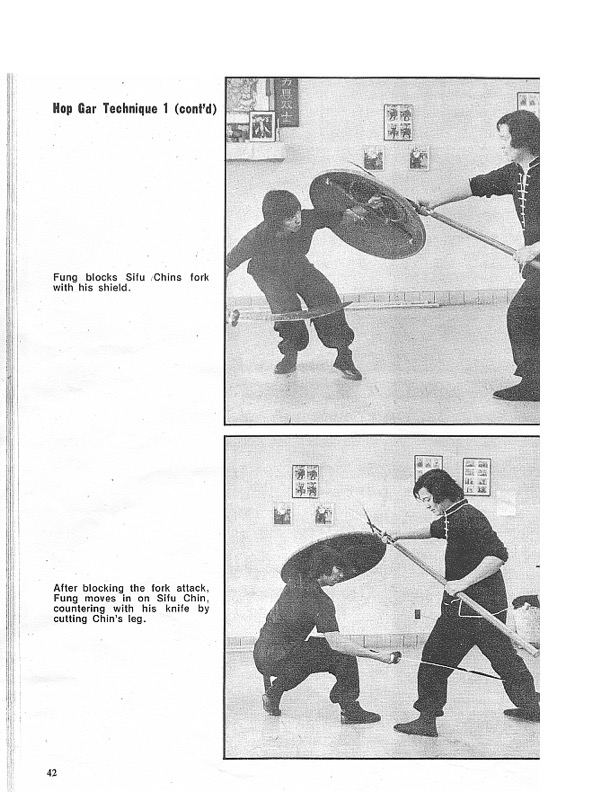
Southern systems often go left-forward. The idea was to keep the stronger/dominant right hand in the rear for power strikes or weapon cuts. You see this in Hung Gar, Choy Li Fut, White Crane, and other southern styles. Weapon use (saber, staff, etc.) reinforced that setup.

Northern systems often go right-forward. These emphasized reach, long-range strikes, and dominant-side control. Arts like Long Fist, Praying Mantis, and many Shaolin sets show this preference.

Examples of left and right hand usage, weapons based
hop-gar.jpg
 
Last edited:
Very often there will be an opportunity to strike with your non-dominant side. Even your weak side should be capable of being an effective weapon when the need/opportunity arises.
Will you switch sides in the middle of a fight?

When you and your opponent

1. both have the same side forward, that's uniform stance. Both of your centers are covered.
2. have different side forward, that's mirror stance - both of your centers are exposed.

Unless you both start with mirror stance (both of you need to take the risk), if you start with uniform stance and suddenly switch to mirror stance, you have just put yourself in great risk.
 
Hi all,

In Spanish, there are two words
"Mano Mejor"
meaning
Better Hand

Although it is mostly a right handed world,

As a lefty, I feel
blessed by god

in other words, lucky

I wish you all the success that I have found.

okay
 
I've actually been dealing with the rifle example the last couple of years. My father was left handed- he had several pistols and a couple of rifles that eject on the left in his little collection. Since inheriting them I've been shooting a couple. It has not been an easy thing to do!
 
See it as a waste of time trying to develop both sides equally.

IME, CMA (like boxing) develops one dominant side, It’s natural,
even though both sides are trained.

Think of shooting a rifle — most people don’t train both sides, and some don’t even realize their dominant eye may differ from their dominant hand.

Some MA forms include symmetry, often it's for health, balance, or completeness — not because fighters historically used both sides equally. In practice, most relied on their dominant side.

In CMA, things like iron hand were usually developed on just one side. Very few people actually manage to develop both sides equally.
Most modern rifles are designed for one side or the other, in most modern pistols they function well in either hand as many have ambidextrous controls. I found that although I’m right hand and right eye dominant, I consistently shoot handguns more accurately with my left hand regardless of position or stance.
 
true šŸ‘
Pulling the trigger, not the issue...

Hitting the target is..

In the US military they had brass defectors for left handed shooters...

n CMA there’s a trend depending on region and style...

Southern systems often go left-forward. The idea was to keep the stronger/dominant right hand in the rear for power strikes or weapon cuts. You see this in Hung Gar, Choy Li Fut, White Crane, and other southern styles. Weapon use (saber, staff, etc.) reinforced that setup.

Northern systems often go right-forward. These emphasized reach, long-range strikes, and dominant-side control. Arts like Long Fist, Praying Mantis, and many Shaolin sets show this preference.

Examples of left and right hand usage, weapons based
hop-gar.jpg
Brass deflectors can negatively affect accuracy to some extent. We have both Southern and Northern elements in Wing Woo Gar. Training both sides was/is part of both our Tai Chi and Gung fu practices. Changing sides and stance has worked well for me when sparring other styles. Boxers in particular seem to dislike sparring switch hitters as much as they dislike having their legs attacked. I regularly shoot 17 inch triangles at 1000yds, but I doubt I can do it as well using my left hand/eye on my right handed rifle. This thread makes me want to try my buddies left hand rifle…
 
Will you switch sides in the middle of a fight?

When you and your opponent

1. both have the same side forward, that's uniform stance. Both of your centers are covered.
2. have different side forward, that's mirror stance - both of your centers are exposed.

Unless you both start with mirror stance (both of you need to take the risk), if you start with uniform stance and suddenly switch to mirror stance, you have just put yourself in great risk.
I switch sides often. I have never found it to be anything but useful, except in handwriting class where the slant of my writing made it obvious I switched sides randomly. The teacher did not approve and made me choose a side. I honestly think she did me a disservice because in third grade my cursive was equally dreadful on both sides.
 
Back
Top