fine vs gross motor skills (left/right)

Southern systems often go left-forward. The idea was to keep the stronger/dominant right hand in the rear for power strikes or weapon cuts. You see this in Hung Gar, Choy Li Fut, White Crane, and other southern styles. Weapon use (saber, staff, etc.) reinforced that setup.

Northern systems often go right-forward. These emphasized reach, long-range strikes, and dominant-side control. Arts like Long Fist, Praying Mantis, and many Shaolin sets show this preference.
This is an interesting difference in fighting doctrine and such things are found in karate as well but are more individualized. Motobu advocated using the closer front hand for offense with the rear for defense/being held in reserve, although he also liked using both hands simultaneously. In the end it's all good if used effectively. And there is no rule that one cannot mix various strategies.
Will you switch sides in the middle of a fight?
Absolutely. When you present yourself in a certain fashion: stance, facing or distance, the opponent takes note and plans his attack/defense accordingly. By changing these you force him to constantly readjust his plans and throw his timing off. Additionally, when you change position, it often causes the opponent to change as well. Thus, you manipulate him to your wishes.
When you and your opponent...have different side forward, that's mirror stance - both of your centers are exposed.

if you start with uniform stance and suddenly switch to mirror stance, you have just put yourself in great risk.
I have never understood this thinking. It seems a defensive point of view - "What can the opponent do to me?" While the answer to this question should always be kept in mind, IMO the overriding question should be - "What can I do to the opponent?" In all cases of facing both you and the opponent have the identical risks and opportunities. It's just a matter of who recognizes them and acts on them first and more effectively.
 
Most modern rifles are designed for one side or the other, in most modern pistols they function well in either hand as many have ambidextrous controls. I found that although I’m right hand and right eye dominant, I consistently shoot handguns more accurately with my left hand regardless of position or stance.

That may work for you...

My experience from the US Army.
1995 Retired,
Having fired many weapons of all types...and calibers
unless somethings changed.,,,in the last 30 or so yrs
They had brass deflectors for left handed shooters....

Every one had to qualify with their weapon....hitting targets 300 meters out
 
In the end it's all good if used effectively. And there is no rule that one cannot mix various strategies.

We seem to have very different experiences.

Speaking only for myself, I don’t think it’s really possible to mix strategies the way you suggest. The skills and methods developed can be very different depending on style and training approach.

So much so that, physically, it’s not really possible. Some people try, but what they end up showing is only the shell — not the substance.
 
We seem to have very different experiences.

Speaking only for myself, I don’t think it’s really possible to mix strategies the way you suggest. The skills and methods developed can be very different depending on style and training approach.

So much so that, physically, it’s not really possible. Some people try, but what they end up showing is only the shell — not the substance.
Interesting, that you, of all people, say it’s not physically possible. Much like I say that making people fly away with a mere touch is not physically possible. Perhaps we need to cross train with one another, since neither of us believes in what the other has experienced.
 
That may work for you...

My experience from the US Army.
1995 Retired,
Having fired many weapons of all types...and calibers
unless somethings changed.,,,in the last 30 or so yrs
They had brass deflectors for left handed shooters....

Every one had to qualify with their weapon....hitting targets 300 meters out
Now there are left hand configured service rifles. I regularly shoot 17 inch triangles at 1000yds with a custom built 7.62x51M14 variant. I have won several 1000 yds competitions. 300 yds with iron sights should be easily accomplished with a decent rifle, ammunition, and a few hours of training. Shooting past 600 yds is where the additional skills are required. I have over 45 years of shooting experience, it is my primary hobby outside of MA practice.
 
This is an interesting difference in fighting doctrine and such things are found in karate as well but are more individualized. Motobu advocated using the closer front hand for offense with the rear for defense/being held in reserve, although he also liked using both hands simultaneously. In the end it's all good if used effectively. And there is no rule that one cannot mix various strategies.

Absolutely. When you present yourself in a certain fashion: stance, facing or distance, the opponent takes note and plans his attack/defense accordingly. By changing these you force him to constantly readjust his plans and throw his timing off. Additionally, when you change position, it often causes the opponent to change as well. Thus, you manipulate him to your wishes.

I have never understood this thinking. It seems a defensive point of view - "What can the opponent do to me?" While the answer to this question should always be kept in mind, IMO the overriding question should be - "What can I do to the opponent?" In all cases of facing both you and the opponent have the identical risks and opportunities. It's just a matter of who recognizes them and acts on them first and more effectively.
I agree with all of your points here 100%.
 
I know a few people who shoot clays both right-handed and left-handed to keep their shoulders from getting beat up.
I’ve done skeet and trap but shotguns aren’t really my thing. I played 5 rounds of skeet with the club president, he got really angry with himself. He shot a total of 499/500. I was nowhere near his score. I’ve hunted a lot of non water fowl ( I don’t like duck much ). Chukar is the finest bird for eating IME.
 
I have a friend who hunts birds but he hates guns. He uses this for hunting birds!
 

Attachments

  • IMG_0275.webp
    IMG_0275.webp
    84 KB · Views: 57
Perhaps we need to cross train with one another, since neither of us believes in what the other has experienced.

Whether anyone believes it or not doesn’t matter — I’m not asking for belief, just sharing experience.
My path ran from Tibetan White Crane, through Praying Mantis, to what I practise now — over 40 years training in Asia and the U.S.

IME, those styles are fundamentally incompatible — their physical methods, strategies, and skill sets are too different. Trying to mix them doesn’t create a stronger art; it only dilutes the substance of each.
 
Last edited:
Speaking only for myself, I don’t think it’s really possible to mix strategies the way you suggest. The skills and methods developed can be very different depending on style and training approach.
I was not so much talking about systems and doctrinal strategy, but individual fighting tactics. I agree there may be arts and styles that have strong ingrained strategic doctrines such as those based on hard v soft, grappling v striking, circular v linear, long v short range, etc. These are cases where technique is based on a core philosophy that determines the training approach and therefor restricted by it, making it difficult to mix approaches as you say. (This is what Bruce Lee advocated against.)

It must be considered what the art was designed to do (and how it may have changed over time). Okinawan karate evolved as practical close-range empty-hand self-defense. Taoistic philosophy nor trying to mirror animal movements had little to do with it nor was it partially based on prior lineage involving spears/swords. Karate also developed pretty much free of military battlefield influence. Free of these "imposed" stylistic constrictions it was perhaps more open to mixing various methods, bounded only by what was pragmatically effective in serious close-range personal self-defense.

This changed with the advent of sport fighting. The pure Okinawan method was not designed for this, needing to adopt other ways needed to successfully compete in the rule set such as longer-range moves and a different selection of technique. TKD (being more recent) generally evolved with sport in mind incorporating extended power strikes and has (as commonly taught) suffered to some extent close-in self-defense ability, generally speaking.

I think I'm wandering a bit, but the point is on the macro level there are fighting styles for whatever reason are hard to mix as their evolved strategic perspective (including fundamental biomechanics) conflict. But on the micro level there are less restrictions. Certainly, changing lead sides, using front v rear hand, use of angles, etc., are some things that are not strongly regulated by style, but by personal preference. These are the kind of things I favor switching around during a fight as tactical tools.
 
Whether anyone believes it or not doesn’t matter — I’m not asking for belief, just sharing experience.
My path ran from Tibetan White Crane, through Praying Mantis, to what I practise now — over 40 years training in Asia and the U.S.

IME, those styles are fundamentally incompatible — their physical methods, strategies, and skill sets are too different. Trying to mix them doesn’t create a stronger art; it only dilutes the substance of each.
I can see why certain aspects are not compatible, stances etc. When you generalized what is physically possible followed by saying the product will be without substance, that is simply an unjustified assumption. You have not followed my path of experiences.
 
You have not followed my path of experiences.
šŸ˜‚ nor have you followed mine....

Saying ā€œyou haven’t followed my pathā€ doesn’t really address whether the methods themselves are compatible — it just shifts things to personal experience.


My point is more structural: different systems build their skills on very different foundations. If the base mechanics, strategies, and principles don’t match, the result may look functional on the outside but lacks the depth each system was meant to develop. That’s what I meant by ā€œwithout substance.ā€
 
Last edited:
and šŸ˜‚

Was Bruce Lee, known as a fighter, actor or someone who arrived
at his own conclusions ?
Sometimes used as an example for those finding their own ?
Not putting Lee on a pedestal, just making a relatable reference to clarify a point. To answer your questions, he was all of those things. He was also a thinker (though much of what he wrote about was nothing new) and a driven personality. Like Norris, another poor actor, he was an icon that became a symbol of MA. Good? Yes, but not legendary IMO.
 
I frequently switch left/right stances in sparring at least, have for a long time. It's good and bad. Each side forward has its own things I can and can't do, or at least not as well. It throws a lot of people off if we haven't sparred together much before. My right side is more powerful, but i actually like fighting with right side in front. Having the side with more dexterity forward has advantages, especially at close range.
 
šŸ˜‚ nor have you followed mine....

Saying ā€œyou haven’t followed my pathā€ doesn’t really address whether the methods themselves are compatible — it just shifts things to personal experience.


My point is more structural: different systems build their skills on very different foundations. If the base mechanics, strategies, and principles don’t match, the result may look functional on the outside but lacks the depth each system was meant to develop. That’s what I meant by ā€œwithout substance.ā€
As I said, I see that a wing chun stance is at odds with the Hung Gar horse stance Have you ever known someone with two masters degrees? Does having two somehow devalue the ā€œdepthā€ of understanding, or ability to syncretize the two? While it may be true that not everyone has the wherewithal to accomplish this, it is patently false that it cannot be accomplished to the same depth as someone focused on one.
 
My right side is more powerful, but i actually like fighting with right side in front.
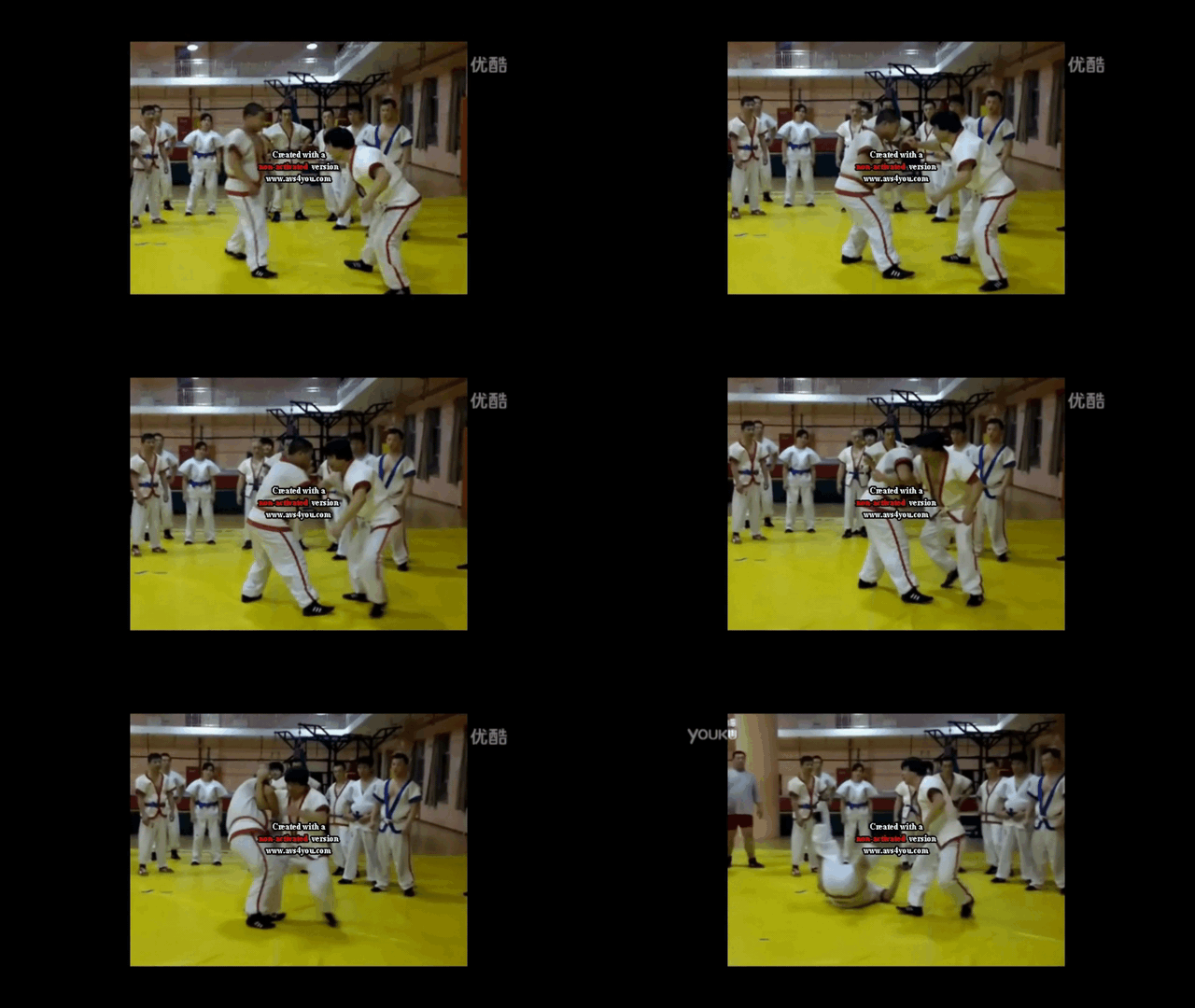
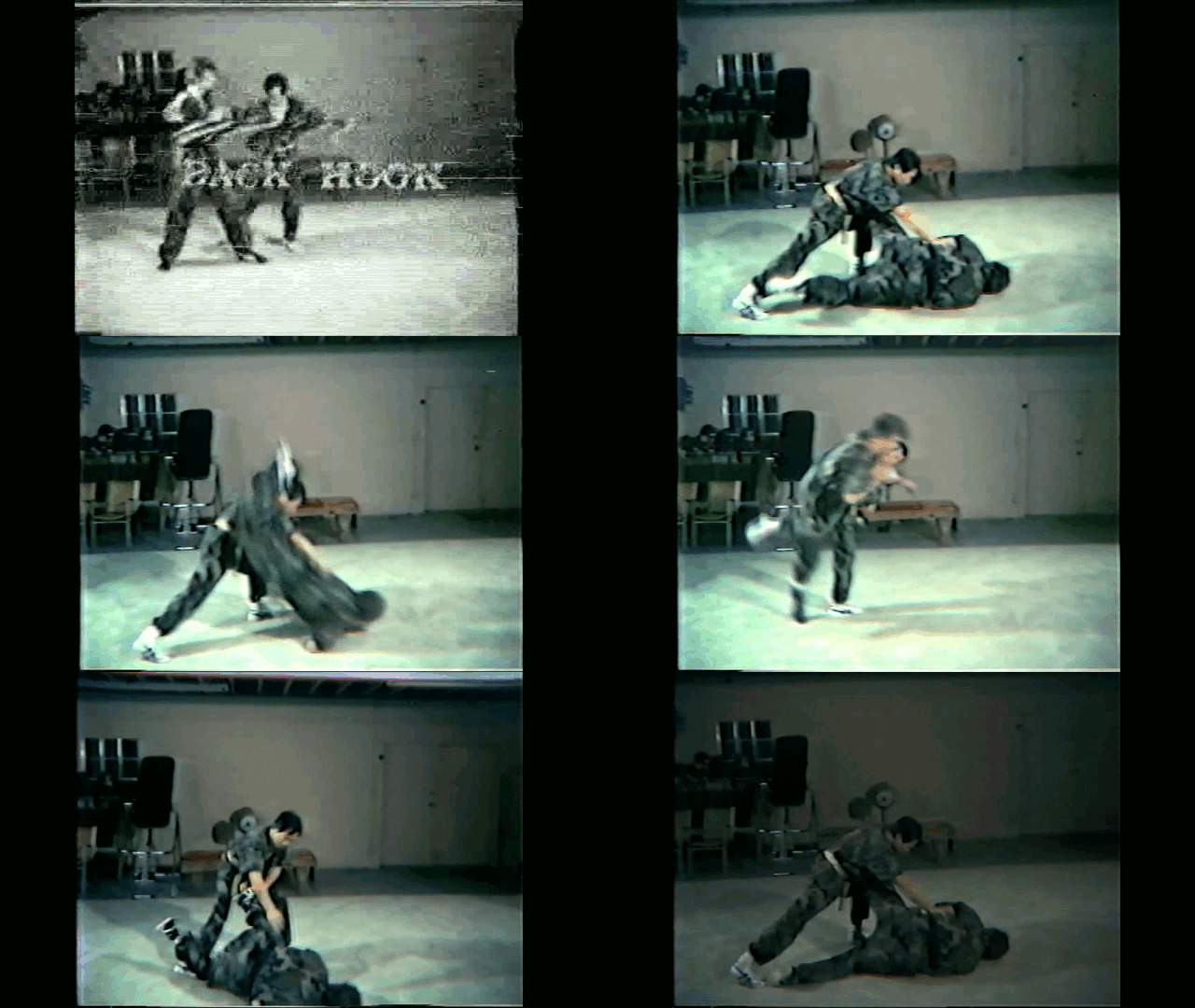
To put strong side forward has advantage. Here are examples.

If you put strong side forward, when your opponent tries to play with your strong arm, he will be in trouble.


If you put your strong side back, when your opponent picks up your leading leg, your powerful back hand cannot punch on his head because he moves in through your "side door".

 
To put strong side forward has advantage. Here are examples.

If you put strong side forward, when your opponent tries to play with your strong arm, he will be in trouble.


If you put your strong side back, when your opponent picks up your leading leg, your powerful back hand cannot punch on his head because he moves in through your "side door".

I really like the first little video! That's pretty much what I learned as a wedge throw, and it's a technique I really like to use. We see that one in karate kata a good bit.
 
Interesting, that you, of all people, say it’s not physically possible. Much like I say that making people fly away with a mere touch is not physically possible. Perhaps we need to cross train with one another, since neither of us believes in what the other has experienced.
Yes. Per Mizner, tai chi strategy is not restricted to left or right. ā€œThe Whole Body Is A Hand...ā€

 
Back
Top