Is JKD a philosophy that can be applied independently?

The philosophy of JKD absolutely can be applied independently of any lineal connection to Bruce Lee or his students. He wasn't the first person to come up with it or the last. He was perhaps the first person in the modern age to widely publicize that philosophy with regards to martial arts, but it didn't begin or end with him. Lots of people (myself included) take a similar approach.

The more relevant question is whether there is any value in using the name Jeet Kune Do without any lineal connection to Bruce Lee or his students. I'd say no. In fact, I'd say it would be deceptive, because (even though Lee may not have intended it to be so) JKD is now a recognized style in its own right, largely distinguished by that lineage going back to Bruce Lee. Using the name without that lineage adds no new information and leads people to expect something other than what they are getting. By the same token, I wouldn't care for someone using BJJ as a name for their system without a BJJ lineage, even if they were very good at ground grappling and followed the classic Gracie methodology.

BTW, with regard to Shannon Lee's IP rights, she appears to hold registered wordmarks related to Jeet Kune Do. To the best of my understanding (I am not a lawyer), these represent particular designs for a Jeet Kune Do logo (including specific fonts, etc) for use in specific markets (clothing, magazines, etc). I don't believe she owns the actual phrase "Jeet Kune Do", and in fact there are a number of other registered Jeet Kune Do wordmarks held by other people, such as the International Jeet Kund Do Federation.
 
The philosophy of JKD absolutely can be applied independently of any lineal connection to Bruce Lee or his students. He wasn't the first person to come up with it or the last. He was perhaps the first person in the modern age to widely publicize that philosophy with regards to martial arts, but it didn't begin or end with him. Lots of people (myself included) take a similar approach.
This is kind of what I was hinting at....

The OP has spent considerable time training in TKD. TKD was put together by a a group of people that had trained Japanese Karate styles, Korean Martial Arts styles and I believe Chinese Arts. They took what worked and could be used and discarded the rest.

His second art is BJJ. Again, they take anything that you can make work in their way of training. They took from lots of sources and continue to adapt and update their art. They take and seek out what works, discarding what does not.

He already has access, and significant training in two arts, that have followed and do follow the philosophy that Bruce named JKD. So, there really is no need to include JKD terms.... use the philosophies he already has time in. If you want to spend time training in "formal JKD," then you could add that in.... but you don't need to, in order to use that philosophy.

Danzan Ryu did the same thing... Okazaki studied 3 forms of formal Jujitsu, he studied Judo, he studied Hawaiian Lua, he studied a Chinese Art (the name Danzan Ryu is to honor his Chinese instructor)... he took what worked, discarded the rest and called it Danzan Ryu.

Judo did similar, taking techniques, and kata and philosophies from the classical Jujitsu systems... keeping what worked.

MMA is doing this now, taking and including techniques from anywhere, that can be successfully applied in the cage.

I would argue that all modern martial arts did / do this process. Bruce just came up with an American / Chinese way to talk about it, name it and market it. Now there is nuance to the way each art did this.... what TKD took as working is very different than what BJJ took as working, which is different than what <insert art name> took as working. To understand why, you need to understand that art. There is no need to include JKD into TKD, in order to explain or use a philosophy of taking what works.... Needing to use JKD to help explain / understand a combination of TDK and BJJ.... when you have no training in JKD...in not being like water and taking the shape of the vessel....
 
"The way of intercepting fist" was not invented by Bruce Lee. Your opponent throws a straight punch; you use circular punch to knock that straight punch down. It's just as simple as that.
 
"The way of intercepting fist" was not invented by Bruce Lee. Your opponent throws a straight punch; you use circular punch to knock that straight punch down. It's just as simple as that.
Well, es and know, there was a little more to it. JKD martial arts philosophy is focused on stopping an opponent’s attack by intercepting it mid-motion, rather than blocking and then countering . It emphasizes speed, efficiency, and directness, using tools like the "stop hit" or "stop kick" to hit the opponent exactly as they initiate their move.

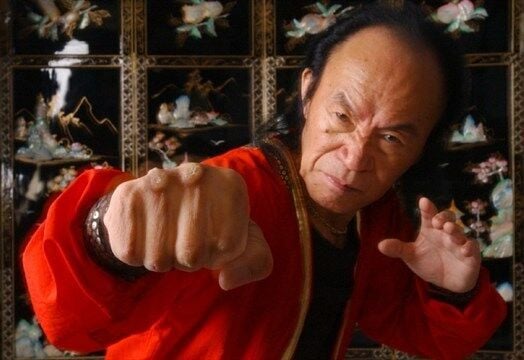
With that said, it is not new, I was in a seminar many years ago that was held by Pan Qingfu (1940–2017). He did not understand the concept of block the counter, it was to slow, His view was if I am blocking I can strike with the same arm I am stopping the attack with. He and Bruce Lee were the same age, but grew up in different areas and trained very different styles. So Bruce Lee's take on it, although impressive, is not unique to CMA styles. Xingyquan will also do something similar since it like preemptive strikes

646e21cae7c37.image.jpg

Pan Qingfu (1940–2017)
 
Well, es and know, there was a little more to it. JKD martial arts philosophy is focused on stopping an opponent’s attack by intercepting it mid-motion, rather than blocking and then countering . It emphasizes speed, efficiency, and directness, using tools like the "stop hit" or "stop kick" to hit the opponent exactly as they initiate their move.

With that said, it is not new, I was in a seminar many years ago that was held by Pan Qingfu (1940–2017). He did not understand the concept of block the counter, it was to slow, His view was if I am blocking I can strike with the same arm I am stopping the attack with. He and Bruce Lee were the same age, but grew up in different areas and trained very different styles. So Bruce Lee's take on it, although impressive, is not unique to CMA styles. Xingyquan will also do something similar since it like preemptive strikes

646e21cae7c37.image.jpg

Pan Qingfu (1940–2017)
For that matter, Lee didn’t even come with the idea independently. He got the idea of the stop hit (intercepting fist) from fencing and western boxing, and his approach to the concept is based on how it is used in those styles.
 
I think that's an important point, that what we're talking about isn't the idea itself. It's--as Tony put brilliantly upstream--the branding. The name, etc. And, with that name, the association with Bruce Lee and his students.

The idea is fair game. It exists in the martial arts zeitgeist and has done for literal ages. The implied connection with Lee is the sticking point. That's what I don't think everyone has claim to necessarily.
 
I think that's an important point, that what we're talking about isn't the idea itself. It's--as Tony put brilliantly upstream--the branding. The name, etc. And, with that name, the association with Bruce Lee and his students.

The idea is fair game. It exists in the martial arts zeitgeist and has done for literal ages. The implied connection with Lee is the sticking point. That's what I don't think everyone has claim to necessarily.
Read Tao of Jeet Kune Do (I'm guessing you already have ;) ) Many of the things one could consider philosophy comes from other sources, Still I liked the book, but it too is not all original from Bruce Lee
 
Read Tao of Jeet Kune Do (I'm guessing you already have ;) ) Many of the things one could consider philosophy comes from other sources, Still I liked the book, but it too is not all original from Bruce Lee
Oh yeah, big sections of the book were lifted directly from other sources. In fairness, those were just his personal notes that were published by his wife after his death. In some cases those notes were just copied from other books.
 
Read Tao of Jeet Kune Do (I'm guessing you already have ;) ) Many of the things one could consider philosophy comes from other sources, Still I liked the book, but it too is not all original from Bruce Lee
A time or two. ;)

Sure yeah. Krishnamurti, The Tao de Ching. Etc. And as Tony points out, these were personal notes, not something Lee presents to the public as his original thinking. It's really a question of packaging. JKD packages those philosophies (Krishnamurti, Daoism, etc.) together with those physical approaches (boxing, fencing, wing chun, etc.) in a way that he now has some claim to. ("He" being his legacy at this point.) None of it is original in isolation.

Which brings us back around to marketing, I suppose.
 
A time or two. ;)

Sure yeah. Krishnamurti, The Tao de Ching. Etc. And as Tony points out, these were personal notes, not something Lee presents to the public as his original thinking. It's really a question of packaging. JKD packages those philosophies (Krishnamurti, Daoism, etc.) together with those physical approaches (boxing, fencing, wing chun, etc.) in a way that he now has some claim to. ("He" being his legacy at this point.) None of it is original in isolation.

Which brings us back around to marketing, I suppose.
Or just his belief, view and vision as to how he felt a Martial art should be trained and guided
 
Back
Top