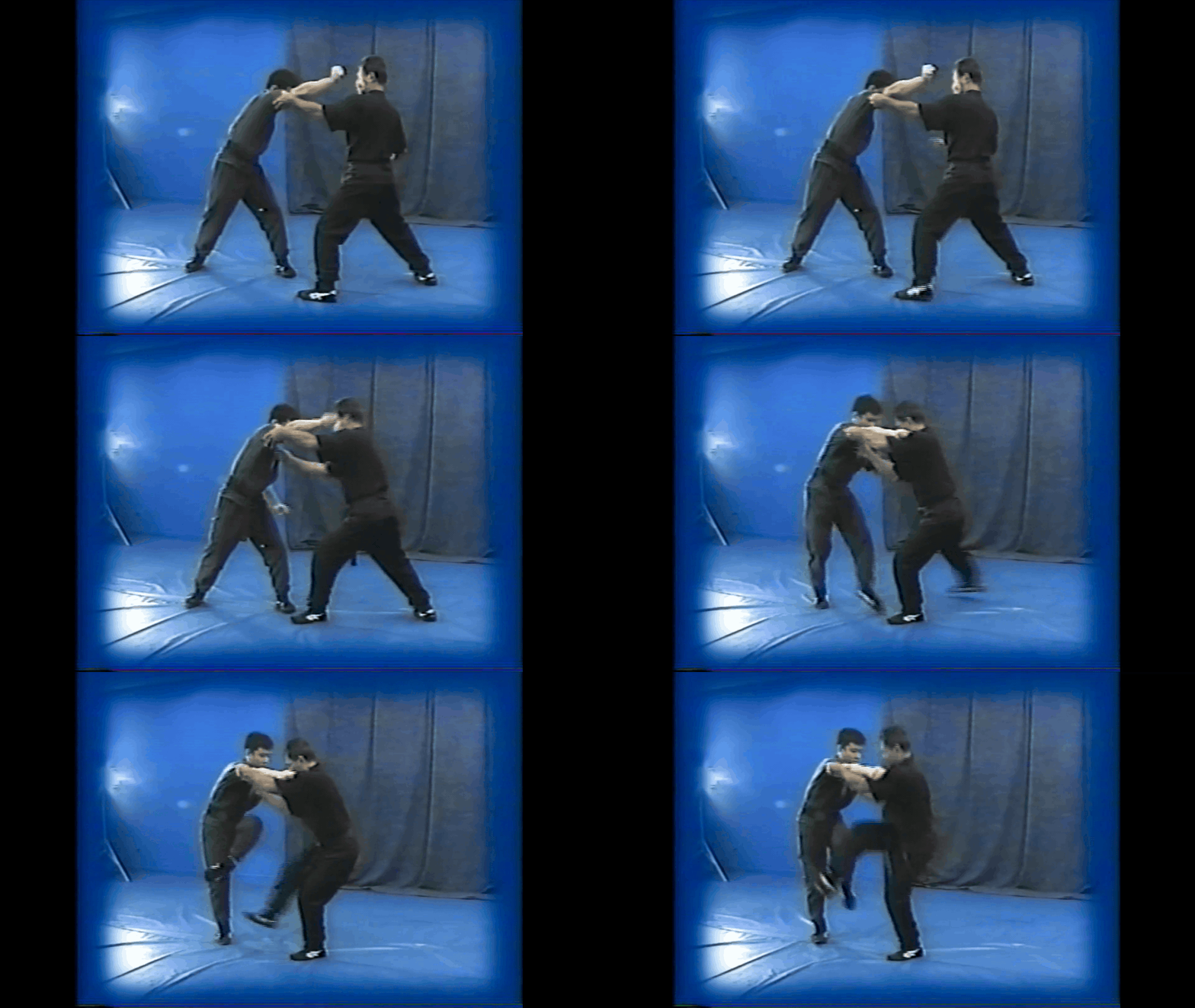
Chen Style Basics Series -- Zuǒyòu chājiǎo (left and right rub with heel)

Systema, shares a lot of the same concepts found in taiji practices..


Systema kicking exercises


This short video illustrates the simplest kicking exercise that is designed to make your kicks fast and efficient, as well as to release your hip and thigh muscles, use proper breathing, deliver heavy foot to the target for the kick, maintain proper posture, and stay relaxed when kicking.


In this presentation we demonstrate and explain the execution of different Systema kicks and the mechanics involved in them; the front kick and its variants, side and rear kicks. Also, the intended target areas in the opponents' body are discussed as well.Part 1 of 3.
 
In Taiji, what is referred to as "kicking" is not isolated or different from any other type of movement practiced. All movements follow the same theory, based on the specific line of Taiji being practiced.
How does a Taiji guy develop/test his Taiji kicking?
 
Something that takes a while to train out...👍
If the whole body is connected, the need to emphasize any one point for solidity or power is eliminated.
Actually the feeling of wanting to put “juice” in the kick comes with the whole body contention… I write “wanting” because here I speak out of forms practice perspective.

-

I should explain better, what I mean about that “putting some hip” into the kicks doesn’t mean as isolated move, it’s all synchronized move and fit well with the overall flow of the form.
One quite nice thing with Yang TJQ practice is when all has set in correctly a certain amount of spontaneous “freestyling” comes forth. It’s that point when where one has made the form one’s own……..or maybe it’s a stage of demonic possession 😈
 
Last edited:
How does a Taiji guy develop/test his Taiji kicking?

Only speaking from my perspective and experience, the Taiji community, others may have different views.

"In Taiji, what is referred to as 'kicking' is not isolated or different from any other type of movement practiced. All movements follow the same theory, based on the specific lineage of Taiji being practiced."

As such, it's part of a process, not developed or tested independently as an isolated movement.

Movements are tested statically and dynamically for whole-body connection, six harmony integration, and body alignments that develop inner body alignment awareness.

What is tested are the expressions of the process, as performed by the practitioner, relative to the practitioner.

In Taiji, it is said, "each step is a kick," a concept echoed in Systema , a Russian martial art that shares many of the same principles, though not always based on the same rationale.


Actually the feeling of wanting to put “juice” in the kick comes with the whole body contention… I write “wanting” because here I speak out of forms practice perspective.

my mistake...understanding English is not your first language 👍

Same trick: I get spirited and although the kicks slow I put in some hip push, a remnant from my karate days when I just loved to plant a solid kick on my opponents


The expression, 不用力,用意 (bù yòng lì, yòng yì) "Don't use force, use mind "
often heard by many in their practice.

For those coming from other disciplines, it is often difficult not to "feel" consciously or unconsciously that something should be done, instead of allowing "it" to come from the process itself.

For many, including myself, it is hard to get past this point of trying to add or do something.
 
Last edited:
Honest question from someone who has never practiced tai chi or any CMA. The kicks in the video- where does the power come from? I can see the pushing up off the non kicking leg adding power. These kicks are different from karate, I'd like to understand more.
I didn't see an answer for this, so I'll share how it works for me. It gets
reduced to this "The faster you can lift the knee the more power you can generate. The lower leg gets its power from whipping out.". The combination of lifting the knee and using that motion to power the whip of the kick is how I do it. There are other elements that can help create power or make the impact more effective but that's pretty much how it works for me and how I generate power.
 
I didn't see an answer for this, so I'll share how it works for me. It gets
reduced to this "The faster you can lift the knee the more power you can generate. The lower leg gets its power from whipping out.". The combination of lifting the knee and using that motion to power the whip of the kick is how I do it. There are other elements that can help create power or make the impact more effective but that's pretty much how it works for me and how I generate power.
That's a big part of what got me about the first video- to my uneducated eye it they appeared to be lifting a mostly stiff, already extended leg. I wasn't seeing a whipping action of the lower leg. I'm seeing body mass being moved, but no additional acceleration of that mass through the lower leg. Am I missing something?
 
That's a big part of what got me about the first video- to my uneducated eye it they appeared to be lifting a mostly stiff, already extended leg. I wasn't seeing a whipping action of the lower leg. I'm seeing body mass being moved, but no additional acceleration of that mass through the lower leg. Am I missing something?
Your analysis is correct. Their exercise is not applications based it's conditioning based so to speak. If you want to improve your front kick then do standing straight leg lefts.

You want to be standing instead of sitting, but you want your leg to lift over and object the same way that is show here. This is the quickest way to build strength for those the front kick lift without putting bad stress on the hip or the knee. If the exercise is too easy then simply raise the leg higher. 5 days a week for 2 months will yield great results. Don't do reps, do time. First start at 30 second rounds 3 sets. at 3 different levels. Low , Mid, High. High would be were the standing leg is at 90. Most people will have trouble getting to that level. So high for them would be the highest level that they can do.

To increase the strength and power of the whipping part. I recommend thinking of it like this " The whipping motion should be like kicking an imaginary nail into the wall. With the ball of your foot. You don't want to kick it with the toe because the nail may go in between the toes. Plus, you don't want your toes to become deformed or broken. Practice kicking a heavy bag in this manner. Using the same low, mid, and high levels that you set for the straight leg lifts.

Remember to whip that lower part of the leg out and not push into the bag. If I were going to use the same exercise that the OP posted then I would make it applications informed and then do separate exercises to help improve the kicks.
 
That's a big part of what got me about the first video- to my uneducated eye it they appeared to be lifting a mostly stiff, already extended leg. I wasn't seeing a whipping action of the lower leg. I'm seeing body mass being moved, but no additional acceleration of that mass through the lower leg. Am I missing something?
It's important for you not to over-analyze the video (or take other people's advice on what should or shouldn't be shown in the video). The video is as-is. The people in the video are beginners. The video is more to illustrate the sequence of movements for people who are already trained in Chen style tai chi.

For those who are interested in improving their Tai Chi kicks and who do not have a teacher I urge you not to take any advice you get on the internet as most of the information you get on forums like this is simply wrong. Get a qualified teacher, that is your only way out. By qualified, I mean someone who has a lineage. If your teacher does not have a clear lineage, you are being cheated.
 
It's important for you not to over-analyze the video (or take other people's advice on what should or shouldn't be shown in the video). The video is as-is. The people in the video are beginners. The video is more to illustrate the sequence of movements for people who are already trained in Chen style tai chi.

For those who are interested in improving their Tai Chi kicks and who do not have a teacher I urge you not to take any advice you get on the internet as most of the information you get on forums like this is simply wrong. Get a qualified teacher, that is your only way out. By qualified, I mean someone who has a lineage. If your teacher does not have a clear lineage, you are being cheated.
I think the issue you are going to run into is the discussion of Exercise vs Application. Exercise and Form are one thing. Application is something very different. Form should come from application, but it is often not trained that way.
One cannot fully understand form before understanding application.
Understanding application will help a person to understand form.
Understanding Form will not help to understand application.

An example of this can actually be seen in the video that you posted. One student sinks their stance, but the other only turns. The student who doesn't sink his stance can get away with that in Forms or in Exercise. But in application that sinking becomes important. If Form / Exercise are not trained with the focus of application, then power, motion, and muscle development may not be trained correctly. While the ability to "sink" one's weight is not important in forms or exercises. In application it's very important.

I can't speak about the knowledge of other forums, but I've been impressed with the collection of knowledge on this site. It is not uncommon on this site for advice to be given about martial arts and to have people come back and say how the advice has helped them. If you have conversations with people here, then you'll begin to know which advice to trust.

I do agree about your statement in learning a system. If you are trying to learn a system then it's better to find qualified teacher than to try to learn on your own
 
Chi Gerk and foot-tag for basic footwork and alignments is a good start
No, a Wing Chun sticky leg technique has nothing to do with Tai Chi and will damage your Tai Chi progression.
 
All kinds of 'sticky leg' training in Wu style. It's basic two-person work in distinguishing empty and full and has absolutely nothing to do with Wing Chun "leg technique".

Nine Palace Stepping should have a foot tag format once the pattern can be done smoothly.

In lieu of Wu style instruction, freestyle chi gerk and foot tag are excellent exercises for "a taiji guy to develop/test his taiji kicking" - speed, ranging, balance, strength, alignment, timing, pinning, evasion, blocking, endurance, etc etc.
 
Last edited:
All kinds of 'sticky leg' training in Wu style. It's basic two-person work in distinguishing empty and full and has absolutely nothing to do with Wing Chun "leg technique".

Nine Palace Stepping should have a foot tag format once the pattern can be done smoothly.

In lieu of Wu style instruction, freestyle chi gerk and foot tag are excellent exercises for "a taiji guy to develop/test his taiji kicking" - speed, ranging, balance, strength, alignment, timing, pinning, evasion, blocking, endurance, etc etc.

No, in lieu of proper tai chi instruction, you cannot just substitute Wing Chun leg techniques. It doesn't work that way.

The fact that Wu style may or may not train leg techniques doesn't mean anything if you're talking about "in lieu of Wu style instruction." The work done in Wu Style is not called chi gerk. Chi gerk is an exercise from Wing Chun.

If you are looking for a way to train legs in Tai Chi please refer to the video in the OP, and feel free to ask if there is something in the video you don't understand :)
 
Not really getting into this Wing Chun/Taiji discussion, although i do both.

But for the record, part of Chen style, when you get into higher level of push hands, incudes using your legs as you do you arms. I was taken out (put on the floor) by a Chen guy, who was also a sifu of Chen, with his leg, while doing push hands. After that, i too started working on use of the legs in push hands.
 
Not really getting into this Wing Chun/Taiji discussion, although i do both.

But for the record, part of Chen style, when you get into higher level of push hands, incudes using your legs as you do you arms. I was taken out (put on the floor) by a Chen guy, who was also a sifu of Chen, with his leg, while doing push hands. After that, i too started working on use of the legs in push hands.

As already stated, it has nothing to do with Wing Chun. That's a red herring.

Yes, the use of legs to push, pull, hook, trip, entwine etc has been a part of myriad martial method all over the world since forever.

A long time ago, some Wu style guys figured out how to adapt and incorporate chi gerk/sticky leg into their practice without having it 'damage their taiji progression'. The sticky leg training I learned in Wu style was actually referred to as chi gerk more than a few times.

Any practitioner with a deep enough understanding of their taiji practice should be able to figure it out without violating the principles and methods they learned as a part of their particular taiji style/method. If they can't figure it out, they probably shouldn't be teaching taiji. It isn't rocket science.

As for the op, whether it's for attention, validation, or whatever other reason one might have to post videos such as that (and others), there's just something really "off" with a person who hides behind a couple of kids - possibly as a way of avoiding scrutiny and criticism - to show half-baked presentations of whatever material is supposed to be demonstrated. It comes off as exploitive and cowardly. Not something a normal adult does on a public martial arts forum.
 
Last edited:
the use of legs to push, pull, hook, trip, entwine etc has been a part of myriad martial method all over the world since forever.
I also believe the "leg skill" should be above all MA systems. There should be just "leg skill". There is no such thing as WC leg skill or Taiji leg skill.
 
As already stated, it has nothing to do with Wing Chun. That's a red herring.

Yes, the use of legs to push, pull, hook, trip, entwine etc has been a part of myriad martial method all over the world since forever.

A long time ago, some Wu style guys figured out how to adapt and incorporate chi gerk/sticky leg into their practice without having it 'damage their taiji progression'. The sticky leg training I learned in Wu style was actually referred to as chi gerk more than a few times.

Any practitioner with a deep enough understanding of their taiji practice should be able to figure it out without violating the principles and methods they learned as a part of their particular taiji style/method. If they can't figure it out, they probably shouldn't be teaching taiji. It isn't rocket science.

As for the op, whether it's for attention, validation, or whatever other reason one might have to post videos such as that (and others), there's just something really "off" with a person who hides behind a couple of kids - possibly as a way of avoiding scrutiny and criticism - to show half-baked presentations of whatever material is supposed to be demonstrated. It comes off as exploitive and cowardly. Not something a normal adult does on a public martial arts forum.
First, relax, take a few deep breaths, I am not attacking your posts, I'm to some extent supporting it.

I know what you said, I said Chen style already uses legs. And although it is not the same as Chi Gerk, it is sticky legs and is in Chen style. This also means that it predates Wu style. I also would not be surprised if it already was in Traditional Wu style. Wu style (Wu family) is, as far as I know, the only taijiquan family that trains break falls.

Basically it is all part of advanced push hands training includes shin-to-shin, knee-to-knee, and foot-to-foot sensitivity exercises.
 
Last edited:
First, relax, take a few deep breaths, I am not attacking your posts, I'm to some extent supporting it.

I know what you said, I said Chen style already uses legs. And although it is not the same as Chi Gerk, it is sticky legs and is in Chen style. This also means that it predates Wu style.
Apologies, Xue Sheng, for any confusion or offense I may have caused with my reply. Only the first two lines were in response to what you wrote.

The rest of it was addressing the red herring and other 'stuff'.

Yes, nothing new under the sun.
 
I also believe the "leg skill" should be above all MA systems. There should be just "leg skill". There is no such thing as WC leg skill or Taiji leg skill.
Want to try a 2-person taiji leg skill exercise? You may find it boring, or very interesting, but it only takes about 20 minutes to complete.
 
Want to try a 2-person taiji leg skill exercise? You may find it boring, or very interesting, but it only takes about 20 minutes to complete.
The SC leg skill training contains 4 sides:

You use your right leg to attack

Side 1 - the outside of your opponent's left leg.
Side 2 - the inside of your opponent's left leg.
Side 3 - the inside of your opponent's right leg.
Side 4 - the outside of your opponent's right leg.

Side 1:

踢(Ti) - Forward kick,
撮(Cuo) - Scooping kick,
粘(Zhan) - Sticking kick,
撞(Zhuang) - Trunk hitting,
靠(Kao) - Advance squeeze,


Side 2:

彈(Tan) - Spring,
挑(Tiao) - Hooking kick,
纏(Chan) - Foot entangling,
合(He) - Inner hook,
掏(Tao) - Inner knee seizing,


Side 3:

穿(Chuan) - Fireman’s carry,
撿(Jian) - Foot picking,
沖(Chong) - Inner kick,
掛(Gua) - Inner heel sweep,
刀(Dao) - Inner sickle,


Side 4:

蹩(Bie) - Break,
撩(Liao) - Back kick,
扣(Kou) - Knee seizing,
切(Qie) - Front cut,
削(Xiao) - Sickle hooking,


How to escape/counter leg attack is also trained.

 
Last edited:
Back
Top