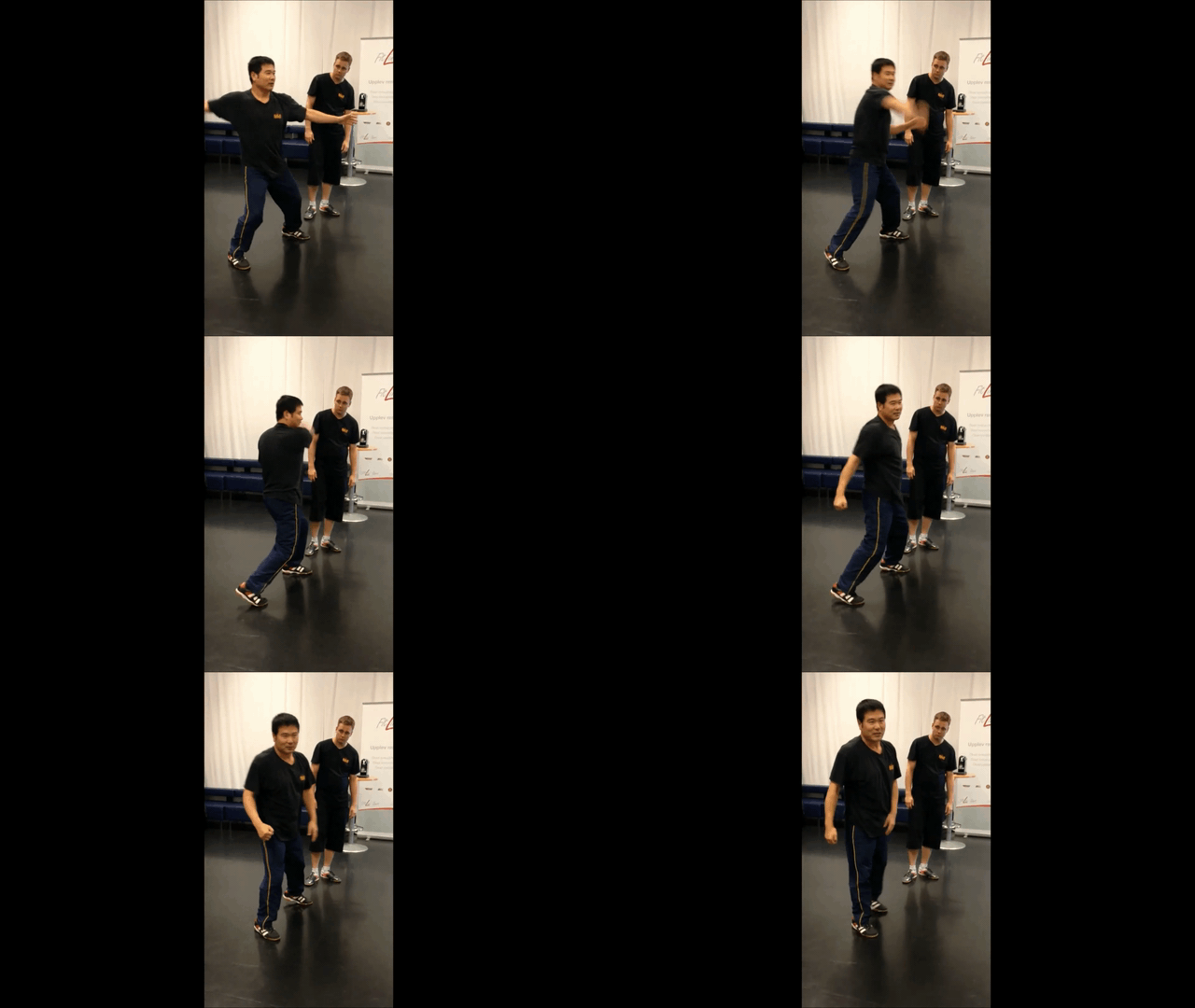
I do believe they are different arts, with different emphasis, just that they share much of the same DNA.
My linage contains Chen style and Xinyi liuhe, and I can tell you that they are very similar from a practical standpoint. It is possible to take many moves from Chen style and turn them into xinyi-style exercises. Such as an, an, an, snake spits out tongue, and so forth. My teacher showed me a way to practice fan through the back using san ti shou as a linking posture. So, the way we start teaching Chen style is to show the most difficult postures in line form, as short sets (ex. as I linked above) and then show the whole form so it is easier to learn.
Anyways I'll take what you wrote as a request for evidence -- and the evidence is massive. I would say there is in fact a documented relationship, mainly surrounding the three-three boxing manual and where they got the spear routines. Some notes, mainly from S.Yan, Dai ZQ, etc. will help here, and I will close with a more scholarly article. But I do feel overall, that the roads are pointing in this direction.
(BTW, unfortunately I have lost track of whose notes these are; they have been intermingled, but mainly Dai ZQ's and S.Yan I think):
Because of Damo, the monks had then begun to practice what amounted to daoyin and qigong alongside their martial arts. They soon developed an art called "Xin Yi Ba", which by historical record consisted of the practical movements of general farming and cleaning (such as carrying water, sweeping a broom or shoveling) into a sort of fighting art that they used to defend themselves against wild animals. Shaolin also began to become well-known for their staff fighting skills.
[...]
Xingyi master Dai Longbang wrote the 'Preface to Six Harmonies Boxing' in the 15th reign year of the Qianlong Emperor [1750]. Inside it says, '... when [Yue Fei] was a child, he received special instructions from Zhou Tong. (note: who was a shaolin monk) [...]
[...]
At this time, Ji Longfeng had not yet gained any true inspiration, however, the path to Shaolin runs past the QianZhai Temple in Bo’Ai county. Priest Dong of QianZhai, was famous for his Shi San Shi Rou Shou (13 soft hands) and Tongbei. Dong's liu he chang (six harmony spear) was especially intricate. [...]
This is the same way the merchant Wang Zong Yue passed his Soft Hands and Six Harmony Spear skills to Dong when he passed the temple when he passed by. [...] (see below)
After learning the shenfa of Six Harmony Spear, Ji practiced day and night on the banks of the Yellow River, eventually gaining the level of Six Harmony Divine Spear. He then set off again for Shaolin temple. [...]
Arriving at Shaolin Si, Ji's “6 harmony spear” skill was incomparable, the abbot begged Ji to stay at the temple to teach. (this was recorded in the Ji Family Chronicles. In the Shaolin temple's archives, there is a spear manual titled, "Teacher Ji's Spear Manual) Shi Yong Wen, originally from Shaolin, still has it in his care. (The author has visited Shi Yong Wen in Kaifeng, Henan to authenticate the manual.)
The manual in question is exactly the same as the “Xin Yi Liu He Chang” manual in the author's possession. From this, we can see that Shaolin treated Ji respectfully and called him Ji Lao Shi (teacher, Ji). Therefore this story matches up with the story in the Ji Family Chronicles.
[...]
During the Ming Dynasty, one famous for Six Harmony Spear Li Ke Fu, who used Mei Hua Liu He Chang (Pear Blossom Six Harmony Spear).
The treatise written by Chen Zong You in 1621, “The Selection of Long Spear Ways”, details the style he learned from Li. General Qi Ji Guang, who lived in the same era as Li, had gone to Tang Jing Zhou, 21 years his senior, in search of instruction ...
In his "New Book of Effective Techniques" are records of Yang Family Spear's “8 Mother Spears”, “Six Harmony Spear” and “24 Spears”. The Six Harmony Spear in Tang's book, "Martial Edited Selections", has little differences with the Six Harmony Spear recorded in Qi's manual. [...]
...Xin Yi Spear and taiji are extremely similar ... also has 13 Spears, 21 Spears and 24 Spears etc, and also includes 3 point theory, similar to Xin Yi Liu He. We can see that there is some connection there. It is easy to see why, when in 1887, Mai Zhuangtu's disciple Ding Zhao Xiang visited Chang Nai Zhou's hometown to converse with his 5th generation descendant Chang De Pu, he made a copy of Chang Nai Zhou's treatise, "Tendon Change Classic, Chi Channeling Secret", and included it in his boxing manual.
[...]
Chang Nai Zhou wrote the "Central Chi Theory", and the twenty or so chapters on the "Theory on Yin Yang Entering and supporting" were called the "Tendon Change Classic, Chi Channeling Secret." ...from the same source as as the 3 Point Theory in the Xin Yi Liu He boxing manual. ...Chang was a student of Wang Bao Spear, which came from Taoist Dong of Qian Zhai Temple.
Taoist Dong had incredible skill with Liu He Spear and Staff, ... Chang Nai Zhou (also) had a friendship with Chen Village's 12th generation descendant Chen Ju Xia...
[...]
Chen Family 16 generation descendant Chen Xin once used Taiji theory to edit the Xin Yi Boxing Manual. The part he edited being "3 verses on 10" and renamed the manual the "3, 3 Boxing Manual" ...
14th generation descendant Chen Chang Xing too modified a copy of Xin Yi's "9 Theories" that was passed into Wen county into "Chen Taiji Theories".
=====
Actually I have a lot of notes similar to these pointing out that person X Y or Z either visited chen village or qianzhai, and what they taught or learned there. The general jist of it is that xinyi was one of the arts that intermingled with chen style from multiple sources including visitors to the village, arts taught to the village by qianzhai temple, and shaolin arts itself, and not only that, that they fed back into each other as well. Actually, did you know that Wang Zongyue and Chen Bu both came from the same area?
"When you ask me from where I came, the answer is Shanxi Hongdong Big Scholar Tree." Wang Zongyue, by the way, worked as a schoolteacher near Chen village. At least the person who used this name did. Some have pointed out that Wang Zong-yue means "Revered King Yue".
I'll leave you with the following article, although what I have presented so far is just a small amount to help interested people start researching this.
"... This important evidence directly proves that Wang Zongyue is also the successor of the "Xinyi Liuhe Thirteen Battle". Therefore, Wang Zongyue is not only the successor of Chenjiagou Tou Taoquan, but also the successor of "Yuewu Muwang Boxing Manual"."


 youtube.com