Push hands and knife fighting

Monkey Turned Wolf115 145

MT Moderator
Staff member
Anyone ever try to combine push hands with knife fighting? I was doing an in-close knife flow (essentially swapping sets of techs back and forth naturally), and it reminded me of the bit of push hands that I've done. Feels like the two could fit together, and help people a)be more relaxed when a weapons in the picture and b) be more cognizant of both the weapon and body mechanics at the same time.

I'm nowhere near an expert on push hands, considering looking for a taichi guy nearby and seeing what we can come up with, but wondering first if anyone here has tried combining them before/thoughts from the more cma minded on this board.
 
Anyone ever try to combine push hands with knife fighting? I was doing an in-close knife flow (essentially swapping sets of techs back and forth naturally), and it reminded me of the bit of push hands that I've done. Feels like the two could fit together, and help people a)be more relaxed when a weapons in the picture and b) be more cognizant of both the weapon and body mechanics at the same time.

Among some Cheng Man Ching–based groups, they’ve done something similar using a jian (straight sword).


How that would hold up against someone using real intent — say, a competitive fencer — hard to say.
In the video, you can see that at any time he could easily stab the student he’s working with… but that’s not really the purpose of the exercise.


I'm nowhere near an expert on push hands, considering looking for a taichi guy nearby and seeing what we can come up with, but wondering first if anyone here has tried combining them before/thoughts from the more cma minded on this board.

More CMA-minded” — kind of depends on what one means by it.
The idea differs a lot between gyms as well as individual skill sets.


What some might view as “CMA-minded,” depending on their meaning, could actually be deconstructing the practice — not really understanding its purpose.

Same as when people ask why the practice doesn’t include this or that — it often just means they’re looking at it through a different frame than what it was designed for.


That said, once the skill sets are truly attained, they can be applied to anything — the principle doesn’t limit the expression, only clarifies it. To the OP: the basic idea would be to move before the knife occupies the space — not to directly interact with it.
 
Last edited:
To the OP: the basic idea would be to move before the knife occupies the space — not to directly interact with it.
This is exactly what I was thinking of, but didn't have quite the words yet. Doing push hands, being able to still maintain your own balancing while manipulating the other persons, while either avoiding or neutralizing the weapon.

Waiting until I'm home to watch the video but am very interested to see it.
 
How that would hold up against someone using real intent — say, a competitive fencer — hard to say.
Not so hard to say after testing that idea :dead: Yep, competitive fencer


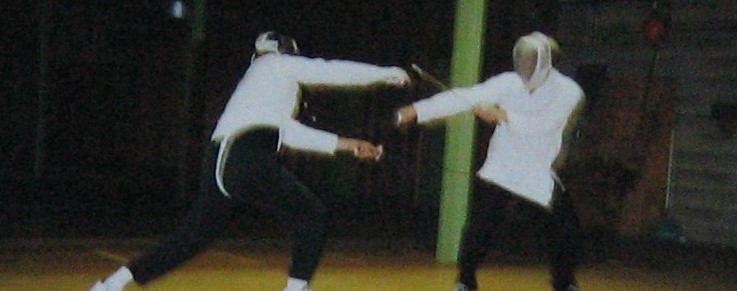
My Yang's style teacher on the left, and me on the right. Did a bit of 'push blades' together when he ran his fencing club in my training hall. Very similar to push hands, at speed, with stick and follow, link and adhere


IMG-0162-3.jpg


Could never get into the sportive format - no lateral movement, grabbing, punching, kicking etc. The Florentine-style double blades, anything goes, was more to my liking.


More CMA-minded” — kind of depends on what one means by it.
The idea differs a lot between gyms as well as individual skill sets.


What some might view as “CMA-minded,” depending on their meaning, could actually be deconstructing the practice — not really understanding its purpose.

Same as when people ask why the practice doesn’t include this or that — it often just means they’re looking at it through a different frame than what it was designed for.


That said, once the skill sets are truly attained, they can be applied to anything — the principle doesn’t limit the expression, only clarifies it. To the OP: the basic idea would be to move before the knife occupies the space — not to directly interact with it.

More taiji-minded, a few of our non-fighty taiji groups were introduced to 2-person taiji bang/ruler play
iu


Each person would hold, or otherwise control one end of the stick with their palm and fingertips, and make up their own rules as they applied their personal learning to the games that emerged and evolved from the practice. It's an item that can be carried in a purse or whatever for whenever the urge, or need, arises to practice taiji on the go, if you will ;)
 
Last edited:
Anyone ever try to combine push hands with knife fighting? I was doing an in-close knife flow (essentially swapping sets of techs back and forth naturally), and it reminded me of the bit of push hands that I've done. Feels like the two could fit together, and help people a)be more relaxed when a weapons in the picture and b) be more cognizant of both the weapon and body mechanics at the same time.

I'm nowhere near an expert on push hands, considering looking for a taichi guy nearby and seeing what we can come up with, but wondering first if anyone here has tried combining them before/thoughts from the more cma minded on this board.

Pushing hands by this or any other names, helps one learn sensitivity and also read the opponents movements.
The contact manages, monitors and delays the opponent.

Grabbing gives hard feedback to the opponent. They know you are there.
Soft touch allows you to read them and react.

Expert wrestlers, stand up and ground both, feel their opponent through their movement and react.
This is not unique to Pushing hands. I am not trying to take anything away from that set of knowledge.
I am trying to say one can find it elsewhere if one knows where to look.
And you are asking the questions so you are looking :) :D

In the Balintawak I teach, we use the terms Manage Monitor and Delay for how the off hand works while in contact with the opponent or the opponents stick.
Balintawak is an optimized stick dueling system so blade references are valid for blade system. I mention here as one could in crease their sensitivity by reading the inanimate object (The Stick) and reacting to it.

Reading the blade is a last resort as it means it is touching you already :o

Once one gets even better with the inanimate objects going back to animate objects is like the person yelling at you. The are easy to be heard.

Of course the harder would be Inanimate to inanimate.
I do not recommend this until you feel real comfortable with the animate reading the inanimate.

As for the knife as you stated it will keep them more relaxed and looking to learn the sensitivity is a good plan in my book. (Modern Arnis which I also tech has blades.)

Once one is open to seeing and reading the sensitivity, then the knife disarms that most complain about are not as bad.
The forward thrust stab that most teach the crossed arm hard block.
If one steps left then the right is the lower arm and it is not a hard block the right is a cam or a parry or a pass depending upon the term used by your primary system. The left falls on top not to block, it falls to also manage, monitor, and delay. And if it begins to retract it allows for more feedback.
One can pull back both arms / hands or one could use the left the grab / grapple the knife hand.
.
Similar for stepping offline to the right only the left hand would be the bottom hand and the right hand would be the top hand.

Good Luck in your journey and training :)
 
Pushing hands by this or any other names, helps one learn sensitivity and also read the opponents movements.
The contact manages, monitors and delays the opponent.

Grabbing gives hard feedback to the opponent. They know you are there.
Soft touch allows you to read them and react.

This is not unique to Pushing hands. I am not trying to take anything away from that set of knowledge.
I am trying to say one can find it elsewhere if one knows where to look.

Once one gets even better with the inanimate objects going back to animate objects is like the person yelling at you. The are easy to be heard.

Of course the harder would be Inanimate to inanimate.
I do not recommend this until you feel real comfortable with the animate reading the inanimate.
A pretty good break-down overall of how weapons training can relate to certain aspects of push hands. But there are levels and specific facets of empty-hand push hands that focus entirely on intent having to do with how each person attends to what's going on internally, within themselves, as much as what's going on between them and the other person.

Your comment on levels of touch is exactly what is applied to governing those facets of internal development having to do with listening/ting jin and responsiveness to the intent of the other - heavy touch - normal touch - lightest of touch. Each level of touch is determined by the individual according to their own application of touch. Heavy touch is the same as one would use to self-massage a sore shoulder or stiff neck or a cramp in their thigh. Normal touch is the same as one uses when they fully extend the index finger of their non-dominant hand and touch random spots on their own face. Lightest of touch is the touch one would use to tickle their lip or cause it to itch. Since those levels of touch are according to what each individual applies to themselves, it will almost always be different from their partner's sense of the same types of touch, so there's a need to be constantly adjusting the way one reads the touch of the other. It takes mutual trust and honesty to really have that component present in the practice.

Heavy and normal touch are fairly easy to understand and apply to 2-person practice in both empty-hand (animate) and weapons (inanimate) formats. Lightest of touch is a different level that is hard enough for most people to apply in empty-hand and impossible for most people to work with in any other format. It takes years to develop a practicable ability to work with lightest of touch. Then there's no touch that is focused entirely on intent, but I only know that as a thing and not from personal experience as that takes the right teacher to guide that practice.

I really liked the way you address the difference between what I know as intermediary objects and what you refer to as inanimate, and what I know as the energetic exchange of touch = animate. Intermediary objects removes the element of 'contention' from the practice so that something separate is going on while the outward aspects of interaction play out.
 
Last edited:
If you're doing knife flow...sure there's crossover elements of training.

If you're really talking about actual knife on knife fighting...NO, you need fast snapping strikes, to be able to then keep range on the opponent, NOT staying in trapping range.
 
To echo Rich Parsons a bit (perhaps a lot), there are lots of drills in FMA similar to push hands and sticky hands. Hubud lubud, palisut, palakaw. Things that are often first performed with weapons, whether that's sticks, knives, or swords. Because of the range of a knife (virtually the same as empty hand), you could adapt lots of drills to the knife. I think it's more a question of overlaying that awareness that the things you get away with in empty hand you wouldn't get away with in the case of a knife. You're not going to "roll with" a knife. You're not going to "take" a knife the way some people can take a punch. And the knife doesn't require wind-up the way an impact weapon does. Even a non-telegraphic punch like the jab still requires momentum. Even casual contact with a knife can be really bad. So the drills you might adapt to knife could be shortened the way you see in Balintawak, for instance.
 
To echo Rich Parsons a bit (perhaps a lot), there are lots of drills in FMA similar to push hands and sticky hands. Hubud lubud, palisut, palakaw. Things that are often first performed with weapons, whether that's sticks, knives, or swords. Because of the range of a knife (virtually the same as empty hand), you could adapt lots of drills to the knife. I think it's more a question of overlaying that awareness that the things you get away with in empty hand you wouldn't get away with in the case of a knife. You're not going to "roll with" a knife. You're not going to "take" a knife the way some people can take a punch. And the knife doesn't require wind-up the way an impact weapon does. Even a non-telegraphic punch like the jab still requires momentum. Even casual contact with a knife can be really bad. So the drills you might adapt to knife could be shortened the way you see in Balintawak, for instance.

But I have and do roll with a knife.
I have pocket knife trainers.
How does one deploy and open the weapon?
Which is why many carry small fixed blades as once they are deployed they are always open :)

I think one should have written No Sane person would roll with a knife :D
 
If you're doing knife flow...sure there's crossover elements of training.

If you're really talking about actual knife on knife fighting...NO, you need fast snapping strikes, to be able to then keep range on the opponent, NOT staying in trapping range.

I get the sewing machine and other tactics common for prison yards and serious assassination attempts.
I see the snapping techniques or strikes for longer weapons. Longer than a Bowie.
I agree they all work real nice there.

For the shorter blades if ne is playing on the outside sniping each other's hands then I would contend it might not be a real knife fight.
Real fight and real knife fights people clash. People get cut. etc.

So maybe I am missing something from you comment.
I am not challenging. I expressed my points so you would understand some of what I know.
Now I am asking if you could explain more of the snapping attacks for knife fighting and actual knife.
.
Back to the above post, yes the sensitivity is a drill.
A drill build attributes and skills.
It is not the end all be all.
I get that.

Thank you
 
But I have and do roll with a knife.
I have pocket knife trainers.
How does one deploy and open the weapon?
Which is why many carry small fixed blades as once they are deployed they are always open :)

I think one should have written No Sane person would roll with a knife :D
Are you talking about rolling in the jiujitsu sense? I was talking about rolling like rolling with a punch. Getting hit but taking some of the momentum out of it. The knife not needing momentum to do its damage the way a punch does.
 
Are you talking about rolling in the jiujitsu sense? I was talking about rolling like rolling with a punch. Getting hit but taking some of the momentum out of it. The knife not needing momentum to do its damage the way a punch does.
Yes Rolling like in JJ sense.

Of course one is not going to take a knife stab willingly.

I had read your post both ways.
Sorry for my confusion
 
Yes Rolling like in JJ sense.

Of course one is not going to take a knife stab willingly.

I had read your post both ways.
Sorry for my confusion
No worries Rich. I agree with you about rolling in the jiujitsu sense (though my experience in BJJ or grappling generally is minimal).

Mostly what I was getting at is that sensitivity drills (whether chi sao, hubud, or whatever) can be done with a training knife with the awareness that even "casual" contact with the knife is likely bad news.
 
No worries Rich. I agree with you about rolling in the jiujitsu sense (though my experience in BJJ or grappling generally is minimal).

Mostly what I was getting at is that sensitivity drills (whether chi sao, hubud, or whatever) can be done with a training knife with the awareness that even "casual" contact with the knife is likely bad news.
My practice with these drills with a knife is that you have to be cognizant of the knife while doing it, and adjust to avoid them. While flowing.
 
And yes, don't roll against the force the way you would do unarmed. And be aware that knives will often be sharp sudden movements. But the drills help teach other aspects..there are different drills to deal with sudden movements.
 
I like training with knives and against knives as much as anyone... and have tried out many different systems. While they are fun and educational, I always remember to temper my expectations.

I have read many versions of these classes by Rory Miller (last quote at the bottom):
(Why I Don’t Pretend to Teach Knife Defense)
“Why I Don’t Pretend to Teach Knife Defense” … is the title of a seminar that I’ve done a couple of times over the last few years … The class starts with some pictures I’ve collected of knife wounds, emphasizing that one set was from a prison shank, just a piece of metal that had been scraped on a floor, not some custom fighting knife sharpened to a razor edge. The most gruesome was a single cut from a kitchen knife. Gives them a very basic idea of what the hell they are talking about. What the stakes are if they choose to gamble in this arena. … Then I ask for someone with no experience or training with a knife. I take the volunteer aside, hand her the training knife and whisper, “Keep the knife moving, get it in to them any way you can. Cut anything they stick out, if someone grabs your hand switch hands and keep stabbing and slashing. Got it?” I then turn back to the students and say, “This person now has less than thirty seconds of knife training. Who in here teaches knife defense? … In a big diverse group, it quickly becomes clear that almost nothing works against a fast moving, aggressive knife.”
Rory Miller
Found a more detailed description here:
 
Last edited:
I get the sewing machine and other tactics common for prison yards and serious assassination attempts.
I see the snapping techniques or strikes for longer weapons. Longer than a Bowie.
I agree they all work real nice there.

For the shorter blades if ne is playing on the outside sniping each other's hands then I would contend it might not be a real knife fight.
Real fight and real knife fights people clash. People get cut. etc.

So maybe I am missing something from you comment.
I am not challenging. I expressed my points so you would understand some of what I know.
Now I am asking if you could explain more of the snapping attacks for knife fighting and actual knife.
.
Back to the above post, yes the sensitivity is a drill.
A drill build attributes and skills.
It is not the end all be all.
I get that.

Thank you
So Sticky hand like elements build general sensitivity = good.
Things like sewing machine stab in a prison yard are not "Knife fights" they would be "Knife Assaults"
In a fight both parties are at least somewhat ready for violence, even if one party majorly pre-empts it. In an assault one party is entirely ready for violence and other is not, they might still fight back and win, but it has to do with the mindset of survival and risk aversion.
A fight always has more risk aversion because you know the other person is at a non zero readiness for violence, as well as a "knife fight" more heavily implies both parties have a knife, whereas a "knife assault" it is likely just the assailant has a knife.

So in a knife fight the risk aversion and deterrent of the other knife will naturally cause opponents to be more warry of closing range (still might happen), and hence the need for fast snapping strikes to tag and get away.

In knife assaults the script is flipped, you now have all the risk aversion and no deterrent meaning controlling the knife is now critical and close range mechanics become more "worth it".
Also 76% of knife assaults - the person is already within 3ft
In 80% of knife assaults - the attacker grabs the victim first to keep them in range of the attack

If you want more statistics on knife assaults - I wrote a research paper on it!
 
So Sticky hand like elements build general sensitivity = good.
Things like sewing machine stab in a prison yard are not "Knife fights" they would be "Knife Assaults"
In a fight both parties are at least somewhat ready for violence, even if one party majorly pre-empts it. In an assault one party is entirely ready for violence and other is not, they might still fight back and win, but it has to do with the mindset of survival and risk aversion.
A fight always has more risk aversion because you know the other person is at a non zero readiness for violence, as well as a "knife fight" more heavily implies both parties have a knife, whereas a "knife assault" it is likely just the assailant has a knife.

So in a knife fight the risk aversion and deterrent of the other knife will naturally cause opponents to be more warry of closing range (still might happen), and hence the need for fast snapping strikes to tag and get away.

In knife assaults the script is flipped, you now have all the risk aversion and no deterrent meaning controlling the knife is now critical and close range mechanics become more "worth it".
Also 76% of knife assaults - the person is already within 3ft
In 80% of knife assaults - the attacker grabs the victim first to keep them in range of the attack

If you want more statistics on knife assaults - I wrote a research paper on it!


In the terms you use and have defined I am still confused based upon my personal experiences.

A post said real knife fights like this happens a lot or was implied in a post above.

Yet one can say they dance on the outside. And snipe the hands.

In my experience and it is limited (more than 30 less than 100) - Over

If they had a knife and I could get a knife or improvised weapon there was never any one even getting close enough to snipe a hand. They ran away or left with name calling and such.

A knife fight or a knife duel I have never seen except in west side story, or other media like Force Ten From Navarone and other movies.
.

I have seen in real life a guy with an axe handle attack a guy with a hunting knife. The guy with the big stick lost and almost died. One trust in , he trapped the blade and he kept jerking to try to get free which kept cutting and cutting in the rib area underneath the left arm.
.

My Confusion if my data versus your definitions.
Do you have some data sources I can read?

Thank you
 
Back
Top