The recovering Xingyiquan addict


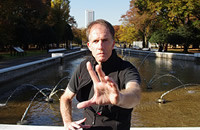
To spark some more conversation. This is a video about a standing posture in Tai Chi (Cheng Men Ching lineage) It is from Scott Meredith, a student of Ben Lo. The posture reminded me of the Santi Shi posture training.

Sun Style folks say 3 to 5 minutes of Santi Shi, Xingyiquan folks 20 minutes to hours... It is more than jsut standing, it is a meditation, and qigong trainingI can say my experience was that at about 18 minutes I started noticing a whole lot of connetions within my own body. DO not think I would have gotten that with only 5 minutes.

Once talked to my Yang Shifu about stance training and the only two things his teacher had him stand in a lot toe forst year was the horse stance. But he did say you could take any posture in taijiusn and stand in it. Ironically he use to make us do that when he would stop the class in whatever posture he decided to stop, walk around and correct postures. But he never told me any length of time to stand.

As to Meredith's play the pipa stance, it appears to be for a different reason and has a different focus. Santi in Xingyiquan is in part for strengthening, as well as relaxation and meditation as time goes on. As well as teaching a structure that is important to Xingyi. But as I said before, you can't forget that this structure has to move powerfully and fast. Xingyiquan will attack an attack, in xingyiquan attack is defense.
 
Interesting, but, different focus and goal. I will post more on t his later, no time to get into it now.

I will say that he is using the term obvious energy, in Xingyiquan that is beginner level and called Ming jing, this is where you build a hard solid foundation. But there are levels after that An Jing and Hua Jing, more on those later. Also of concern are the 6 haromonies (.3 internal, 3 external)

More later, if someone else doesn’t beat me to it
Here’s an old article by him talking briefly on Xingyiquan -


This is from a very old forum that is sadly gone, that Xingyiquan was a big part of, this is from The pages of the Old Empty Flower.com, and from the late David DeVere. There is a lotof info here if someone is interested in Xingyiquan. I was happy to find it still existed somewhere

 
This is from a very old forum that is sadly gone, that Xingyiquan was a big part of, this is from The pages of the Old Empty Flower.com, and from the late David DeVere. There is a lotof info here if someone is interested in Xingyiquan. I was happy to find it still existed somewhere

Do you agree with the way that it was explained in the video? Or would you explain it differently?
 
Do you agree with the way that it was explained in the video? Or would you explain it differently?
Well, I don't agree, but I also am not saying it is wrong. I don't know what style of Xingyiquan, and even if I did, it has been my experience in Hebei style that it can vary from teacher to teacher, and I have had 3. All had different beginnings to the forms, one was vastly different.

However if I am asked what style I do, I will say Hebei, since it is what I have done most and longest. I have also trained Shang, but to me Shang is just Hebei by a different name. I also trained some Wudang, which I would love to have pursued further. Reason being that it was the only style, and only teacher that taught in the way Di Gouyong said it should be trained, and how it use to be trained (with the exception of Piquan as a fist) in his book "Di Guoyong on Xingyiquan Volume I Foundations". I have also dabbled a little in Shanxi, learned a 5 elements linking form in Shanxi. However I have absolutely no training in Henan style and I have been told it can be rather different from the others.

In the Xingyi I have done you never turn back like that to strike, and you always come from the center, not the side, although it may appear that way in Bengquan, but it really isn't. And there is no round strike like he discusses in the video. I will bring an elbow back, but that only enhances the strike of the opposite hand, or fives someone behind you a heck of an elbow to the stomach. A lot of Xingyi striking involves a vertical circle, like a wave, more than turning the waist
 
A lot of Xingyi striking involves a vertical circle, like a wave, more than turning the waist

That’s what I’ve always felt watching his clips, and others like them. It’s also something I use to describe aspects of my own work when training with people.

The “gearing” model he used always seemed a bit static to me. Others have used the millstone (磨盘, mó pán) analogy to describe the turning of the waist — something continuous and connected — but even that still feels more rotational.

In Taiji we tend to talk more in terms of sinking and spiraling (螺旋, luó xuán), which feels less like fixed rotation like a continuous wave moving through the body. What you’re describing lines up more with that.
 
Mrs Wu has gone to China for 2 weeks, so... my mornings, before work, and working from home will be used to work on Santi Shi as well as doing Baduanjin.

Evenings will be % elements and Taijiquan

Need to get moving, I have been sitting to much these days, something about turning 64 made sitting and doing nothing way to easy

So off to work on Wuxingquan (5 elements) Xingyiquan....
 
Back
Top