The recovering Xingyiquan addict

Back to the topic
Interesting reading 🤔

I’ve done long stance training in other systems — 20 minutes in horse stance isn’t unusual. In Tibetan White Crane, they’d time us with incense, leave, then come back and “test” our structure with impact.

I’ve also had Qigong teachers who required 30 minutes before they’d even teach you.

That was very different from what we did in Beijing. The focus there was on subtle, continuous alignment — more of a micro, active adjustment rather than holding a fixed posture.

My last Taiji teacher felt that if you could hold a posture much longer than about 5 minutes, the alignment probably wasn’t being maintained in the way he intended.

What I’ve found is that people who can hold stances for long periods often develop strong rooting, but it can become fixed and make it harder to “empty” and move dynamically.

In a push hands setting, they may not feel the need to move. In other settings, not moving — or being unable to move — may not work out very well.

It may be more related to what’s being trained — endurance in the posture, or continuous internal alignment. Not necessarily developing the same thing


Agreed, enduracne and allignement are not necessarily training the same thing. But Santi shi is training training endurance over a period of time and putting a stance into muscle memory, and that stance is important to the style, at least Hebei, Shang and Wudang. It is slightly different in Shanxi.

However it should no be forgotten that this posture has to move and move fast. I am not a proponent of standing in Santi shi for hours, I use to be, but I am no longer. However I don't think 20 minutes is unreasonable, but it should not be the main focus of the training, especially as you progress. But with that siad, currently I am only standing 5 minutes. But I can still feel the connections that I discovered way back when I got to 20 minutes.

But I feel you should also approach it this way, JKD has its stance, it trains in with live movement, Same should be done with Xingyiquan and the santi shi posture
 
xingyiquan wanted you to stand for 20 minutes to an hour
What exactly is the aim of this exercise, other than building static strength in the legs - if it's to develop rooting ability, just how does it do this? Is there no better way than holding a position?
I’ve also had Qigong teachers who required 30 minutes before they’d even teach you.
I can see this can test the student's desire, perseverance and will power to prove their dedication. Not a bad thing as far as this goal is concerned.
What I’ve found is that people who can hold stances for long periods often develop strong rooting, but it can become fixed and make it harder to “empty” and move dynamically.
It seems not to be time efficient. I agree that it can hinder dynamic movement which seems the more important ability. Karate emphasizes a strong rooted stance ability, but we try to accomplish this each step in motion. Sanchin form is designed for this, but is present in most other kata as well.
 
I can see this can test the student's desire, perseverance and will power to prove their dedication. Not a bad thing as far as this goal is concerned.
Some teachers do use this as a kind of test — to gauge a student’s desire, perseverance, and commitment.

I had a Qigong teacher, who taught “Shaolin Qigong Nei Jing Yi Zhi Chan” — One Finger Qigong.
.
He used standing for 30min, as an entry requirement. It allowed him to see whether someone could handle the training, which often required standing for long periods, along with other demanding practices.

One of the reasons I didn’t continue with that training was simply that it was too time-intensive for what I was looking for.


It seems not to be time efficient. I agree that it can hinder dynamic movement which seems the more important ability. Karate emphasizes a strong rooted stance ability, but we try to accomplish this each step in motion. Sanchin form is designed for this, but is present in most other kata as well.
There’s a difference between “standing practice” as a general category and what is actually being trained.

I’ve done Sanchin. What’s being discussed here isn’t the same. Sanchin and Zhan Zhuang are quite different in method, purpose, and what they develop — even though they’re sometimes mentioned together when people talk about standing in general.


IMG_1759.jpg

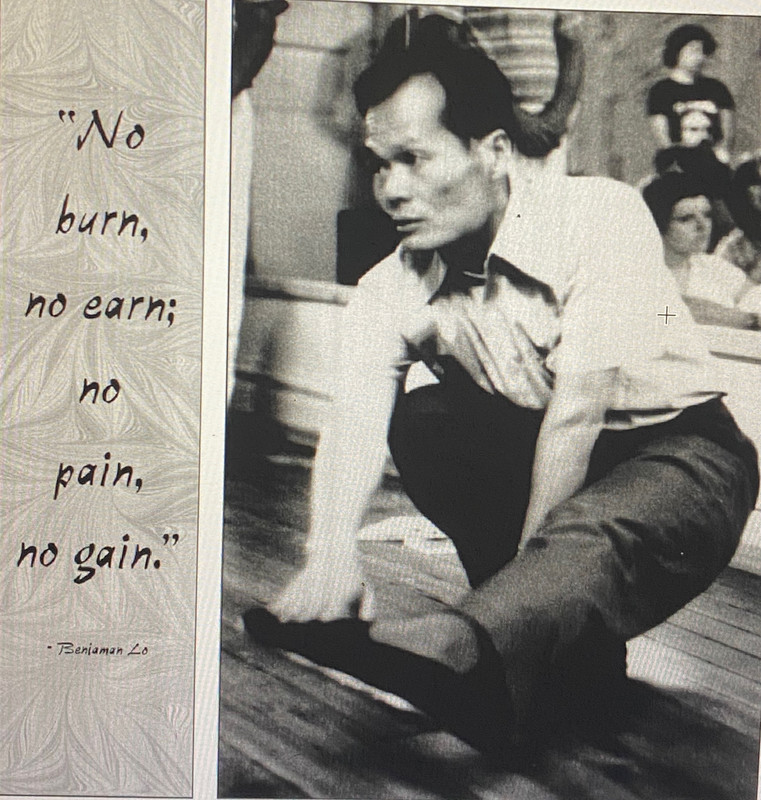
Ben Lo, a well-known 37-step Taiji practitioner, taught in a way that could completely exhaust your legs from solo practice alone. He would stop class and go to each person, correcting alignment on the supporting leg. The weighting was 100%–0%. If there were ten students, one would hold the posture while the others waited. Anyone who trained with him would remember that experience.

At times, it was difficult to drive home afterward — you could barely feel the brake or gas pedal. Ones legs, at least mine were shot...from the training...

In my teacher’s group, the weighting was also 100%–0%. He wasn’t a fan of long standing sessions. He taught the fundamentals, but felt that if someone could stand comfortably for more than about five minutes, the alignment was probably not correct. Genuine structure under load isn’t comfortable — One might feel it is, until someone else corrects it . 🙂

When I work with people, I make corrections — but only to the extent they can handle. Enough for them to feel it and understand how to train, based on their own focus and needs. Too much correction too quickly creates collapse, not growth.
 
Last edited:
Too much correction too quickly creates collapse, not growth.
A lesson all good teachers learn. One must be selective on what to correct since we can only absorb (mentally and physically) so much at a time. There's always next week, next month and next year. No rush. A teacher can always find something wrong with you, even after 20 years. :)
 
In the early 2000s I talked with with 3 different people to get their thoughts on Santi Shi. My xingyiquan teacher said his teacher teacher (BP Chan) had said you are not even a beginner if you cannot stand in Santi Shi for 20 minutes per side. Also my xingyiquan teacher felt that all you needed to do to get to 20 minutes was stand 5 minutes right, 5 minutes left and repeat. He and I did not agree on this.

So I contacted Di Guoyong, who actually responded. His view was the repeating 5 minutes gave you nothing but 5 minutes (this was my view as well). However he felt that 20 minutes was the bear minimum, 30 minutes should be the goal, 60 minutes was better.

Zhang Yun , student of Wang Pei Sheng, also felt the 5 minutes switch only got you 5 minutes. But also added he would be thrilled if his students stood 20 to 30 minutes per side per day. But no one has that kind of time. When his shifu learned it was easy to have an hour or two a day to stand. He ended with 30 is better than 20, 20 is better than 15, and so on to 5 minutes.

Dennis Rovere, author of ‘The Xingyi Quan of the Chinese Army: Huang Bo Nien's Xingyi Fist and Weapon….’ Had a very interesting take, that I agree with. 20 minutes is a good goal, but people put to much emphasis on Santi Shi and forget that ultimately this structure has to move.

All were email conversations by the way
Interesting experience. Yes length of time in the santishi is important.

But all too often it’s claimed without further explanations/instrucktions that one must stand for long sessions , and it seems that many teachers themselves early on in their own learning was left to just stand and endure.
Sometimes that method of teaching is used as a weeding away “weak” students, in some instances I suspect teachers actually have not much of clue themselves of what to do with the posture.
When I moved to China, my Yiquan teacher here immediately began to teach methods non of my teachers back in my homecountry was teaching, methods that made such an immediate practical result i just had to invardly laugh on how these “simple” methods seemingly are hidden by the belief that one must stand for extreme long sessions for quite a long time for any relevant results to be achieved.
My teacher said it’s better to stand for five minutes with correct unbroken focus(methods) applied to the postures rather than just dead stand for 50 minutes.
 
Last edited:
Which one will give you better benefit?

1. Stand in 3-7 stance for 30 minutes.
2. Drill XingYi Pi Quan 1000 times nonstop for 45 minutes.

IMO, 1 < 2.
santishi and (XYQ)piquan are obviously and not so obviously closely connected , one is the other and the other is the one…..does that make sense?
 
What exactly is the aim of this exercise, other than building static strength in the legs - if it's to develop rooting ability, just how does it do this? Is there no better way than holding a position?
somewhat of a clue you might find in the meaning of “Sanchin”
Santishi or SanCai also refers to certain threesome unifications .
The posture seems like just a posture but in practice lots of movements are in play, the mind must be involved in certain visualizations/imaginations so to nervous system come to work in required manner.
It’s an exercise of self suggestion
 
What exactly is the aim of this exercise, other than building static strength in the legs - if it's to develop rooting ability, just how does it do this? Is there no better way than holding a position?

I can see this can test the student's desire, perseverance and will power to prove their dedication. Not a bad thing as far as this goal is concerned.

It seems not to be time efficient. I agree that it can hinder dynamic movement which seems the more important ability. Karate emphasizes a strong rooted stance ability, but we try to accomplish this each step in motion. Sanchin form is designed for this, but is present in most other kata as well.
Coming from an "external karate" perspective.

The purpose is to "burn out" your muscles so that your body learns to stand without excess tension and using proper structural alignment. It is easy to "think" that your body is doing these things while actually it is relying on your muscles.

To use a bad analogy, it is how bodybuilders will "pre-exhaust" a muscle group to engage other muscles in a lift to get a better benefit from that particular lift. For example, using the pec dec or dumbbell flyes to exhaust the pectoral muscles before doing a bench press. This way the smaller triceps/deltoids don't give out first before the pectoral muscles are fully activated.
 
Coming from an "external karate" perspective.

The purpose is to "burn out" your muscles so that your body learns to stand without excess tension and using proper structural alignment. It is easy to "think" that your body is doing these things while actually it is relying on your muscles.
Yes, but generally with muscle groups
To use a bad analogy, it is how bodybuilders will "pre-exhaust" a muscle group to engage other muscles in a lift to get a better benefit from that particular lift. For example, using the pec dec or dumbbell flyes to exhaust the pectoral muscles before doing a bench press. This way the smaller triceps/deltoids don't give out first before the pectoral muscles are fully activated.
Good analogy
 
Interesting experience. Yes length of time in the santishi is important.

But all too often it’s claimed without further explanations/instrucktions that one must stand for long sessions , and it seems that many teachers themselves early on in their own learning was left to just stand and endure.
Sometimes that method of teaching is used as a weeding away “weak” students, in some instances I suspect teachers actually have not much of clue themselves of what to do with the posture.
When I moved to China, my Yiquan teacher here immediately began to teach methods non of my teachers back in my homecountry was teaching, methods that made such an immediate practical result i just had to invardly laugh on how these “simple” methods seemingly are hidden by the belief that one must stand for extreme long sessions for quite a long time for any relevant results to be achieved.
My teacher said it’s better to stand for five minutes with correct unbroken focus(methods) applied to the postures rather than just dead stand for 50 minutes.
My stance has been adjusted by 2 different teachers. The main difference in those cases was the hand position. But I would not be surprised if many were only talkng about hours in Santi Shi based on Tradition. And not that tradition is wrong, I am of the opinion that some of todays shortcuts around traditional training methods is weakening the style they are training

And I am not a big on standing for hours for training.
 
What exactly is the aim of this exercise, other than building static strength in the legs - if it's to develop rooting ability, just how does it do this? Is there no better way than holding a position?
Strengthening, stability, relaxation and muscle memory. Rooting, well it is, at least in the styles I trained a 60/40 or 70/30 back weighted stance, and rooting is important, but I think this is where people can get into trouble and if not careful become double weighted and forget that the main point is getting this structure to move and move quickly. However t is also in a sense a type of qigong as well.
 
Some teachers do use this as a kind of test — to gauge a student’s desire, perseverance, and commitment.
agreed
IMG_1759.jpg

Ben Lo, a well-known 37-step Taiji practitioner, taught in a way that could completely exhaust your legs from solo practice alone. He would stop class and go to each person, correcting alignment on the supporting leg. The weighting was 100%–0%. If there were ten students, one would hold the posture while the others waited. Anyone who trained with him would remember that experience.

At times, it was difficult to drive home afterward — you could barely feel the brake or gas pedal. Ones legs, at least mine were shot...from the training...

In my teacher’s group, the weighting was also 100%–0%. He wasn’t a fan of long standing sessions. He taught the fundamentals, but felt that if someone could stand comfortably for more than about five minutes, the alignment was probably not correct. Genuine structure under load isn’t comfortable — One might feel it is, until someone else corrects it . 🙂
My Yang Shifu use to stop us in the middle of a posture and walk around the correcting, did not matter if you were in Grasp Sparrows tail, White crane spreads it's wings, snake creeps down, or any of the kicks. He would walk around student to student adjusting postures. I liked it, but in a room with 12 or more students you could be standing there a while. And then when he got to you, looked and did nothing you were both happy and disappointed. Happy you had it right, disappointed you had to stand there so long for nothing
 
I liked it, but in a room with 12 or more students you could be standing there a while. And then when he got to you, looked and did nothing you were both happy and disappointed. Happy you had it right, disappointed you had to stand there so long for nothing
😂 yes!


It did take a long time… when not much was said, I’d always wonder if that was a good thing or a bad thing 🤔


I grew up in SF and was introduced to Ben through another teacher Professor Ken Wen Chi, “亓冠文”.
who taught me the 37 step...He told me he had learned directly from Master Cheng Man-Ch’ing. As a high school teacher of Cheng’s daughters in Taiwan, he asked them if they could introduce him to their father. Master Cheng agreed to teach him — though not as a formal disciple.


Whenever I was back in town from the military, I’d stop by. Ben was funny… , he had some interesting viewpoints....very strict in his teaching... always asking saying ,,,you'er not "song" relaxed enough......a good person, highly skilled teacher....
 
Last edited:
😂 yes!


It did take a long time… when not much was said, I’d always wonder if that was a good thing or a bad thing 🤔


I grew up in SF and was introduced to Ben through another teacher Professor Ken Wen Chi, “亓冠文”.
who taught me the 37 step...He told me he had learned directly from Master Cheng Man-Ch’ing. As a high school teacher of Cheng’s daughters in Taiwan, he asked them if they could introduce him to their father. Master Cheng agreed to teach him — though not as a formal disciple.


Whenever I was back in town from the military, I’d stop by. Ben was funny… , he had some interesting viewpoints....very strict in his teaching... always asking saying ,,,you'er not "song" relaxed enough......a good person, highly skilled teacher....
Read a few articles about Ben Lo, he was one person I always wanted to train with. Sadly I never got the chance. Glad you had the chance.
 
Whenever I was back in town from the military, I’d stop by. Ben was funny… , he had some interesting viewpoints....very strict in his teaching... always asking saying ,,,you'er not "song" relaxed enough......a good person, highly skilled teacher....
Did you get chance to touch hands with him ?
 
Did you get chance to touch hands with him ?

Indirectly — I didn’t have the chance to formally push with him, our interactions through drop-in classes when I was in town and was corrected on my practice.

At one point he touched my back while adjusting my posture and said, “With my small finger I can make you move.” I thought about it for a moment and replied, “Yes… but that small finger belongs to a Taiji master.” He paused, laughed a bit, and said, “Yes, this is true.” Ben, was good man, high skill, would have been interesting meeting him, after my meetings with my last taiji teacher.

Much later, I had the opportunity to push with one of his more well-known students who went on to teach. This was after I had moved on to my last Taiji teacher in Beijing. It took place during an informal meeting in San Francisco with a small group connected to another of his students.

Some thoughts…

For many, the practice tends to become more competitive, focusing on strategies and methods used to overcome the other person. That is a bit different from focusing on developing the kind of skill that makes things work regardless.

Robert Smith mentioned in one of his books something his wife said after pushing with Cheng Man-Ch’ing. She noted a feeling before the contact, describing it as a wave, and asked CMC about it. CMC replied that most people will not feel this, which is why in most cases their reactions are late and they cannot recover.

I mention this to highlight different levels and focuses within push hands practice.

When I pushed with Ben’s student, he immediately felt something was off from his usual encounters. When we asked him about it, he said he felt very full, unable to really empty. He attributed that to focusing mainly on competing and dealing with others who used force, rather than with those who did not.
 

To spark some more conversation. This is a video about a standing posture in Tai Chi (Cheng Men Ching lineage) It is from Scott Meredith, a student of Ben Lo. The posture reminded me of the Santi Shi posture training.
 

To spark some more conversation. This is a video about a standing posture in Tai Chi (Cheng Men Ching lineage) It is from Scott Meredith, a student of Ben Lo. The posture reminded me of the Santi Shi posture training.
Interesting, but, different focus and goal. I will post more on t his later, no time to get into it now.

I will say that he is using the term obvious energy, in Xingyiquan that is beginner level and called Ming jing, this is where you build a hard solid foundation. But there are levels after that An Jing and Hua Jing, more on those later. Also of concern are the 6 haromonies (.3 internal, 3 external)

More later, if someone else doesn’t beat me to it
 
More on Santi Shi and Xingyiquan


Levels of XIngyiquan

Ming Jing (明劲 - Obvious Energy/Force): The beginner stage where one builds a hard, solid foundation.

An Jing (暗劲 - Hidden/Covert Energy): The intermediate stage where the force becomes more subtle, internal, and integrated.

Hua Jing (化劲 - Transforming/Mysterious Energy): The advanced stage where the energy becomes flexible, adaptable, and effortless.
 
Back
Top