The true essence of Tai Chi is to stop interfering with oneself.

windwalker099114 144

Master of Arts

"The most misunderstood word in Taijiquan may be "qi" (氣).

Many people think qi is some mysterious energy, a kind of superpower, or even a magical skill that can send someone flying with a single touch. But if we look at it from the perspective of the body and physics, qi is not addition... it is subtraction.

Qi is not something extra that you gain. Rather, when the shoulders stop using unnecessary tension, the chest is no longer rigid, the feet stop gripping the ground unnecessarily, and the breath is no longer chaotic, the body's natural flow, perception, and ability to transmit force begin to reappear.


In this episode, starting from "The Physics of Qi," we revisit several of Taijiquan's most difficult concepts in a way that ordinary people can understand:

  • Song (鬆) is not being weak; it is no longer pressing the accelerator and the brake at the same time.
  • Chen (沉) is not pushing downward; it is connecting with the ground.
  • Dantian (丹田) is not a ball inside the abdomen; it is the body's control returning to the center.
  • Listening Energy (聽勁, tīng jìn) is not a superpower; it is the body finally becoming quiet enough to hear.
  • Neutralizing Energy (化勁, huà jìn) is not avoiding force; it is changing the conditions under which force acts.
What Taijiquan truly trains is not the acquisition of more mysterious abilities. It is learning to stop interfering with yourself.


The skill is not gained by adding. It is revealed by subtracting."


The teacher mentioned in the video

Yang Style Taiji Master Zhu Chunxuan (2017)
 
Last edited:
,


Interesting contrast between the two viewpoints. They highlight some of the differences in thought among those who practice what are called the internal arts, along with those who consider the distinction between internal and external to have little or no meaning.

What strikes me is that the first teacher focuses on what must be added or changed in the body to create power, while the second focuses on what must be removed to reveal what is already there.
 
Seems like tai chi would be a really good add-on if you wanted to be a good grappler. I remember my teacher in MMA kept telling me to relax, and showed me why by getting me in a side mount and moving all over the floor. And now I know how. I wanna do judo waaaaah
 
Seems like tai chi would be a really good add-on if you wanted to be a good grappler. I remember my teacher in MMA kept telling me to relax, and showed me why by getting me in a side mount and moving all over the floor. And now I know how. I wanna do judo waaaaah
Knew a long time Chen style guy who went to train at an MMA gym. He said it was quite a learning experience for him, and the others in the MMA gym as well. The biggest issue the MMA guys had with him was his relaxation and his rooting. So they had a big problem with him when it came to grappling. But the level of striking and kicking he was training/encountering was a great learning experience for him. All in all he was having a great time
 
Knew a long time Chen style guy who went to train at an MMA gym. He said it was quite a learning experience for him, and the others in the MMA gym as well. The biggest issue the MMA guys had with him was his relaxation and his rooting. So they had a big problem with him when it came to grappling. But the level of striking and kicking he was training/encountering was a great learning experience for him. All in all he was having a great time
True MMA, sounds awesome
 
,


Interesting contrast between the two viewpoints. They highlight some of the differences in thought among those who practice what are called the internal arts, along with those who consider the distinction between internal and external to have little or no meaning.

What strikes me is that the first teacher focuses on what must be added or changed in the body to create power, while the second focuses on what must be removed to reveal what is already there.
I don’t like “tucking”. I think often times that concepts end up being externalised.
 
I don’t like “tucking”. I think often times that concepts end up being externalised.

👍

kinda depends, when is to much to much, or to little not enough..

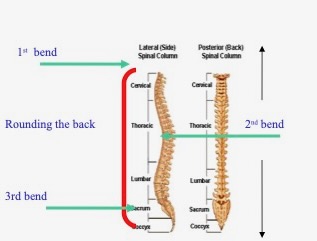
the-back.jpg


For many people in the West, modern lifestyles involving prolonged sitting and relatively little deep squatting can contribute to stiffness in the lumbar spine, pelvis, and surrounding tissues. The area can become less mobile and lose some of its natural adaptability.

The slight pelvic tuck used in Taiji isn't about flattening the back or forcing a posture. It's a training method to help free the pelvis and lower back, develop awareness of the center, eventually allow the body to organize itself naturally.

In Teacher Pang's presentation, he makes a similar distinction. He contrasts a slightly forward-leaning body with an internally organized pelvis against standing upright and centered, which he describes as a more "external" approach. Whether one agrees with his terminology or not, he's contrasting what is said, with how something is done.
 
The slight pelvic tuck used in Taiji isn't about flattening the back or forcing a posture. It's a training method to help free the pelvis and lower back, develop awareness of the center, eventually allow the body to organize itself naturally.
A very helpful perspective, helped my understanding, thank you!

In Goju we often employ tucking the pelvis, and I've noticed some absolutely overdo it and miss the point. I like your description of it as not forcing a posture but as a means of collecting awareness in and utilising the centre in movement.

Structurally it feels stronger, and I often define it as a methodologically to glue the upper and lower body together or enhance the connection so you can use the whole body in movement and technique. Your framing of it makes sense!
 
👍

kinda depends, when is to much to much, or to little not enough..

the-back.jpg


For many people in the West, modern lifestyles involving prolonged sitting and relatively little deep squatting can contribute to stiffness in the lumbar spine, pelvis, and surrounding tissues. The area can become less mobile and lose some of its natural adaptability.

The slight pelvic tuck used in Taiji isn't about flattening the back or forcing a posture. It's a training method to help free the pelvis and lower back, develop awareness of the center, eventually allow the body to organize itself naturally.

In Teacher Pang's presentation, he makes a similar distinction. He contrasts a slightly forward-leaning body with an internally organized pelvis against standing upright and centered, which he describes as a more "external" approach. Whether one agrees with his terminology or not, he's contrasting what is said, with how something is done.
I understand the distinction, and the concept. I disagree with the instruction given. Leaning forward to compensate for lack of organizational control or ability. Externalising an internal concept shows a lack of foundational training. I see it as often in Karate/TKD schools as I do in CMA. It’s a poor outcome and an incorrect approach. Leaning is an obvious tell. Bad structure, bad posture, based on misunderstanding the concept. This is one reason that learning from videos is crap.
 
Breaking hip structure by bending at the waist is seldom a good idea. Leaning can be done by keeping the hip structure intact if you adjust and keep your stance under your center of gravity. Unsupported structure is useless.
 
Breaking hip structure by bending at the waist is seldom a good idea. Leaning can be done by keeping the hip structure intact if you adjust and keep your stance under your center of gravity. Unsupported structure is useless.
To be clear, it is possible to maintain strong structure and balance while bending or leaning forward.

The fundamental stance in freestyle and folkstyle wrestling is a good example.
wrestlingStance.webp


It's harder to use a strong lean while maintaining structure and balance in striking, but it can be done. Manny Pacquiao famously would throw his left cross and extend and lean way further than most boxing coaches would normally call prudent. But he made it work.

The key, as you note, is to maintain your base underneath you. (Pacquiao made use of an additional mechanic, where he would actually throw his balance outside of his base for a split second, only to immediately regain his base as part of the same movement. I would consider this a more advanced application and would only recommend it for fighters who have already developed a strong sense of base and structure.)
 
To be clear, it is possible to maintain strong structure and balance while bending or leaning forward.

The fundamental stance in freestyle and folkstyle wrestling is a good example.
View attachment 34333

It's harder to use a strong lean while maintaining structure and balance in striking, but it can be done. Manny Pacquiao famously would throw his left cross and extend and lean way further than most boxing coaches would normally call prudent. But he made it work.

The key, as you note, is to maintain your base underneath you. (Pacquiao made use of an additional mechanic, where he would actually throw his balance outside of his base for a split second, only to immediately regain his base as part of the same movement. I would consider this a more advanced application and would only recommend it for fighters who have already developed a strong sense of base and structure.)
Pekiti also has a similar concept. I haven't seen it in my limited study of other forms of FMA, but there are times when you 'jab' with your weapon and actually lean enough that you lift up your back foot to get that extra reach before recovering. I've used the same thing successfully in fencing as well.
 
To be clear, it is possible to maintain strong structure and balance while bending or leaning forward.

The fundamental stance in freestyle and folkstyle wrestling is a good example.
View attachment 34333

It's harder to use a strong lean while maintaining structure and balance in striking, but it can be done. Manny Pacquiao famously would throw his left cross and extend and lean way further than most boxing coaches would normally call prudent. But he made it work.

The key, as you note, is to maintain your base underneath you. (Pacquiao made use of an additional mechanic, where he would actually throw his balance outside of his base for a split second, only to immediately regain his base as part of the same movement. I would consider this a more advanced application and would only recommend it for fighters who have already developed a strong sense of base and structure.)
It’s important to remember that manny doesn’t need to worry about being kicked, swept, or thrown. Similarly, folk wrestlers also only deal with grappling. Context is everything. The guy in the video in question is not fighting so he can get away with it. I’m speaking more to the concept as it applies to CMA teaching and principle. People get knocked out by haymakers too, but that isn’t a reason to teach that and label it as quality striking.
 
Back
Top