Shaolin Kempo - Poking the Bear: Suggest improvements for the combinations

Matt

Black Belt
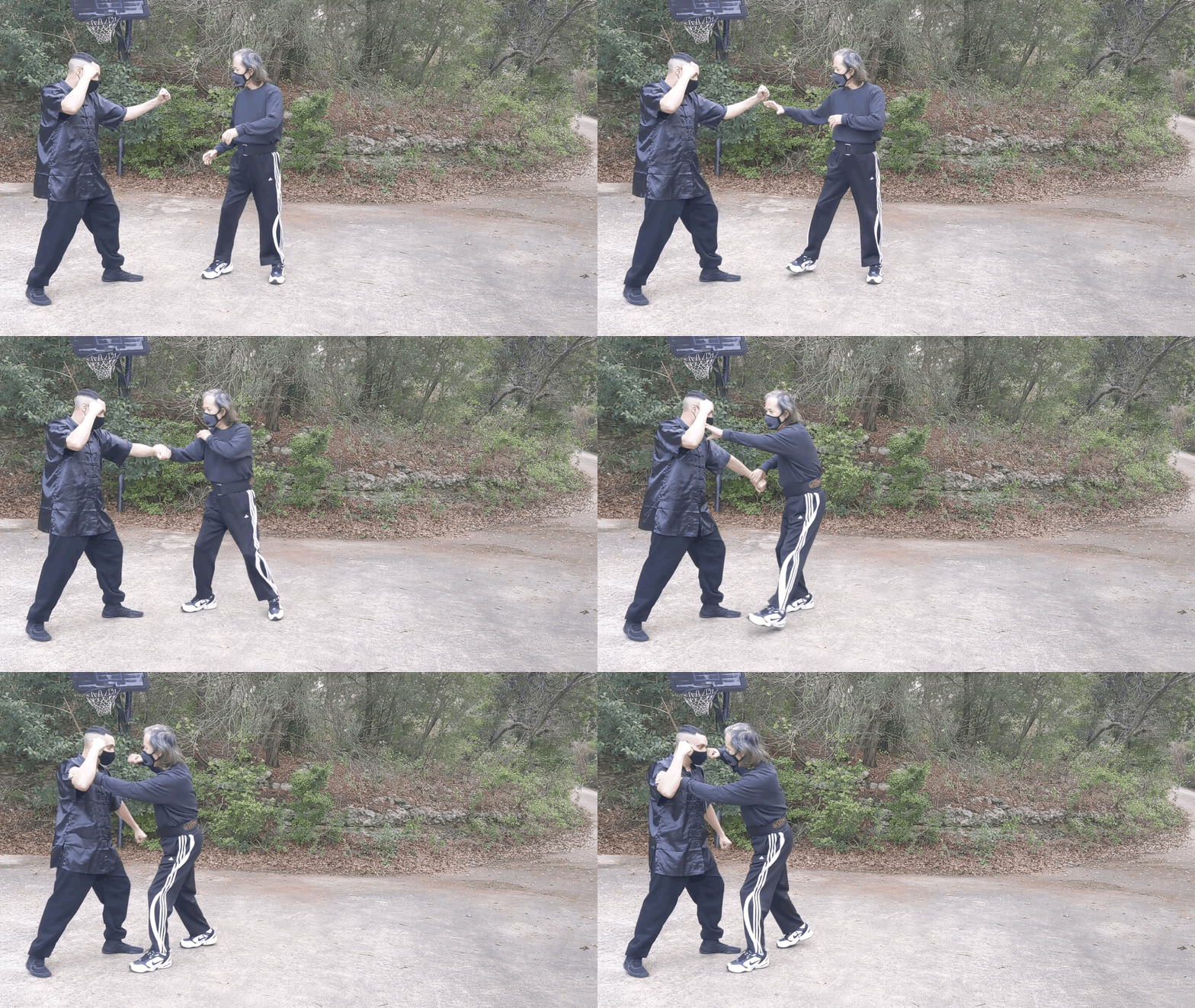
I've recently (almost) completed the Shaolin Kempo Technique Archive, and now I'm embarking on a quest to suggest tweaks to tune up the combinations. Every video has the same comments - "They wouldn't just stand there with their fist out" or "You'd just get punched in the face if that wasn't your student" and I think they are right. Let's offer our adjustments that keep the spirit of the technique while solving some of the problematic elements.

Here's the kind of problem I am describing and a potential solution:
 
Every video has the same comments - "They wouldn't just stand there with their fist out" or "You'd just get punched in the face if that wasn't your student"
IMO, you won't have those negative comments on your videos if you always control your opponent's arm/arms when you attack (make sure your opponent's arms are not free).

If I try to enter my opponent's front door as your video is shown, when I use my left arm to push down his right arm, I'll also use my right arm to push up his left arm at the same time. This way my opponent's left hand cannot punch me.

In other words, it doesn't matter whether my opponent's left hand may punch me or not, I'll proactively reach my right arm to his left arm.
 
Last edited:
The Judo "waist wrap hip throw" has the same issue. When A uses right arm to wrap around B's waist, B's left hand is free. B can use his left hand to punch on A's head, or does a lot of different counters.

How to hip throw your opponent while disabling his free arm is the key.

 
Last edited:
IMO, you won't have those negative comments on your videos if you always control your opponent's arm/arms when you attack (make sure your opponent's arms are not free).

If I try to enter my opponent's front door as your video is shown, when I use my left arm to push down his right arm, I'll also use my right arm to push up his left arm at the same time. This way my opponent's left hand cannot punch me.

In other words, it doesn't matter whether my opponent's left hand may punch me or not, I'll proactively reach my right arm to his left arm.
That's definitely a valid point, but that's what I'm getting at - the techniques often don't take into account either controlling the opponent's arms or at least controlling shoulder rotation to make that next punch difficult to pull off.
 
The Judo "waist wrap hip throw" has the same issue. When A uses right arm to wrap around B's waist, B's left hand is free. B can use his left hand to punch on A's head, or does a lot of different counters.

How to hip throw your opponent while disabling his free arm is the key.

With that O-Goshi setup, at least he has a sleeve grip controlling rotation of his opponent, so any left handed punch will be annoying, but not powerful.
 
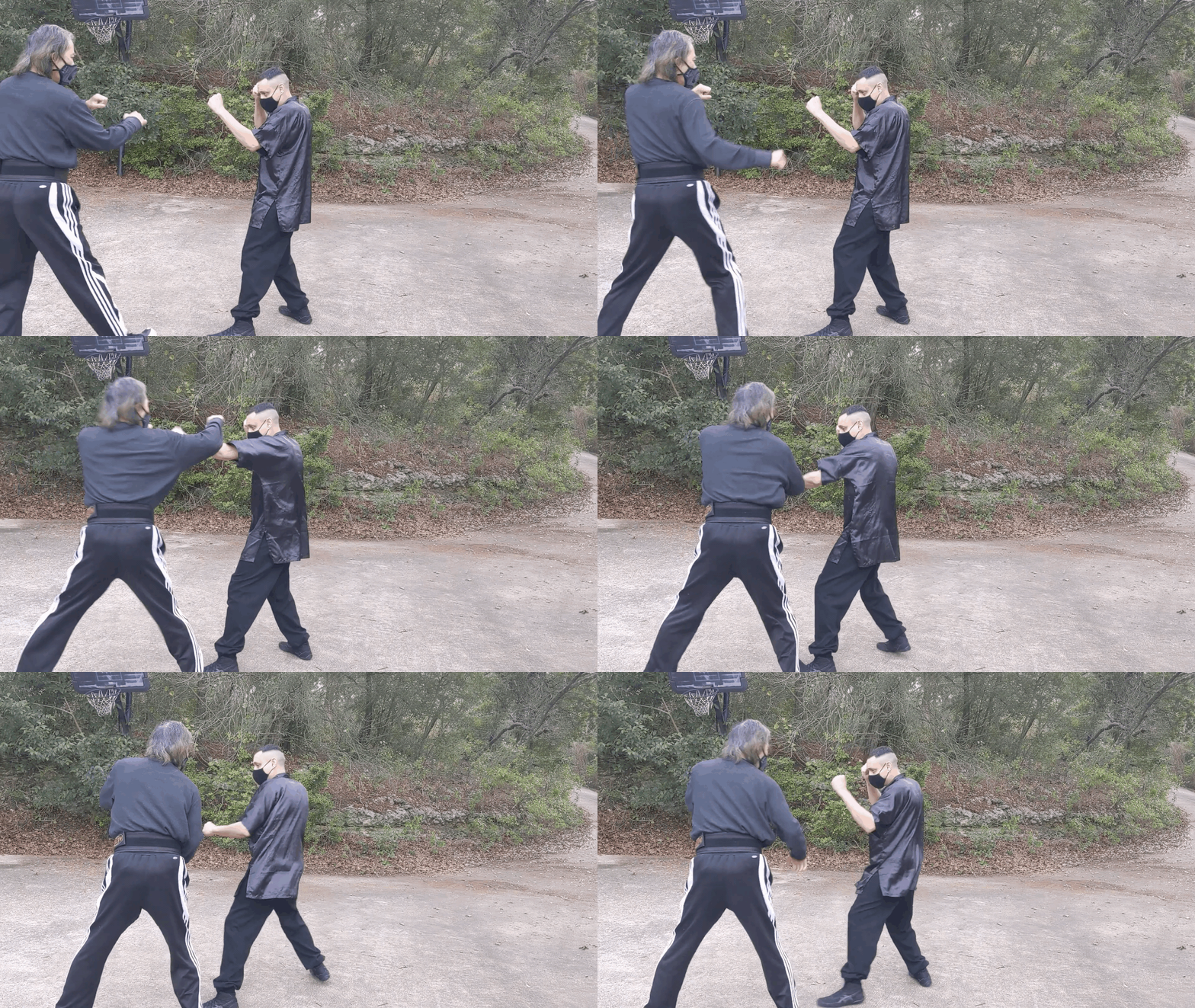
I gave a take on Shaolin Kempo combination two, and some people got a little salty about it in the YouTube! comments.
 
I gave a take on Shaolin Kempo combination two, and some people got a little salty about it in the YouTube! comments.
I don't like this combo. 1. Economy of motion and flow should be better. 2. The possible left reverse counter should be checked sooner or at least the attacker's balance should be effectively broken to prevent it.
 
I gave a take on Shaolin Kempo combination two, and some people got a little salty about it in the YouTube! comments.
Many MA videos may share the same problem. That is, your opponent throws a punch, he then freezes into the thin air while you make many moves to knock/take him down. In reality, when you make 1 move, your opponent responds with 1 move. When you make next move, your opponent responds with next move.

Here you have another video for "front door entering - enter between your opponent's arms".

When you use right arm to block your opponent's right arm, your right block just help him to spin his body to his right. He can borrow your force and counters you with a left hook punch to your head (his body spins to his right).

So, what should you do?

In "side door entering", you can always push your opponent's leading arm to jam his own back arm. There are not that many valid "front door entering" available. Either you control your opponent's back arm (correct entering strategy), or you don't (wrong entering strategy).

There is a concept called "separate hands". You use both arms to separate your opponent's both arms away from his head at the same time.

In this video, he uses right hand to parry down his opponent's right arm. He then uses his left palm to chop on his opponent's right elbow joint at the same time. This way, when he right punch at his opponent's face, his opponent's right arm won't give him any trouble (either block his right punch, or punch him back).

 
Last edited:
I actually did this a while back with the first 26 combinations for SKK. Not necessarily 'fixing' since I wouldn't call them broken. But focusing on getting to the heart of each one and what the purpose is/what it's trying to teach and streamlining it.

To go with combination one and your video - First thing is what is the combination trying to teach? To me, it is trying to teach an option for entering into range to take someone down.

With that in mind, the step back and cat stance is not needed. You also don't need to have your hands down by your chamber (not sure if that's a different in training; we learned all of them from pine tree stance with hands up, not in chamber).

So instead, take that out. As the person comes in, step diagonal to the right to avoid, and at the same time start with the wrap. Wrap won't be perfect, but particularly if they go to a guard, you can wrap around the guard. The other hand stays up in guard as you go in, with the two strikes and takedown. It makes it quicker, more effective, and still teaches the general principle. The only issue is that it's tougher to handle the first punch (and IMO my variation works better against a hook or looping strike. But my other issue is almost all the combinations are based on frontal jabs/step-in punches).
 
My answer for combination 2 is almost the exact same as yours. The only difference is that mine I do a rolling backfist on a top-down 90 degree angle, after the first block. But honestly either way is fine to me.
 
I gave a take on Shaolin Kempo combination two, and some people got a little salty about it in the YouTube! comments.
Is there any reason that you are not using your left arm at all? It's very risky to enter the front door without using your both arms. You can't use 1 arm to deal with your opponent's both arms.
 
Last edited:
I would also be looking at what the combination is trying to teach as well. In general I would break the combination into 3 points. Entry, the core technique and the follow through.
For #2 the important core is the heel grab takedown. To do this take down you have to drop a level of your stance, thus going under the attackers left hook.
I would play around with the takedown to see what conditions make it most effective. Does he need to be leaning back or weight on front foot ? Should there be an angle to the direction of your sweep?
If i wanted to make the combinations effective I would separate the 3 parts Entry, technique and follow up. Practice differnt entries in sparring. Try different pieces alone in sparring see what it takes to actually execute them.
 
Here is a video that A has controlled on B's right arm (But A has no control on B's left arm). Since A attacks on B right way, even if B may punch A back, A's right arm attack can block B's left punch.

 
Is there any reason that you are not using your left arm at all? It's very risky to enter the front door without using your both arms. You can't use 1 arm to deal with your opponent's both arms.
For this technique, it originally doesn't use the left arm, and I'm trying to adjust them as little as possible. I think using both would be a much better choice. My mental gymnastics explanation is that you saw this punch coming, decided to use a hard block to attempt to incapacitate the arm, and underestimated your opponent. 🤷‍♂️
 
Here is a video that A has controlled on B's right arm (But A has no control on B's left arm). Since A attacks on B right way, even if B may punch A back, A's right arm attack can block B's left punch.

I really enjoy Bas Rutten's videos. That video is the other way I considered adjusting the first technique. By getting to the overhook more efficiently, he can control the opponent's rotation and limit the attacker's ability to generate a strong punch. The palm heel he's using, if used to turn the face away, further controls the rotation and shuts down the punch. I didn't go that route because there is another technique in the system that uses that mechanic that comes along later.
 
I actually did this a while back with the first 26 combinations for SKK. Not necessarily 'fixing' since I wouldn't call them broken. But focusing on getting to the heart of each one and what the purpose is/what it's trying to teach and streamlining it.

To go with combination one and your video - First thing is what is the combination trying to teach? To me, it is trying to teach an option for entering into range to take someone down.

With that in mind, the step back and cat stance is not needed. You also don't need to have your hands down by your chamber (not sure if that's a different in training; we learned all of them from pine tree stance with hands up, not in chamber).

So instead, take that out. As the person comes in, step diagonal to the right to avoid, and at the same time start with the wrap. Wrap won't be perfect, but particularly if they go to a guard, you can wrap around the guard. The other hand stays up in guard as you go in, with the two strikes and takedown. It makes it quicker, more effective, and still teaches the general principle. The only issue is that it's tougher to handle the first punch (and IMO my variation works better against a hook or looping strike. But my other issue is almost all the combinations are based on frontal jabs/step-in punches).
The horse stance / hands down thing is apparently an East Coast phenomenon - that's how all of the schools I trained in taught them. The justification was that it was the worst place to start from, so anything else would be easier. I'm not sure it's great strategy, but it's a throwback to the early days.
 
The horse stance / hands down thing is apparently an East Coast phenomenon -
I had sparred many Kempo guys in the past. They all liked to use horse stance with leading arm dropping down (protect groin) , with back hand covered the face. Any straight line punch can be blocked by their circular ridge hand attack. It was very effective strategy - expose your head to bait for straight punch, you then use your circular punch to intersect it.
 
Last edited:
For this technique, it originally doesn't use the left arm, and I'm trying to adjust them as little as possible.
If a combo doesn't make sense to start with, it will still make no sense no matter how you may try to adjust it.

When you enter your opponent's front door, if you use one arm to block your opponent's

- right punch, his left punch will attack you.
- left punch, his right punch will attack you.

How do you solve this problem? I just don't believe the solution exist.
 
Last edited:
This was Bruce Lee's main guard position.
If you move in, you will run into his right hook followed with his left cross. Both punches are in "compressing" mode and ready to be released.

Bruce_Li_guard_2.webp


I like to use it too. The nice thing about this strategy is when your opponent attack you is the time you attack him. You love to see your opponent's punch coming toward your face. It's time for you to jump on him and eat him alive.

 
Last edited:
Back
Top