Learn Karate from a book?

Not at all. It serves to generally illustrate some basic concepts and strategy in dealing with specific attacks, arcane and largely unusable info on Chinese medicine, vital points are shown with a bit of how to attack them, philosophy and the historical roots of karate but does not tell or show "how to" do it. There are a number of positions illustrated but are just single frames of longer sequences. As is noted in McCarthy's 2016 edition:

Article 27 - "There is no explanation to accompany this illustration." Article 28 - "there is no detailed explanation to accompany this illustration." Article 32 - "There is no descriptive text accompanying the illustrations."

Most of Okinawan karate, including the traditional kata, was developed prior to the work being introduced to Okinawa. No evidence of it being there prior to early 1900's. While the Bubishi offers valuable insights into the origin of karate and some of its principles, it does not teach how to execute any techniques. You can't learn karate from the Bubishi, only to appreciate it.
From the description of [McCarthy’s] Bubishi-

“Treasured for centuries by karate's top masters”

“All of karate's legendary masters have studied it, applied its teachings, or copied passages from it.”

“No other classic work has had as dramatic an impact on the shaping and development of karate as the Bubishi.”

“the true origins and spirit of classic Okinawan martial arts, one need look no further”

“the "bible of karate"


https://www.amazon.com/Bubishi-Classic-Manual-Patrick-McCarthy/dp/4805313846?tag=ff0d01-20
 
“the "bible of karate"
Bubishi, like most ‘how to books…’ is an aide-mémoire and not an instruction manual. It reminds those, who’ve received instruction what they have practised.

For example, do slightly rational people live their lives by the Bible or by its interpretation by a church/preacher/religious community?
 
From the description of [McCarthy’s] Bubishi-

“Treasured for centuries by karate's top masters”

“All of karate's legendary masters have studied it, applied its teachings, or copied passages from it.”

“No other classic work has had as dramatic an impact on the shaping and development of karate as the Bubishi.”

“the true origins and spirit of classic Okinawan martial arts, one need look no further”

“the "bible of karate"


https://www.amazon.com/Bubishi-Classic-Manual-Patrick-McCarthy/dp/4805313846?tag=ff0d01-20
Exactly, all these things. But not "how to" do it. It does not teach karate.
 
Bubishi, like most ‘how to books…’ is an aide-mémoire and not an instruction manual. It reminds those, who’ve received instruction what they have practised.

For example, do slightly rational people live their lives by the Bible or by its interpretation by a church/preacher/religious community?
Don’t know who coined okinawan bubishi the “Bible”, but it wasn’t me.

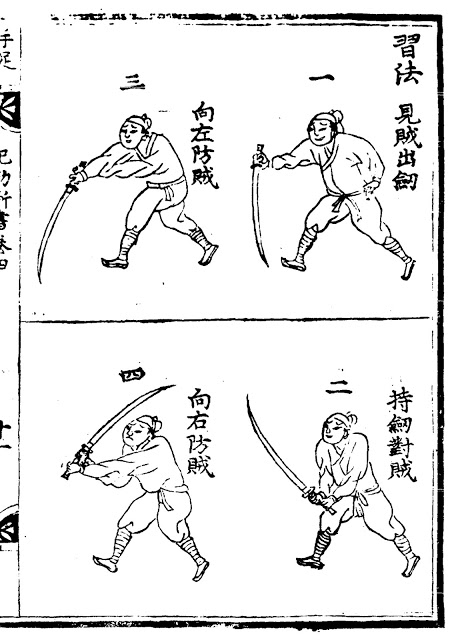
The Okinawan Bubishi is sort of a minor and altered extract from the much more comprehensive Chinese original(wubeizhi, early 1600’s) that largely dwells on military matters. As I understand , the martial arts(non military) section of the Chinese wubeizhi is primarily about staff and sword methods, and the small part of that section that covers barehand methods points out that thats mainly for recreational exercise, showing drawings of individual postures of more gymnastic character, and that differ from the Okinawan Bubishi that rather show drawings of two persons(men) engaged in pulling each others hair and nuts(maybe meant as instruction, maybe as reminder ?)

A source I read put forth that the sword methods described in the Chinese wubeizhi are actually derived from Japanese sword schools that had become sort of en vogue in China during Ming dynasty, primarily from the Kage-ryu’s methods and tactics.
And that’s kind of interesting when it comes to karate since the karate line from Sokon Matsumura hold influences from Jigen ryu sword school, and Jigen ryu is said to have its foundation from Kage ryu .
 
Last edited:
Don’t know who coined okinawan bubishi the “Bible”, but it wasn’t me.

The Okinawan Bubishi is sort of a minor and altered extract from the much more comprehensive Chinese original(wubeizhi, early 1600’s) that largely dwells on military matters.

How easy is it to extract and alter a text in an age when at least the drawings were all done by hand? I imagine they had moveable type at that point, although probably not everyone had access to such technology. So perhaps this was all hand-written? I don’t know. But to extract from and alter such a text seems more work than it’s worth. I haven’t read the wubeizhi so I can’t comment on it. Perhaps it was a material resource for the Bubishi? But not simply extracted and altered?
…and that differ from the Okinawan Bubishi that rather show drawings of two persons(men) engaged in pulling each others hair and nuts(maybe meant as instruction, maybe as reminder ?)

Have you read the Bubishi or are you speaking purely from what you have heard, second-hand? This description rather misses the mark. Maybe at least read the book if you want to discuss it?
 
How easy is it to extract and alter a text in an age when at least the drawings were all done by hand? I imagine they had moveable type at that point, although probably not everyone had access to such technology. So perhaps this was all hand-written? I don’t know. But to extract from and alter such a text seems more work than it’s worth. I haven’t read the wubeizhi so I can’t comment on it. Perhaps it was a material resource for the Bubishi? But not simply extracted and altered?


Have you read the Bubishi or are you speaking purely from what you have heard, second-hand? This description rather misses the mark. Maybe at least read the book if you want to discuss it?
As I understand what’s claimed as the history of this, is that there was a specific place in Fuzhou/Fujian province where the small okinawan community in that city used to meet up, in that place studies of Chinese ma’s was also available from one hired teacher named RyuRyuKo(?), the place probably made available all sorts of lectures, books and recreational stuff, a place one could sit down to copy manuals and similar to be brought back home to Okinawa when that time came.

I do have Patric MacCarthy’s Bubishi (first edition) packed away back in Sweden, many, many years ago now since I read it, and frankly it was sort of a disappointment as I recall.

The drawings wary but the intent they’re show are the same

As an example.
 
The Okinawan Bubishi is sort of a minor and altered extract from the much more comprehensive Chinese original(wubeizhi, early 1600’s)
Not very accurate. You are correct in that the massive Wubeizhi was compiled in the early 1600's (from the mid 1620's to the early 1630's). This fact, in fact, invalidates your assertion of the Bubishi being an extract of it:

1. Much of the Bubishi deals with white crane style, which, according to legend, began in about 1700, just after the Qing defeated the Ming dynasty.

2. Master Wang (Faodang) was the 3rd? generation master of that style and his teachings are included in the Bubishi.

3. The hair styles depicted in several illustrations in the Bubishi are of the Qing Dynasty period.

All of the above date from the time after the Ming dynasty which is when the Wubeishi was written so the Bubishi could not have been extracted from it. (The Bubishi does contain a bit of Sun Tzu, but his teachings were widespread and found their way in many other works.)
karate line from Sokon Matsumura hold influences from Jigen ryu sword school
Matsumura learned jigen ryu in Satsuma, Japan as a government official and so has no relation to any direct lineage in China. Futhermore, I do not believe there is any influence of this art on karate.
Don’t know who coined okinawan bubishi the “Bible”
This is attributed to Miyagi Chojun, founder of goju.
 
Last edited:
Not very accurate. You are correct in that the massive Wubeizhi was compiled in the early 1600's (from the mid 1620's to the early 1630's). This fact, in fact, invalidates your assertion of the Bubishi being an extract of it:

1. Much of the Bubishi deals with white crane style, which, according to legend, began in about 1700, just after the Qing defeated the Ming dynasty.

2. Master Wang (Faodang) was the 3rd? generation master of that style and his teachings are included in the Bubishi.

3. The hair styles depicted in several illustrations in the Bubishi are of the Qing Dynasty period.

All of the above date from the time after the Ming dynasty which is when the Wubeishi was written so the Bubishi could not have been extracted from it. (The Bubishi does contain a bit of Sun Tzu, but his teachings were widespread and found their way in many other works.)
Qing united tribes - 1616 - expand took more and more land Qing dynasty official start 1644.
 
Don’t know who coined okinawan bubishi the “Bible”, but it wasn’t me.
You cited it though which suggests support for it.
The Okinawan Bubishi is sort of a minor and altered extract from the much more comprehensive Chinese original(wubeizhi, early 1600’s) that largely dwells on military matters. As I understand , the martial arts(non military) section of the Chinese wubeizhi is primarily about staff and sword methods, and the small part of that section that covers barehand methods points out that thats mainly for recreational exercise, showing drawings of individual postures of more gymnastic character, and that differ from the Okinawan Bubishi that rather show drawings of two persons(men) engaged in pulling each others hair and nuts(maybe meant as instruction, maybe as reminder ?)
Nobody who has posted here is calling into question the cogency of Bubishi, we are suggesting it’s an aide memoir and not an instruction manual.
A source I read put forth that the sword methods described in the Chinese wubeizhi are actually derived from Japanese sword schools that had become sort of en vogue in China during Ming dynasty, primarily from the Kage-ryu’s methods and tactics.
In my many years of reading about swordsmanship, I have never heard this. Would you please cite your source?
And that’s kind of interesting when it comes to karate since the karate line from Sokon Matsumura hold influences from Jigen ryu sword school, and Jigen ryu is said to have its foundation from Kage ryu .
I think we’ve discussed elsewhere (quite a few times) that the Jigen Ryu/Karate link seems to be unsubstantiated at best and complete conjecture at worst.
 
I tried that. As a 14 year old kid, me and my brother found a book about karate in the school library. We read it and tried to learn the techniques. Attending our first actual class we discovered we knew absolutely sod all.
 
Jesse Enkamp has a blog. One tells how Soke Yoshimi Inoue taught himself karate from a book. This is the blog: The Wisdom of Inoue Yoshimi: Legendary Japanese National Team Kata Coach (Seminar Recap) Is this possible? Are there online videos that help?
I will have to look into that but if you're trying to learn Karate from a book and not at a dojo you're not going to learn anything beyond the most basic level. All a book can do is introduce you to the art and introduce you to the basic techniques.
 
Mind you, it depends on the book. A book that goes into the minutiae of exactly how the techniques are trained and suggests a study program could potentially be pretty helpful
 
Mind you, it depends on the book. A book that goes into the minutiae of exactly how the techniques are trained and suggests a study program could potentially be pretty helpful
It could, however a book can't instruct you on how to develop the technique. From my experience, when you're first taught a technique you have it taught to you at the most basic level. Then as you develop the technique you're told to make all sorts of adjustments. A book can't tell you what adjustments to make as you develop the technique.
 
You cited it though which suggests support for it.
That’s your suggestion
Nobody who has posted here is calling into question the cogency of Bubishi, we are suggesting it’s an aide memoir and not an instruction manual.
Yes that’s yours suggestions
In my many years of reading about swordsmanship, I have never heard this. Would you please cite your source?
”Qi, like many in the Ming Dynasty, was fascinated by and held in great respect, the Japanese sword. During the early Ming, large numbers of steel swords from Japan were imported. The collectors market for these swords was fairly large. Connoisseurship of many things including swords and knives was widespread in the Ming. The Japanese swords and swordsmanship were already famous among the literate population”


”The first few drawings are of monkeys with swords. This is presumably some reference to the Kage Ryu story of monkeys using sticks in the founding of the style”

-


——-


”In the late Ming dynasty, Chinese coasts were raided by Japanese pirates -mockingly called 倭寇 wokou or "Dwarf Bandits" by their Chinese adversaries- who were using their long sabers, nodachi, to great effect”


”According to: Mao Yuanyi, TREATISE OF MILITARY PREPAREDNESS:

“Long sabers: The Japanese slaves manufacture them very sharp. Their blades are 5 chi long." -


Chinese long sabers of the Qing dynasty | Mandarin Mansion


https://www.chineselongsword.com
I think we’ve discussed elsewhere (quite a few times) that the Jigen Ryu/Karate link seems to be unsubstantiated at best and complete conjecture at worst.
Yes you seems to think that
 
It could, however a book can't instruct you on how to develop the technique. From my experience, when you're first taught a technique you have it taught to you at the most basic level. Then as you develop the technique you're told to make all sorts of adjustments. A book can't tell you what adjustments to make as you develop the technique.
You'd think so, but there are various more or less traditional training techniques that teach you the correct technique as a sort of feature. It's long and involved, so I won't describe it here, but it starts off with punching in horse stance, initially with a belt held in both hands holding a belt looped over some sort of pillar or post to teach the correct arm movement and moves on to teach the enitre movement through various other practices. I concur that you'd be much better off attending classes, but some of these exercises are so valuable they should form part of everybody's solo training. At the simplest level, standing knee raises and lying leg kicks can totally change the way you front kick, for example. Rob Redmond wrote a series of articles about this sort of training which he called 'isolation drills', but his website has been defunct for some time, sadly.
 
punching in horse stance, initially with a belt held in both hands holding a belt looped over some sort of pillar or post to teach the correct arm movement and moves on to teach the enitre movement
This is a training technique for new students that I thought I "invented" 50 years ago. Not only teaches power generation thru reciprocating motion, but also the concept of pulling an opponent into a punch.
 
Last edited:
This is a training technique for new students that I thought I "invented" 50 years ago. Not only teaches power generation thru reciprocating motion, but also the concept of pulling an opponent into a punch.
I found it in an old book sensei was giving out at class. Thought it was pretty cool. There are loads of other things like that. At the simplest level, 'marching arms' teaches you to rotate the torso properly. It's worth noting that these are not practices confined to karate- I went through a series of drills to teach a proper punch at MMA class back in the day.
 
I think its better to go to the studio and train your karate there than learning in the book and video caused maybe there's different variation than the studio
 
This blog has good advice too.


Being a beginner is a confusing time. Books, DVDs, online teaching are useful tools. Wim Demeer's blog has lots of good tips for martial artists.
 
Being a beginner is a confusing time. Books, DVDs, online teaching are useful tools. Wim Demeer's blog has lots of good tips for martial artists.
Yes it must be. In the 80s we has one book about Karate in the local library and our Sunday morning class. Once every couple of months an 8th Dan Hanshi would visit us (Tatsuo Suzuki) and blow our minds!
 
Back
Top