Many discussions about wooden dummy training focus primarily on curriculum order:
whether the dummy should come after Siu Nim Tao, after Chi Sao, or only after years of practice.
That is a valid discussion.
However, the purpose of this article is different.
I am not arguing that students should skip foundational training, nor am I presenting the wooden dummy as a replacement for Siu Nim Tao or sticky hands.
What I am pointing to is a specific training function that the wooden dummy can develop very early when approached correctly:
continuous whole-body coordination under contact.
In this approach, the dummy is not treated mainly as a "collection of fighting techniques or fixed sequences."
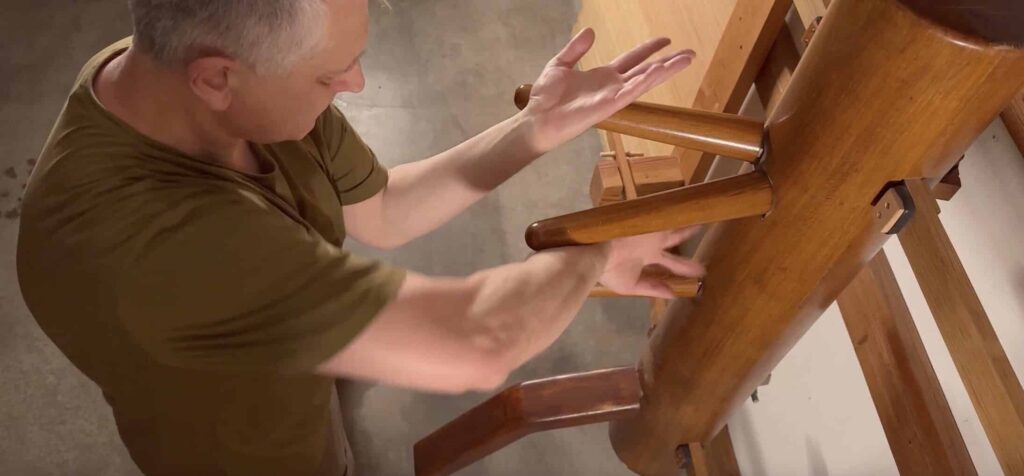
It becomes a "tactile-feedback instrument" through which the practitioner learns how the hands, wrists, feet, balance, pressure, and directional force continuously reorganize together.
The central idea is not “position memorization,” but maintaining coordinated awareness between two continuous reference points:
• the contact with the dummy through the hands and arms,
• and the contact with the floor through the feet.
Over time, prolonged transitions without disconnecting from the dummy arms begin to create a very different kind of training experience—one based on tactile adaptation, structural reorganization, and multi-directional force management.
This article attempts to explain that process more clearly.
The Wooden Dummy as a System of Continuous Coordination
Reconsidering Wooden Dummy Training Beyond Fixed Positional Models
Wooden dummy training within Wing Chun is frequently approached through the memorization of positions, sequences, and predetermined applications. In this framework, emphasis is often placed on reproducing formal arrangements of the arms and preserving the external structure of the form. Although such training may provide organizational value at an introductory level, it can obscure a deeper functional dimension of wooden dummy practice: the development of continuous whole-body coordination under tactile contact.
This article proposes that the wooden dummy may be understood not merely as a striking apparatus or repository of techniques, but as a tactile-feedback instrument through which the practitioner develops ongoing structural adaptation, sensory refinement, and multi-directional coordination. From this perspective, the primary function of training is not the preservation of static positions, but the cultivation of continuous reorganization between the upper and lower body during uninterrupted contact.
Beyond Static Positional Thinking
During tactile interaction, the hand is never functionally neutral. Force is continuously redistributed, redirected, transferred, absorbed, and reorganized according to changing conditions within the contact relationship. Consequently, training cannot be adequately reduced to isolated techniques or disconnected mechanical positions.
The body is continuously adjusting beneath the point of contact. For this reason, prolonged transitions performed without disconnecting from the dummy arms become particularly significant. Under sustained contact conditions, the practitioner gradually learns to coordinate balance, timing, pressure, direction, and structural adaptation as components of a unified process rather than as separate mechanical actions.
In this approach, the wooden dummy does not simply teach where the arms should be positioned. Rather, it trains how the body reorganizes itself dynamically during continuous tactile interaction.
Tactile Precision and the Perception of Energy Density
A central dimension of this training method is the cultivation of tactile precision. At each point of contact, the practitioner develops sensitivity to pressure density, directional intention, structural alignment, and variations in force quality. The objective is not merely to react mechanically, but to perceive and manage energy transfer through increasingly refined tactile feedback.
Over time, this process deepens tactile perception significantly. The practitioner gradually acquires the ability to discern:
- the quantity of force entering the contact,
- the direction from which force is emerging,
- the manner in which pressure changes during transitions,
- and the structural adjustments required to preserve continuity under changing conditions.
Training therefore shifts away from external choreography and toward the refinement of sensory organization under contact.
Two Continuous Reference Systems: Hands and Feet
A deeper layer of wooden dummy training emerges when one recognizes that two continuous reference systems operate simultaneously throughout practice:
- the tactile reference system of the hands,
- and the adaptive balancing system of the feet.
The upper body maintains continuous tactile interaction with the dummy through the wrists, forearms, and palms. Simultaneously, the lower body remains in constant interaction with the floor through the feet, which continuously grip, release, redistribute pressure, and reorganize balance beneath movement.
This creates what may be described as a form of “Floor Chi Sao,” wherein the practitioner develops an ongoing tactile relationship not only with the dummy, but also with the ground itself.
Within this model, the practitioner cultivates simultaneous awareness of both ends of the body:
- the upper body adapting through tactile contact,
- and the lower body reorganizing balance and directional support underneath that contact.
Over prolonged practice, tactile awareness in the hands becomes increasingly linked to the adaptive adjustments occurring within the feet. The practitioner begins to perceive direct relationships between:
- contact and balance,
- pressure and structure,
- directional force and footing,
- and upper-body transitions and lower-body organization.
Such coordination is difficult to develop through isolated striking methods alone.
Continuous Contact and Nervous-System Adaptation
A substantial difference exists between continuous-contact training and a simple connect–disconnect rhythm. When training repeatedly alternates between contact, disengagement, resetting, and reconnection, the nervous system is deprived of the continuity necessary for deeper tactile organization.
By contrast, prolonged uninterrupted transitions produce different adaptive effects. Continuous contact gradually develops:
- continuity of tactile feedback,
- directional sensitivity,
- multi-directional force organization,
- whole-body timing,
- coordination under pressure,
- and fluid structural adaptation.
As a consequence, the experiential quality of training begins to resemble forms of grappling, clinch adaptation, and continuous positional adjustment more closely than isolated striking mechanics.
This dimension of wooden dummy practice remains insufficiently discussed within many contemporary interpretations of Wing Chun training.
The Wooden Dummy as an Instrument of Sensorimotor Development
From this perspective, the wooden dummy should not primarily be understood as an opponent simulation. More accurately, it functions as an instrument for refining tactile responsiveness, coordination, structural adaptation, balance organization, and continuous transitions under contact.
Through sustained and mindful repetition, the nervous system gradually adapts to increasing levels of tactile complexity and sensorimotor demand. This process promotes genuine internal development without reliance upon exaggerated tension or artificial mechanics.
The practitioner progressively develops the ability to:
- project force in multiple directions,
- maintain structural continuity,
- adapt dynamically through tactile interaction,
- and reorganize balance while preserving sensory awareness.
When approached progressively and with sustained awareness, wooden dummy training develops organizational principles transferable across martial disciplines because the training concerns the coordination of the body itself rather than the memorization of stylistic choreography.
Ultimately, the objective is not the preservation of positions, but the continuous reorganization of the body under contact.
For those interested in the broader training structure and demonstrations of these concepts:
Discover how Wing Chun wooden dummy (Mook Yan Jong) training builds tactile sensitivity-awareness, asymmetry correction, energy transfer.
www.theartofmookyanjong.com