Tai chi video recommendation.

Prince_Alarming77 13

Senior Master
Heya, as you know, I'm tai chi curious and just recently my mother has professed an interest in learning a little tai chi. What I'd like is if any of you tai chi guys have any recommendations for simple, introductory tai chi videos, preferably ones that are available on youtube, suitable for home study. We're not really interested in the martial side of it, because as far as I can see you probably need an instructor to know that side of things. I've used google fu a bit, but as I know very little about tai chi, I don't really know what I'm looking for. Can anyone help?
Thanks
 
Heya, as you know, I'm tai chi curious and just recently my mother has professed an interest in learning a little tai chi. What I'd like is if any of you tai chi guys have any recommendations for simple, introductory tai chi videos, preferably ones that are available on youtube, suitable for home study. We're not really interested in the martial side of it, because as far as I can see you probably need an instructor to know that side of things. I've used google fu a bit, but as I know very little about tai chi, I don't really know what I'm looking for. Can anyone help?
Thanks

👍

Some thoughts —


Why limit you or your mother to something called Taiji?
If the goal is simply gentle movement and relaxation, you might be open to exploring other forms of movement study as well.

There are many kinds of Qigong and body-awareness practices that are simpler to start with and, in many cases, do a better job of promoting health than classes designed around the “Taiji for health” label.

Having said this...you might find this teachers approach interesting


Heya, as you know, I'm tai chi curious and just recently my mother has professed an interest in learning a little tai chi. What I'd like is if any of you tai chi guys have any recommendations for simple, introductory tai chi videos, preferably ones that are available on youtube, suitable for home study. We're not really interested in the martial side of it, because as far as I can see you probably need an instructor to know that side of things. I've used google fu a bit, but as I know very little about tai chi, I don't really know what I'm looking for. Can anyone help?
Thanks
If you're not interested in the martial side, you are (literally) talking about Chi Kung.

I've been thinking of creating a style of Tai Chi with all of the martial concepts removed -- i.e. that is it, as the foundation for the style. What is left is basically a kind of moving daoyin which some people would call qigong. Interestingly enough I am not the first person to do this, Taoist Tai Chi is just like that. And, they probably have a branch in your mother's area or nearby (they're quite popular, or they were). They have a number of videos. It would probably be perfect for her, if she is anything like my own mother!
 
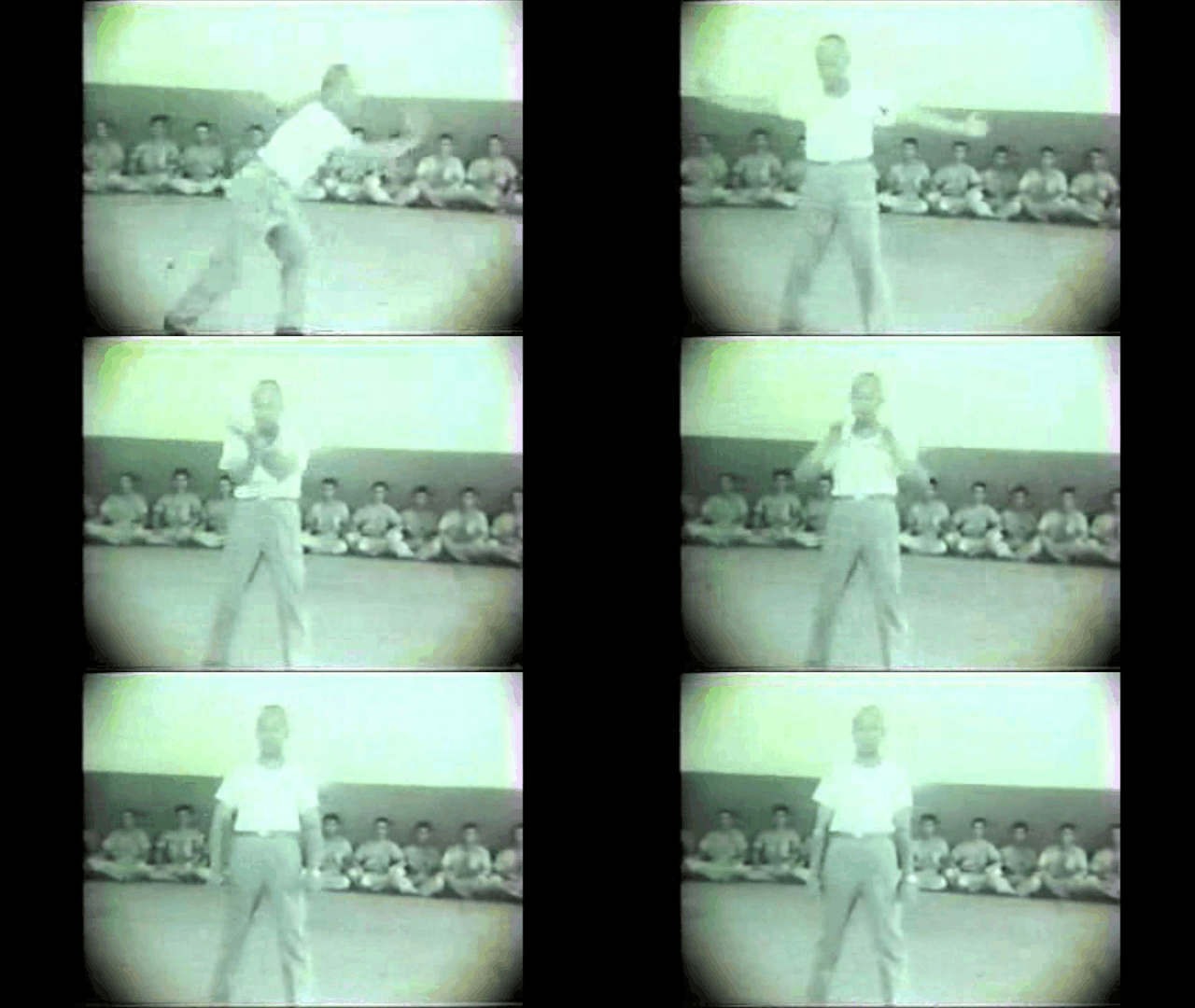
If you just want to train 1 Taiji move, you should train the Taiji form ending move. This move can also help you to "accumulate/sink Qi". Make sure you have the following breathing pattern.

- Arms open (inhale).
- Arms close (exhale).
- Arms separate (inhale).
- Arms push down (exhale).


Last edited:
Heya, as you know, I'm tai chi curious and just recently my mother has professed an interest in learning a little tai chi. What I'd like is if any of you tai chi guys have any recommendations for simple, introductory tai chi videos, preferably ones that are available on youtube, suitable for home study. We're not really interested in the martial side of it, because as far as I can see you probably need an instructor to know that side of things. I've used google fu a bit, but as I know very little about tai chi, I don't really know what I'm looking for. Can anyone help?
Thanks
You’re a karate guy, wado-ryu ? If there’s no taijiquan instructor available, you could teach a kata to your mother, perhaps soften it a little leaving out kiai’ing and such. As a karateka you have all the posture specifics and understand to see any mistakes. I think this would be much much better and rewarding health wise than try learning Taiji from video.
Anyhow, the great Wado ryu karate master Shingo Ohgami was also a keen taiji practitioner and teacher of it, maybe he had som videos out ? Maybe even som Wado schools in Britain teach his Taiji curriculum?
 
You’re a karate guy, wado-ryu ? If there’s no taijiquan instructor available, you could teach a kata to your mother, perhaps soften it a little leaving out kiai’ing and such. As a karateka you have all the posture specifics and understand to see any mistakes. I think this would be much much better and rewarding health wise than try learning Taiji from video.
Anyhow, the great Wado ryu karate master Shingo Ohgami was also a keen taiji practitioner and teacher of it, maybe he had som videos out ? Maybe even som Wado schools in Britain teach his Taiji curriculum?
It's a good idea seishan has a lot of the dynamic tension stuff she's interested in
 
It's a good idea seishan has a lot of the dynamic tension stuff she's interested in
I recently found online a demonstration of wado ryu’s seisan, I was impressed, not by any dynamic tension performed but the overall movements, in sequence same as Shotokan but body structure wise much more “whole body”.

Actually Taiji is quite a “dynamic tension” exercise but in another kinda opposite way, it comes forth through proper relaxation in the postures, so its not a form of contracting muscles but a feeling of streching.

Seisan meaning 13 and taijiquan’s core is its 13 “postures” 😃
 

Does this seem like the real deal to you chaps?
 

Does this seem like the real deal to you chaps?
I know a lot of people like this. In fact in my lineage there's someone just like this, maybe a bit older, teaching Tai Chi down in the states somewhere. Her 'Tai Chi' is a bit more akin to what you might expect 'Tai Chi' to be, and in any case it's the real deal, if by "Tai Chi" you mean medical-grade qigong for rehabilitation.

I'm sure these exercises work and she is obviously some sort of professional and/or collaborates directly with professional therapists for some of her videos. But Tai Chi? Well, that's the term people understand. I am getting the feeling though that ultimately these are really PT/rehabilitative exercises. Sometimes, the hospital really can't help you and you need to do rehabilitation on your own. Injuries can be cruel... that's what these exercises were really designed to do -- medical qigong of this calibre works, and was in widespread clinical practice by the sui and tang dynasties... Nothing major... But in America, Tai Chi is the buzzword which sells...

Anyways, have you found a style of Tai Chi you like? I can recommend some good videos to you, if you feel it would help.
 
A small note, the term “Qi-gong” was coined sometime in the early 1950’s
What was it called before? ex. what did Hu Yaozhen study in his youth that would later earn him the title Father of Qigong?

Hu Yaozhen studied:
  • TCM/traditional Chinese medicine
  • Daoist cultivation methods, neigong and yangsheng etc
  • internal martial arts -- xingyiquan and some others
  • trained in breathing and “healing movement” systems such as Wu Qin Xi
  • studied under both Daoist and Buddhist masters, collecting and refining knowledge that had become fragmented
  • Was said to have mastered a kind of iron finger technique that could temporarily stun people
  • Worked closely with Chen Fa-Ke in the creation of Xinjia and with Feng on the creation of Hunyuan.
Around this time this general area of study became known as "qigong". It was Liu Guizhen who started publicizing the word in the 50s after his medical research team in Hebei came up with the term, likely in 1949. It was used to categorize all that came before; ex. what Hu Yaozhen had studied. But actually, the suggestion came from experience -- the word did exist and was used before, it just wasn't in the public consciousness. Ma Jiren, a historian, tracks the usage of the term from before the Qing dynasty. For example in the Yuanzhi Pian, a work from the Qing dynasty.

Another great example is the book "氣功療法 (Qigong Liaofa or "Qigong Therapy") published in 1934.

So you see, anyone interested in this topic would probably have been generally aware of the term Qigong, just maybe not exactly like how it is used today.

Today it refers to any kind of mix of daoyin, tuina, tuna, xingqi, yunqi, yangsheng, or whatever. Originally it was a technical term within a wider body of study, having no importance in and of itself except as part of a wider body of terms, likely indistinguishable from them and being paid no special notice. Kind of like the word tensegrity in Li Yiyu and Hao Weizhen's writings.

Today the previous generation considers Qigong as an advancement, technologically, over Daoyin. In that sense, the modern meaning of the word is probably even more recent, from the 60s. Notably, Wang Ziping's "祛病延年二十势" (20 exercises for health and longevity") was canonized and published in the 50s with Dr. Wu Chengde and was NOT referred to as a kind of qigong at the time, but was understood as such by the creators. It was only later that it was referred to as a kind of qigong. And the current generation generally does not understand it at all and regards it as mysical woo woo, helped in no small part by a slew of severely underqualified instructors and the coming tidal wave of AI slop tai chi and qigong ads.
 
Last edited:
sorry, not much of an explanation, wordy but vague , more wish than fact it seems, except the part that the term was coined in early 1950’s, as I previously wrote.
Of course I could be wrong, but there seems to be an agenda(not by you but by “historians” ) to ancientinize(and I try make up new word of ancient word) modern stuff related to this topic.
 
I know a lot of people like this. In fact in my lineage there's someone just like this, maybe a bit older, teaching Tai Chi down in the states somewhere. Her 'Tai Chi' is a bit more akin to what you might expect 'Tai Chi' to be, and in any case it's the real deal, if by "Tai Chi" you mean medical-grade qigong for rehabilitation.

I'm sure these exercises work and she is obviously some sort of professional and/or collaborates directly with professional therapists for some of her videos. But Tai Chi? Well, that's the term people understand. I am getting the feeling though that ultimately these are really PT/rehabilitative exercises. Sometimes, the hospital really can't help you and you need to do rehabilitation on your own. Injuries can be cruel... that's what these exercises were really designed to do -- medical qigong of this calibre works, and was in widespread clinical practice by the sui and tang dynasties... Nothing major... But in America, Tai Chi is the buzzword which sells...

Anyways, have you found a style of Tai Chi you like? I can recommend some good videos to you, if you feel it would help.
Ooh yes please
 
I know there's something called the yang style, I'm quite attracted to that because it's what Lou Reed practised and I have an extensive collection of his music.
 
I know there's something called the yang style, I'm quite attracted to that because it's what Lou Reed practised and I have an extensive collection of his music.

Hmm, Yang style, ehh? Are you sure? You look like a Slytherin boy to me. There's a lot of power in Slytherin! Well, you're in luck because there are a lot of Yang style videos. However, I might as well say you're in trouble, because there are so many Yang style videos it is difficult to know what is real.


Also while I am at it... Alex Dong
 
I know there's something called the yang style, I'm quite attracted to that because it's what Lou Reed practised and I have an extensive collection of his music.
I remember that I read Reed did Taiji, but that all, so now when that came up I looked up, it actually seems he studied Chen-Taiji, his teacher being one named Ren GuangYi, lots of cool pics of Lou doin KungFo

 
Back
Top