Solemnity

Gyakuto146 155

Grandmaster
Supporting Member
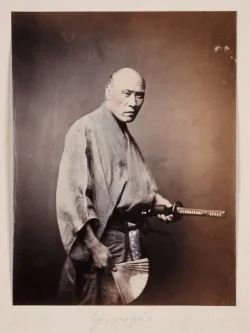
This video shows why Iai and indeed those that practise it with full conviction, is so completely different (and anachronistic) to combat sports.

For clarity, a kaishakunin is the person who ‘stops the suffering’ of a person engaged in seppuku. Please do watch the whole thing đŸ™đŸœ


One of my teachers told me that when delivering the coup de grace at the end of a kata, he sincerely and internally says to the fallen, ‘please rise to heaven’. The idea really moved me and on further investigation I discover bushi/samurai/warriors would sometimes say to those they had just slain, ‘Jƍbutsu seyo’ - rest in nirvana. It’s perhaps a way of sanctifying and acknowledging the enormity of the act they have just performed. It’s something I too have adopted into my practise.
I too feel that Iaido is different from most other TMA/non-TMA. It's the heart (kokoro) within the technique that gives it its unique flavor. My mental bearing was completely different when doing iaido than karate, somehow more spiritually fulfilling and quietly exhilarating. I do miss those years at the late Master Kiyoshi Yamazaki's dojo.
 
Another very interesting video on the the responsibilities of a swordsman before and after a duel.
 
I never knew that participants in a duel signed a document called an ‘Adauchi Muyƍ’ where they agreed the deceased’s kith and kin would not seek revenge in the days/weeks/months after the event. Only the Japanese would be that organised! 😆
 
Another great video from this channel. This installment is about how it the responsibility of the swordsman to be able to deliver a decisive, instantly fatal cut so that a follow up coup de grace is unnecessary and suffering is kept to a minimum.
 
I think this guy has some of the qualities being discussed.
 

Attachments

  • 1787986829305.webp
    1787986829305.webp
    50.6 KB · Views: 21
A bit of a change in this week’s topic but one that is very important for martial arts/combat sports and that is the concept of ‘ma’.
IMG_5150.webp

By sheer coincidence, I’m reading and trying to get my head around the subject as discussed in this book. I’m finding it challenging!😳
 
Please do watch the whole thing đŸ™đŸœ

Will check it out later...â˜Żïž

Reading through the post an old movie came to mind
power of the web..

The Highest Honour

(1982): A joint Australian-Japanese film about the true story of the Operation Rimau commandos. They are captured, and because the Japanese officers grow to deeply respect them for their bushido-like courage, they grant them the "honor" of a formal Japanese-style beheading just before the war ends.

1788736062133.webp
 
Last edited:
Will check it out later...â˜Żïž

Reading through the post an old movie came to mind
power of the web..

The Highest Honour

(1982): A joint Australian-Japanese film about the true story of the Operation Rimau commandos. They are captured, and because the Japanese officers grow to deeply respect them for their bushido-like courage, they grant them the "honor" of a formal Japanese-style beheading just before the war ends.

View attachment 34531
They could have just bought them some beer.
 
I’m really struggling to understand this. Any thoughts?
Really loved that...

So my understanding is that ma is superficially understood of as physical distance, and that's partially right. A slightly wrong distance management and it won't land or be as effective.

But further than that is really a distance between you and your opponent on a level of awareness. More on the level of picking up on intention. The intuitive intertwining with the opponent so there IS no distance. The space between each person isn't empty at all, so tapping into that ma seems what it's hinting at.

I'm sure the logical, rational part of your brain will revolt against all this haha, but it's a thing :P
 
Yes I understand the article’s definitions of ma, but what Nichika sensei is talking about sounds to me something like
 ‘the force’!😬 It’s almost like he senses a perturbation in the ‘ma’ between him and his enemy caused by a change in his ki and reacts accordingly. If one substituted a nonsense word
’bluppy’ for ‘ma’ in his video, it’d make about as much sense.

In his later videos on ma he hints that it can be found in the tiny pause when the sword is swung upward over head and changes momentum to cut downwards. This pause gives one the opportunity to spared the enemy should his intention change (a perturbation in the ma caused by a change in his ki).

I’ve been reading this:
IMG_5150.webp


and it doesn’t illuminate my understanding any furtherđŸ€·đŸŸâ€â™‚ïž
 
It sounds like the granular within an apparently continuous flow.
Classical and quantum models of physics. Smoke is made of particles of smoke đŸ€·đŸŸâ€â™‚ïž
 
I was taken on one side to be shown kaishaku by someone who had done this during WWll. As an officer he was requested to perform this on another officer. I was taught that the method varied throughout Japan. I was shown it as a one-handed cut with the left hand as a stopping hand. Anything stronger was sure to decapitate someone. The blade has to cut so that the head can be stitched back on and not show injury at the front when clothed.
 
Back
Top