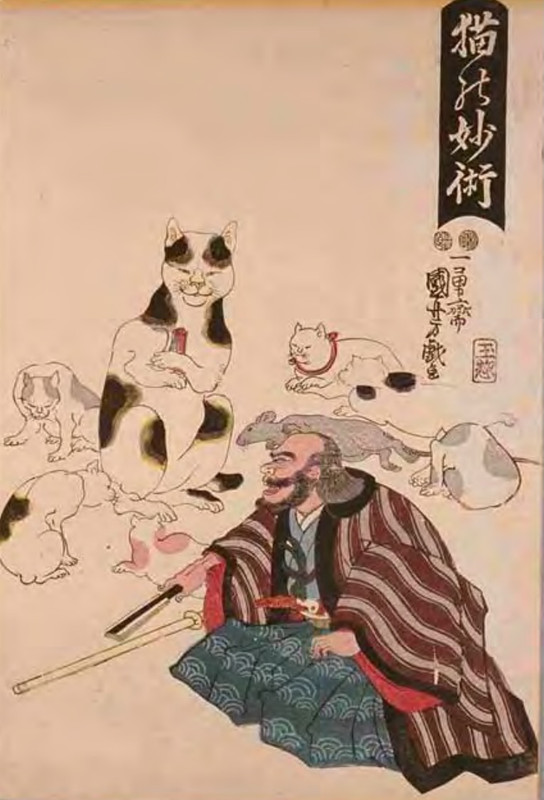
Question:
Would you say your own training today reflects one of these cats, a combination of them, or something else entirely?
Nice painting. So as it turns out, Issai Chōzan (the author of this parable) was not a Zen monk, but a Confucian-educated martial intellectual influenced by Yagyū Shinkage-ryū–style sword philosophy. By Chōzan’s time, Confucian learning was transmitted through domain schools, private academies, and martial lineages. During this time, Zhu Xi's four books were required reading for all three types of learning. In Japan the way this was applied practically deviated in many ways from pure Zhu Xi martial confucianism and more towards what you might call "Samurai Confucianism". So, knowing this, we can understand why an explanation of a koan will be a historical case that is not explained properly. It's not really a koan, it's improper lineage/teaching and it becomes a koan. Let us pray.
The original Japanese is closer to (not my translation):
“Those who rely on technique are bound by technique.
Those who rely on spirit are bound by spirit.
Those who rely on strategy are bound by strategy.
As long as there is a mind that tries to win, there is something for the opponent to oppose.”
This is a very daoist wei-wu-wei influence -- while not being actually daoist -- more of an observation about his own experiences -- and therefore I would have to say that my training is primarily based on the old cat's wise words, but not from experience and not from the same source, but from daoism, buddhism and confucianism. However, it is the same thing because we are discussing something real -- a discovery about ourselves -- self-discovery, and not something abstract such as "two of those, three of these, four of that, five of this, six of that, the eight this," etc.
- Intent creates opposition
- Self-awareness creates tension
- Mind precedes conflict
However, knowing why these things are true, it is difficult to explain the practical process by which they affect your actions.
All I would be able to say by way of explanation, is that "if you want to go and do something, just go and do it, and stop making plans".
Making plans in this case is anything, anything at all other than "doing it". So for example, if I asked you (if you were a new Taiji student) to demonstrate or explain peng to me, you would simply do it, whether or not you knew how to do it or what you were doing.
This is a special kind of thinking and learning, there's one thing I left out to keep the message short, but i've written about it before in posts that discuss wu de.
Perhaps a better example to use here is that if you experience pain and this makes you pause, then you have been distracted by your own plans (which are that you must deal with that pain). Ignoring the pain, pressing on, and not being distracted by it, is part of this. Which is why you so often see the old master pass his hand over a flame and not get hurt -- Well, frankly, I believe it hurts like hell, but he doesn't care because he is very focused. Therefore I do not advise you to put your hand over a fire ever, even to test your strength, because you will hurt your body. But, the principle is that you can get run through with a sword and still manage to kill your enemy before you die. This is a very honorable and important thing to do and makes you a better soldier.
One of the first Crazy 88 members to attack The Bride is Juri Manase. Manase is Sonny Chiba's daughter; Chiba appears earlier in the film as master sword craftsman Hattori Hanzo.
This character demonstrated the willingness to go through the pain to accomplish her goals.
However, Sofie Fatale did not, and that is why Bill killed her; she had no honor and was not a true warrior.
This was the moment Sofie Fatale could have killed Black Mamba. At the moment she struck with her sword, she was the most vulnerable, having committed to the attack. If, at this moment she had spun to attack, she would have accomplished her mission, but she did not, because she was paralyzed by fear and pain.
Having said all that I am reminded why I have such trouble explaining it in words. That was a really crappy explanation, sorry.