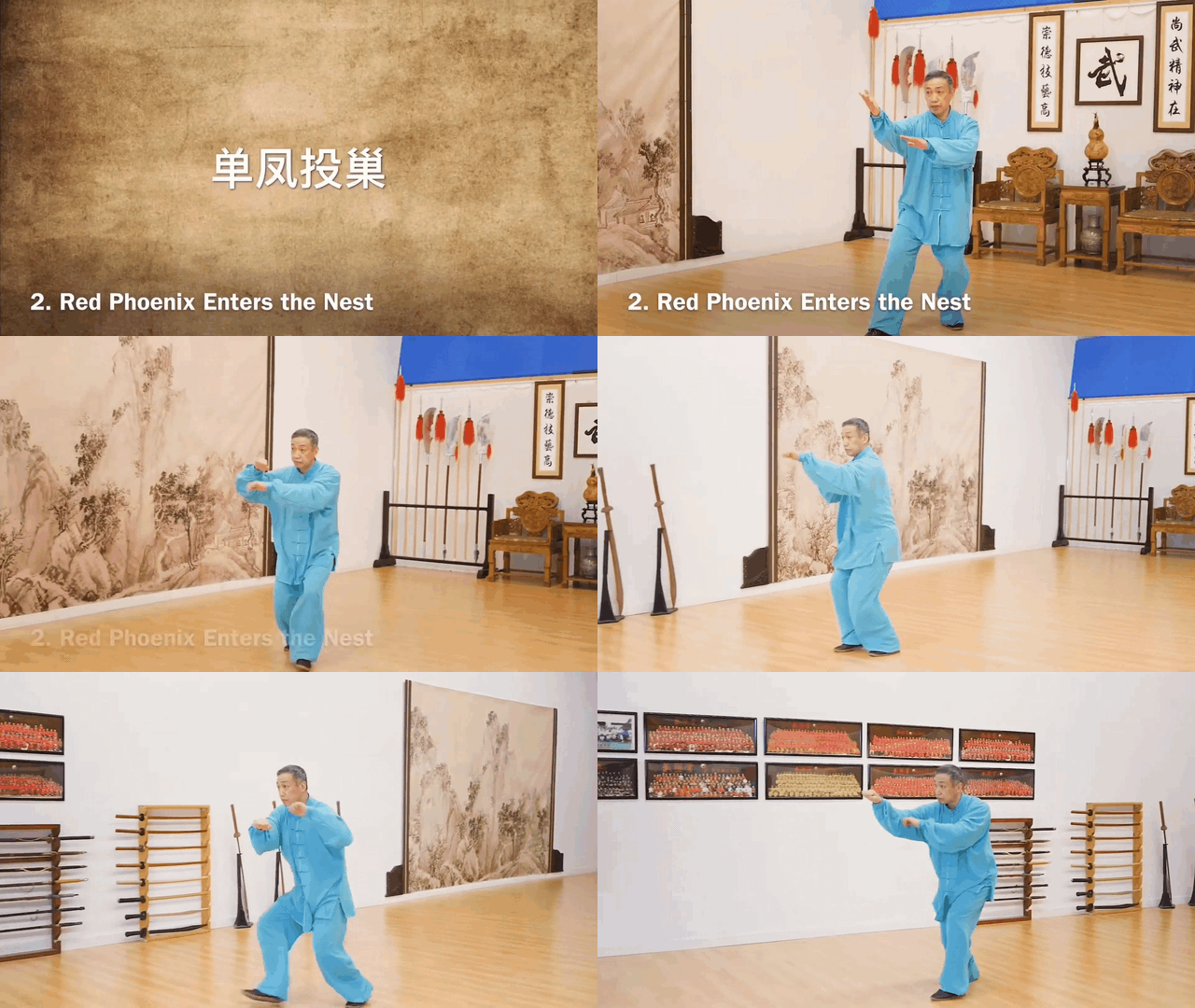
I'd agree with you- I'm fortunate to have trained at a dojo that does a lot of bunkai, but a lot aren't. But when I say performance art, what I mean to imply is that experiencing them as works of art can deepen one's understanding, because works of art are capable of myriads of interpretations- Pierre Bourdieu said that a work of art is remade by every single viewer, and this is a deeper level of appreciation- from my point of view- than just seeing them as a list of blocks and punches interpreted one particular way. This should, in my view, lead towards an appreciation of the principles of movement transmitted, not simply 'He does this, you do that'.
I believe I understand what you are getting at and I agree with you but would like to make a couple distinctions. First, when I think of performance art, to me, that term implies performance for the enjoyment of an audience. If the exercise is done for your own growth and not for an audience, I do not see that as performance art. In my opinion, that is using the movement as a training tool and not as an artistic movement. So my comments on this topic are made with that assumption and if we are each defining these terms in different ways, we might end up misunderstanding each other’s messages. So I just wanted to define what my terms are.
I agree with what you are saying about there being more to the movement in a kata than simply “block this punch and counter with technique A…”. That level of understanding can be very useful and functional, and often it is the simple, straight-forward stuff that is most functional. But yes, that movement can often be interpreted in multiple ways to answer different problems. That requires a deeper level of understanding of the movement, and often cannot be recognized without a good teacher to guide you. Those who are at a higher level of skill and already understand these things more deeply may be able to delve more deeply on their own, to discover some of these deeper possibilities. That is where I see martial training as an excellent form of physical education, yielding in some cases an unusual level of knowledge of human movement.
I also want to point out something that might be relevant here, and that is how the term “art” is being used. It seems to me that people fixate on this term within the context of martial arts, and take it to mean art in the sense of artistic/creative expression of beauty. This would be consistent with the notion of performance art, or fine arts like a beautiful painting or a beautifully executed sculpture. So people take that to mean the martial arts are meant to be beautiful and therefore exercises like kata must be some kind of performance art, meant to be an expression of beautiful movement, and they try to reconcile that idea with their practice of kata. Well, kata is often not beautiful. Take a look at wing Chun forms for example. They are squatty, odd, ugly forms, not beautiful to look at. Some of the forms found in American Kenpo are strange looking. Sanchin, a kata common to many Okinawan methods and probably originating with Fujian crane is not, in my opinion, a beautiful kata.
“Martial art” is an English term and we have adopted that in reference to fighting methods from all over the world. This may or may not be an appropriate way to translate the native terms used to describe these methods. But at the end of the day, that is an English term we are using, and I think people often confuse what it means. I do not believe the “art” in martial arts means artistic and creatively beautiful in the sense of the fine arts and performance art. There is another definition of the English term art, that means skill acquired by experience, study, or observation, and a branch of study. It does not imply aesthetic beauty. I believe that is the proper definition of “art” in the context of martial arts. Once that is understood, the notion that any of this needs to be beautiful, or is meant to be performance art, dissipates. It does not matter if the kata is ugly or strange looking. What matters is if it can be a functional tool in the process of training.