damaged

This is one thing I really like about the TKD style of fighting. I think most styles of Karate, and a few other offshoots (i.e. TSD) are included in this as well. Much less head contact means it's safer and more approachable for a larger number of people.

I know a lot of people say MMA or Muay Thai is better because it's more realistic. A lot of people say you should at least take boxing to round out your TKD. But you know what? In 20 years as an adult, I've been in exactly 0 fistfights. My best "punch defense" has been not training boxing.

I'm not saying nobody should train these arts or that these sports should be banned. But I think it's a risk analysis you need to take when you look at what martial art to train.
 
Right off the bat, shows how dangerous weight cutting actually is. I always encourage my fighters to train to fight at their walking weight. In the MMA league we compete in weight cutting is against the rules so weigh ins happen day of competition. It's also point based and doesn't allow heavy head contact or knock outs.
 
Last edited:
Think people change over the years. I know I have.

Historically "martial arts",
even in today's time, training for combat — due to its nature — has inherent risk.

At what might be considered elite levels, the training itself designed to weed out those not able to survive it. Those that do may not understand the long-term damage that doesn't show up until old age — should one even reach old age.

With combative sports, a similar process occurs. Those in it accept the risk while they may not really understand it until it's too late.
 
Right off the bat, shows how dangerous weight cutting actually is. I always encourage my fighters to train to fight at their walking weight. In the MMA league we compete in weight cutting is against the rules so weigh ins happen day of competition. It's also point based and doesn't allow heavy head contact or knock outs.
Can you share which league? I'd like to see their rules.
 
Regarding cutting, I do think there's a difference between:
  • Gradually leaning out so that you have less fat and a higher strength/weight ratio when you compete.
  • Cutting a small amount (less than 5% of your weight) the day or couple days before the fight by getting rid of excess water weight.
  • Dehydrating and starving yourself for a week before a fight to drop down 20%+ of your weight so that you can min/max your fighting power.
In BJJ, I fight at my walking weight. My friend was cutting a small amount and hated it. His first time fighting at his walking weight is when he first won gold.
 
Think people change over the years. I know I have.

Historically "martial arts",
even in today's time, training for combat — due to its nature — has inherent risk.

At what might be considered elite levels, the training itself designed to weed out those not able to survive it. Those that do may not understand the long-term damage that doesn't show up until old age — should one even reach old age.

With combative sports, a similar process occurs. Those in it accept the risk while they may not really understand it until it's too late.
Modern art have been nerfed for safety. Sometimes in very interesting and useful ways. Two-person co-operative forms are one such thing; removing the spear head and practicing using staffs are another.

There are two dangers in the pursuit of safety. One is, of course, that the methods we invented in the pursuit of safety simply don't work. It's like an experiment. Over the last 100 years, not every martial art has shown it's staying power. This shows at the least that two person co-operative forms weren't to blame -- at least not entirely.

The other danger is that in the pursuit of such safety the art itself changes into something else and we can't go back; the 'you are what you eat' phenomenon. If it walks like a duck, after all.
 
Modern art have been nerfed for safety. Sometimes in very interesting and useful ways.
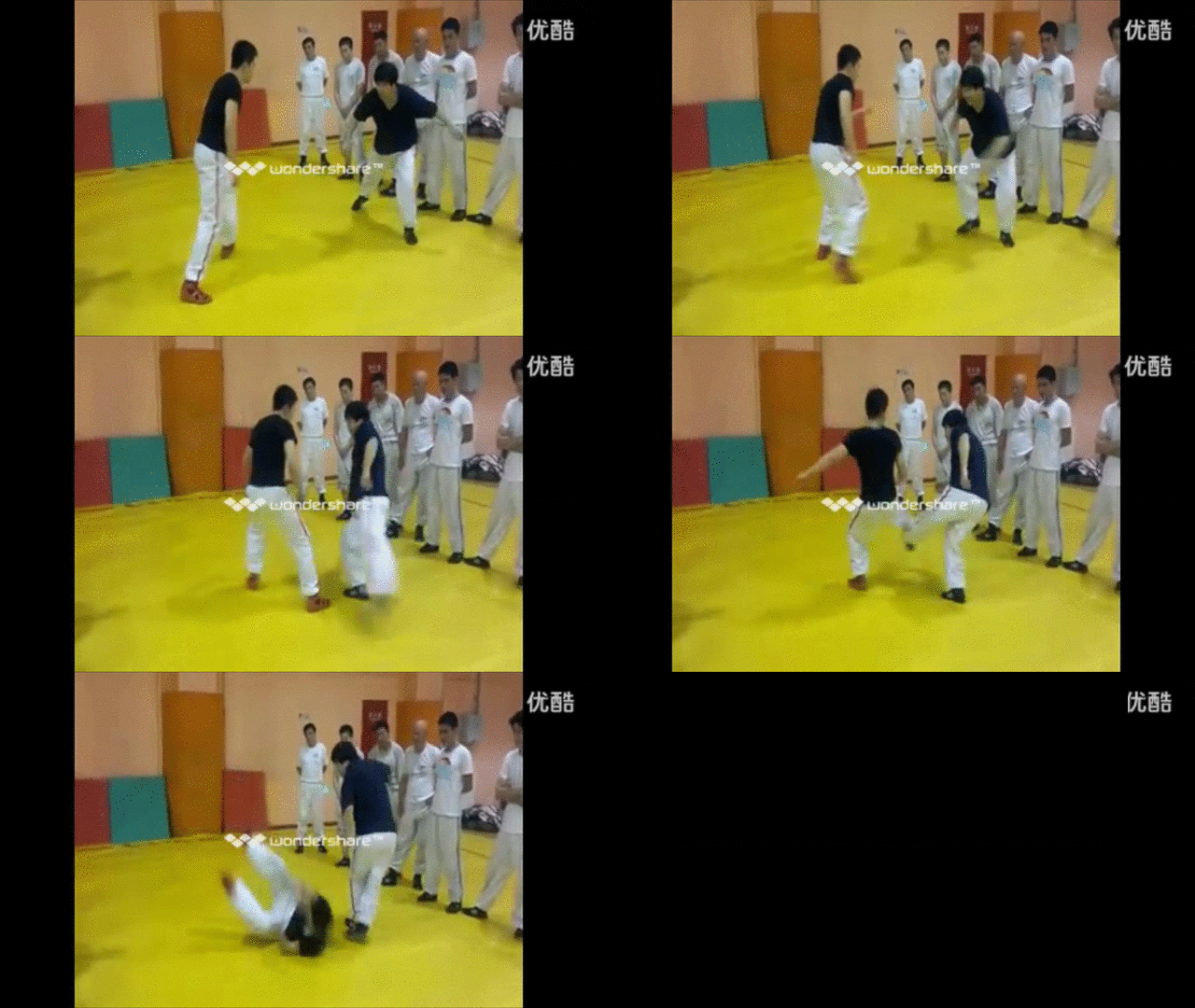
Ancient art had considered safety as well. If you use "foot sweep" to take your opponent down, you then walk away, you don't have to hurt your opponent to end a fight.

The throwing art has advantage over the striking art. It solves the problem without hurting opponent.

Take your opponent down, you then take off (before the cop arrive) is the best street fight strategy.

Even if you don't take off right away, if you keep taking your opponent down many times, he will lose desire to fight you after that. I saw just 1 foot sweep, and the other guy didn't want to fight any more.

 
Last edited:
Modern art have been nerfed for safety. Sometimes in very interesting and useful ways. Two-person co-operative forms are one such thing; removing the spear head and practicing using staffs are another.

There are two dangers in the pursuit of safety. One is, of course, that the methods we invented in the pursuit of safety simply don't work. It's like an experiment. Over the last 100 years, not every martial art has shown it's staying power. This shows at the least that two person co-operative forms weren't to blame -- at least not entirely.

The other danger is that in the pursuit of such safety the art itself changes into something else and we can't go back; the 'you are what you eat' phenomenon. If it walks like a duck, after all.
I do think most martial arts are best against themselves, because that's what they train with. In some cases I think it works very well, because for example a boxer can deal with the most common attack you'll probably see on the street (a punch) or a jiu-jitiero can overcome pretty much anyone on the ground.

But then you have arts that have very specific ways of fighting (e.g. wing chun) that have a lot of drills that (to me anyway) seem to only make sense if you're fighting another wing chun fighter.
 
Back
Top