Uselessness of kata in the real world!

As a side issue, 'passai' is often translated 'storm the fortress', but I've read in Redmond's Kata:the folk dances of shotokan (I think) that the kanji more accurately translates to something like 'sieze the high ground', and that kind of suggests to me that with its backward blocking motions and sudden surges forward that what's meant is more like 'regain the advantage'. Any commentary on this?
 
A more important point: Most karate techniques can be used against a variety of attacks. A Phillips head screwdriver was designed to drive screws. Yet, it has been used as a weapon, to punch holes or even to break apart frozen food (I've used it for the last two examples but I'm capable of using it for the first as well) even though that was not its designed originally intended use. I've taught using a high block against a club and an open hand middle block against a knife. These moves are also found in kata. Should I assume those blocks were invented for weapons defense?

Yes, there are many moves in many kata that can be applied against a club or bo, or even knife (or gun if you're feeling lucky) but that does not mean those were the originally intended uses of the technique. I have no doubt that Mabuni demonstrated a move found in a particular kata being used against a bo, but he could have chosen from 20 moves from 20 kata to demonstrate that as well. This is the broader lens you have to look thru. There is a difference between meant to be and can be.
Kata may “teach” positioning and entering opponents attack and comfort zone using superior timing, when considering this then for example an Age-Uke(upper level/rising block) becomes not a block at all but instead something else that is realistic in a sensible combat scenario.
When we think of “blocks” one should also consider the footwork accompanying/supporting the “block”, and not only that but also consider the full spectrum of the arms/hands movement before the finality position of the “block”.
One may find a much “softer” approach in dealing with forceful attacks, using attackers force against his favor.
 
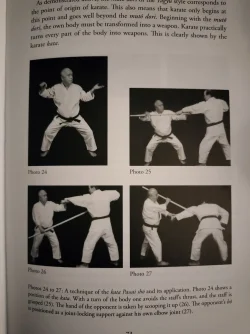
Here is a photo from Mabuni's book.
Bottom of page is his explanation. Click on the pic to see it, doesn't show without expanding the picture.
 

Attachments

  • IMG20241231083849.webp
    IMG20241231083849.webp
    863.3 KB · Views: 88
I hear you, but the questions this post makes me ask are-
Why does Kobudo include nun chukkas, oar, gig pole, tonfas, small scythe (don't remember what it's called). Those are all fishing and farming tools.
What did fisherman use for knives if they couldn't get metal? I can't imagine any fisherman not having a knife.
I guess that's what I'm imagining here- someone trained in self defense getting robbed somewhere by a poor peasant with a small fishing knife of something fashioned from broken glass or some such. The "old masters" said karate wasn't for fighting. It is for a life or death situation. If I'm going to rob you, I'm going to have a weapon. I'd be stupid not to. It still seems crazy to me that karate wouldn't be expecting a weapon if it's meant for that type of situation.......
Lol but if the poor couldn't get knives that would explain why we see examples of defense from the bo in the old katas!

All good questions. For the metal: there was certainly some, imported from outside (China first, Japan later) including the kama. Kobudo includes them because it was - like -te - a rich person's hobby, not a peasant. Or a warrior/guard's.

Not an expert at all, but not sure fishermen used knives. For example, the oldest fishhook known to us is carved from shells and it's from Okinawa, and a shell would come handy to cut a fish is needed, or rocks to sharpen a wooden spear to catch bigger prey.

For the rest, I think it's just down to probabilities. Almost anything can be used as weapon. For example, it's forbidden in many countries (at least here in Europe) to carry a knife, but nobody objects to a screwdriver, and yet you can easily kill with one. Even a fork is a deadly weapon in the right hands. There's no martial skill that can take in account all the possibilities. You get to develop calm under stress, speed, timing, evasion and the likes.

Besides, then as now, people who ended up trying to mug others weren't the sharpest knives in the drawer, and unlikely to have much training. -te teaches you to avoid attacks by untrained opponents, exactly because he will telegraph his move, display excessive momentum and imprudent commitment, and so on. It would not really work that well in a battlefield full of armed people with combat training, but it seems likely to do against your average mugger of the time.
 
Here is a photo from Mabuni's book.
Bottom of page is his explanation. Click on the pic to see it, doesn't show without expanding the picture.
Whoa, trying to grab a bo towards it end can be a very painful affair. The thing moves. Arm a kid with a stick and try! The only way I know to attempt to block a clubbing attack is to get in very close so to work the shoulder joint - and one has to survive the trip, so timing is everything. Tough stuff.
 
Whoa, trying to grab a bo towards it end can be a very painful affair. The thing moves. Arm a kid with a stick and try! The only way I know to attempt to block a clubbing attack is to get in very close so to work the shoulder joint - and one has to survive the trip, so timing is everything. Tough stuff.
Yeah, I kinda thought the same. But then I thought who am I to argue with the son of the founder of Shito-ryu. That guy can can do things I can't for sure.
 
Yeah, I kinda thought the same. But then I thought who am I to argue with the son of the founder of Shito-ryu. That guy can can do things I can't for sure.

Absolutely. Look at Tatsuya Naka.. he can pull off Shotokan stuff that would not be workable for real for a lot of people (and certainly not for me), out of sheer speed, body control and precision. Lots of top "traditional" karatekas can, they are truly marvelous.

I also went back to a video on knife defense I liked, and some kata movements (moving in and trapping the arm and elbow at the shoulder joint, for example) can be used to have a chance against some knife attacks, tough timing is spectacularly critical for that - or you're dead.
 
I have been watching Naka Sensei from the JKA recently and his demonstration of kata applications has changed the way I train...Its an eye opener
 
I have been watching Naka Sensei from the JKA recently and his demonstration of kata applications has changed the way I train...Its an eye opener
Naka Sensei's physical skills are great, and he also seems to enjoy teaching. He reminds me of the original Funakoshi style Shotokan (pre-1936). Modern Shotokan drifted from application oriented to form oriented, losing its Okinawan essence, replacing it with Japanese structure. Naka Sensei is bringing Shotokan back to its earlier roots where kata still had combat effectiveness. I hope his influence grows as IMO he is a positive force in the JKA.
 
Naka Sensei's physical skills are great, and he also seems to enjoy teaching. He reminds me of the original Funakoshi style Shotokan (pre-1936). Modern Shotokan drifted from application oriented to form oriented, losing its Okinawan essence, replacing it with Japanese structure. Naka Sensei is bringing Shotokan back to its earlier roots where kata still had combat effectiveness. I hope his influence grows as IMO he is a positive force in the JKA.
Good on you mate...My thoughts exactly
 
He reminds me of the original Funakoshi style Shotokan (pre-1936).
You think Nakia sensei’s Karate is similar to Gichin Funakoshi’s? Have you seen any of the few films of Funakoshi in action? Naka sensei’s movements are precise, expansive, powerful and fast. Funakoshi’s are the diametric opposite. It was a different time and different standards; professional tennis in the 1950s was very different to tennis played in 2026.
Modern Shotokan drifted from application oriented to form oriented, losing its Okinawan essence, replacing it with Japanese structure.
I think Funakoshi would be surprised and possibly even distressed by Shotokan’s divergent evolution, but that’s what it is; evolution.
Naka Sensei is bringing Shotokan back to its earlier roots where kata still had combat effectiveness. I hope his influence grows as IMO he is a positive force in the JKA.
You see something I really don’t but then I chose not to practise Karate anymore.

Interestingly, when I see Funakoshi’s short stances and lack of kime, it reminds me very much of Hironori Ohtsuka’s (the founder of Wado Ryu) Karate. It almost as though Wado Ryu is more ‘Funakoshi ha’ than JKA’s Karate with its long deep stances and longer duration of muscular tension in its techniques.
 
Naka Sensei's physical skills are great, and he also seems to enjoy teaching. He reminds me of the original Funakoshi style Shotokan (pre-1936). Modern Shotokan drifted from application oriented to form oriented, losing its Okinawan essence, replacing it with Japanese structure. Naka Sensei is bringing Shotokan back to its earlier roots where kata still had combat effectiveness. I hope his influence grows as IMO he is a positive force in the JKA.
I think Nakas Shotokan looks quite as JKA karate looks, he’s a quite advanced and skilled practitioner and teacher.
As it looks he verymuch advocate good timing and non telegraphic attack, Shotokan trademarks displayed in strong lead and reverse punch/strikes.
JKA has always emphasized Kihon(basics), Kata(forms), Kumite(sparring) as one.
meaning the essential spirit within kata is in kumite and kihon, and kumite is in kata and kihon, and kihon in kata and kumite.
It is exactly what Naka seems to exhibit .
 
JKA’s Karate with its long deep stances and longer duration of muscular tension in its techniques.
not sure about “longer muscle tension duration” supposedly in JKA karate, the techniques are longer(travels a bit further) if they are executed in a relaxed/lose manner it may require greater muscle force to stop it(if there’s no taget to hit) so not to over extend , but I don’t really think that’s the case, it probably practitioners specializing on kata competition that has given the impression of “extra kime”.
The Kuro-obi episode where Naka visit Okinawa, there is a scene he is punching the makiwara at one of the dojos he visit, clearly outperforming the dojos teachers and students in punch strength
 
You think Nakia sensei’s Karate is similar to Gichin Funakoshi’s? Have you seen any of the few films of Funakoshi in action? Naka sensei’s movements are precise, expansive, powerful and fast. Funakoshi’s are the diametric opposite. It was a different time and different standards
Yes, Naka sensei is a product of a different time and standards than Funakoshi's and that needs to be factored in. I looked at some clips of Funakoshi from 1924, and I thought he did exhibit good speed and power, though not as strong as Shotokan came to emphsize (his teacher Matsumura stressed speed over power). Naka's technique is more expansive, again typical of the Shotokan of more modern times.
Funakoshi’s... lack of kime
Kime is more Japanese than Okinawan. This quality, along with power and expansiveness were fostered by the Japanese view of karate as "do" and physical expression of "perfection." The sport aspect, which Funakoshi, of course, didn't train in, reinforced these qualities.

But where Naka resembles Funakoshi is quick combos, trapping and grabbing and incorporating kata moves in his sparring that I saw in the clips, typically more representative of Okinawan karate than Japanese.
I think Funakoshi would be surprised and possibly even distressed by Shotokan’s divergent evolution
Indeed he was. In fact, he wrote a poem expressing his distress with the direction his Shotokan was taking. Like other Okinawan masters of the time, he was not a fan of Karate being a sport.
 
Kime is more Japanese than Okinawan.
I didn’t know that!
This quality, along with power and expansiveness were fostered by the Japanese view of karate as "do" and physical expression of "perfection." The sport aspect, which Funakoshi, of course, didn't train in, reinforced these qualities.
Fascinating…
But where Naka resembles Funakoshi is quick combos, trapping and grabbing and incorporating kata moves in his sparring that I saw in the clips, typically more representative of Okinawan karate than Japanese.
Aren’t they simply lifted from kata, ie bunkai?
Indeed he was. In fact, he wrote a poem expressing his distress with the direction his Shotokan was taking. Like other Okinawan masters of the time, he was not a fan of Karate being a sport.
He created a monster !
 
Yes, but most karate-ka don't see kata as having a lot of useful sparring/practical combat moves thinking it's just to practice form or to continue an obsolete tradition.
There’s so much written about what kata mean and their combat function. Admittedly, these writings tend to be about two person swordsmanship kata but there are two man kata in a Karate, for example Wado Ryu’s Kihon Kumite.
The Japanese TMA machine (Dai Nippon Butoku Kai) proved stronger than a simple Okinawan karate master.
I suppose without that organisation TMA would’ve been, at best, chaotic or at worst extinct.
 
Back
Top