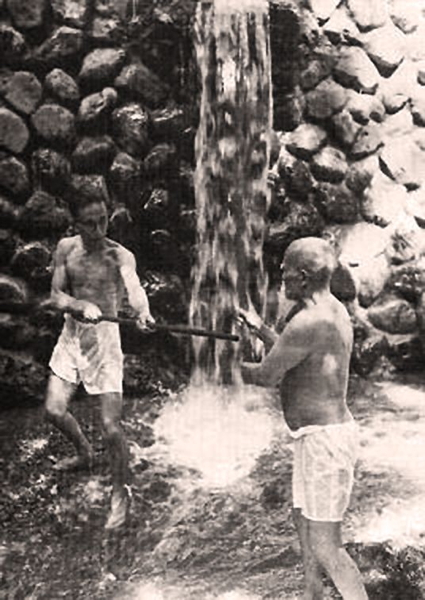
This part of the interview caught my eye:
Tohei tried to apply some techniques to Villabrille, but I guess he, at that time, couldn’t throw Villabrille. That’s the Filipino version of the story, anyway. They went back and forth for a while testing each other but it ended in kind of a draw or stalemate. And then Tohei said to the audience, “This man and I are of the same ability and I cannot throw him.” So Villabrille said, “Let’s do it for real.” Tohei replied by saying, “No, I’m here not for that. That’s not the purpose of Aikido. I’m here to introduce Aikido in Hawaii and that’s my purpose. I’m not here to show that I’m better than, or worse than any man.”
And it’s interesting because Villabrille talked to me about that afterwards, specifically as a character lesson. Villabrille told me that on that day, Tohei was a better man than him because of the way he handled the situation. Later, Tohei gave Villabrille a knife, a Japanese tanto, out of goodwill. And Villabrille showed it to me when I was in there in Hawaii. So he had a very high regard for Tohei.
There is respect and understanding in this exchange. Aikido is the way of harmony and Koichi Tohei demonstrated this with his response. Offering the gift of a tanto as a mark of respect was a great gesture too. Martial arts have more to share than their physical techniques. There are many aspects of martial arts that extend far beyond the mat, and post-war Aikido holds this as one of its core principles.
And Dan Inosanto is another superb role-model for martial artists of the modern age!